March 10, 2008
Smashy Smashy
I'm playing Smash Brothers Brawl right now.
Why aren't you?
Posted by Zach at 05:01 AM | Comments (0)
February 20, 2008
Fez
Oh man, watch this video for the upcoming game Fez:
It's a 2-D platformer in a 3-D world. It's pretty astounding.
Posted by Zach at 05:01 PM | Comments (0)
February 13, 2008
Dos Vedanya
In less crappy news, Game|Life reports that Red Alert 3 will be coming in the near future. Red Alert is Command & Conquer's campier, zanier offshoot, fueled by Cold War paranoia and featuring Soviet Lazer Squids and American Attack Dolphins. No details on Red Alert 3 yet beyond its existence.
Also still no announcement of a Red Alert-style communist spin-off for the Mario games, though clearly the masses are clamoring for one:
Posted by Zach at 04:50 PM | Comments (0)
February 01, 2008
Get the Heck Out of Here, You Nerd!
I should have posted this weeks ago, when it was actually relevant, but:
Capcom's releasing a remake of Bionic Commando on XBox Live Arcade and the Playstation Network, called Bionic Commando Rearmed, to build excitement for the release of the new 3D Bionic Commando game for next-gen systems.
I'm highly excited. Bionic Commando, as the quotations at the start of the trailer make clear, is one of the great video games. I think what really makes Bionic Commando is its well-implemented physics. The game has a somewhat unique play mechanic: It's a platforming game where you can't jump. Instead, you have a bionic arm which you can extend to grab onto things. Once you've grabbed something, you can retract the arm to pull yourself up to it or you can use the arm to swing back and forth and propel yourself through the air. The controls are perfectly smooth and the physics are such that everything you do feels natural and intuitive.
More on this later. Bionic Commando was to be the next game in my long-abandoned Year of NES series, but I've been reluctant to write about it because it's territory that's been so heavily mined that I as worried that I'd have nothing interesting to say about it. But I've got a few ideas and should have something shortly.
Posted by Zach at 03:22 PM | Comments (0)
December 12, 2007
Passage
Go download Passage now and play it. It's a simple game, takes no more than 5 minutes to play, very small, plays on any computer you care to imagine. You should play it with sound. More than that I don't want to say. Discussion in comments.
Posted by Zach at 11:19 AM | Comments (0)
November 28, 2007
Carrie Brownstein on Rock Band
Via Mighty Ponygirl, Carrie Brownstein, former guitarist of Sleater-Kinney, on Rock Band. She falls a little bit into the specious "why not learn to play a real instrument and form a real rock band?" argument, but it's a very good read overall. Now, why aren't there any Sleater-Kinney tracks in Rock Band yet?
Posted by Zach at 02:54 PM | Comments (0)
November 14, 2007
Go Bears
Hey, the marching band for my alma mater, UC Berkeley, performed a pretty awesome half-time show for the game against Washington State a few weeks back. It's video game-themed, and both the instrumentation and the choreography is extremely well done. You can watch it below:
Posted by Zach at 01:58 AM | Comments (0)
October 24, 2007
Quick Gender and Video Gaming Post
I am constantly annoyed by the fact that you can't have a female video character who is not conventionally attractive, often in a goofy over-exagerated way. When such concerns over the sexualization of female characters are expressed in internet fora, the common rejoinder is something to the effect of "Well, men are objectified too, with all the muscles and such!" To which the feminist reply is that "the muscles and such" are generally some criteria relevant to the game character's role in the game's universe, whereas the female character's sexual qualities are entirely tertiary. Male characters are attractive (if they are attractive; you'll see a lot more not-conventionally-attractive male characters than you will female characters) because it's instrumentally useful; female characters are sexy for sexy's sake. And in general it's annoying because it reinforces the notion that women are to be judge by their sexual attractiveness first and by their other qualities only as an afterthought.
For example: Kotaku can't post about game designer Jade Raymond without making the post about how hot she is. Never mind that she's the head designer on one of the year's most anticipated triple-A console titles, that she has a computer science degree from McGill, one of Canada's top universities, or her work on The Sims Online. She's a woman so the main point of any article on her focuses on her looks. When was the last time you read an article about a male game designer that addressed appearance in any but the most superficial way (e.g. "He looks disheveled and unkempt," or "he looks exhausted" or what not)? It doesn't happen.
This is part of the problem, and it's a broad cultural thing. Part of the solution is encouraging media that doesn't reinforce the worst aspects of the collective psyche.
Posted by Zach at 01:04 AM | Comments (0)
October 18, 2007
You Keep Using the Word "IP." I Do Not Think It Means What You Think It Means
I got burned the last time I attacked video game blogs for shoddy journalism, but this time Kotaku (and others) have hit on something that's been annoying me for a while.
According to Kotaku, THQ has entered into an exclusive, confidential agreement with Nintendo to produce software using Nintendo's IP. There follows in the comments a lot of wailing and gnashing of teeth. "Oh Noes! It'll be just like those crappy Zelda games for the CD-i! We're doooooomed!"
This is one of the many situations where I wish that video game journalists would keep someone with legal training around so that they could make sure that they're not making asses of themselves before publishing things like this. In this case, they're reading a legal document and applying to the words in it the stupid video game journalism jargon meaning of the abbreviation IP, rather than its legal definition.
IP stands for Intellectual Property. It is a legal fiction that allows us to conceptualize ownership of an intangible idea. The three principle forms of intellectual property are patents, copyrights, and trademarks. A patent conveys ownership of a particular invention or process and allows the inventor to receive royalty payments from others who would use the patented device. They tend to last only a short time. Copyrights are similar, granting the owner a monopoly over her creative works. Trademarks are somewhat different. They exist both for the good of the public and for the benefit of the trademark owner. They allow consumers to quickly distinguish one brand of product or service from another. They also allow trademark holders to build a reputation for their own products that won't be sullied by the actions of similarly-named competitors.
Video game journalists, in their never-ending quest to appear grown-up, have started using the term IP. When video game journalists use the term IP, they use it to mean a game or series of games that exists in its own universe distinct from a company's other games or series's. Used in a sentence: "Nintendo has a lot of valuable IPs, like Mario and Zelda, but they've been slack in bringing new IPs to the public in recent years." The video game journalism version of IP is sort of like the legal version, but not quite. A video game journalist IP likely includes some legal IP (the copyright to whatever games are part of the seriers, the trademarks in the titles of the games and in the likenesses of the game's characters, that sort of thing) but it is not "an IP" in the legal sense of the word.
So we come to this passage, which makes complete sense if you understand IP in its legal sense:
"...the right to use certain of Nintendo's intellectual property to develop, have developed, have manufactured, advertise, market and sell video game software for play on Wii until October 13, 2009 in all countries within the Western Hemisphere."
What this almost certainly means is that Nintendo grants THQ the right to use various Nintendo trademarks, copyrights, and patents in the development and marketing of games for the Wii. For example, Nintendo is granting THQ the license to use Nintendo's Standard Development Environments (which Nintendo would have a copyright on) to develop Wii software. Nintendo is also licensing some of its trademarks to THQ. Nintendo's name, its logo, and the logo for the Wii are all trademarks. THQ needs to officially license the right to use those marks in order to put them on the packaging for its games. This clause in what is undoubtedly a big, complicated licensing agreement encompases all of those pieces of intellectual property that THQ would need to develop games for Nintendo's platform.
But if you're a video game journalist, and don't understand that not everyone uses Intellectual Property to mean the same thing that you use it to mean, you read that out-of-context passage and say "Wow! Nintendo is granting THQ the right to use its IPs(like Zelda or Mario or Kid Icarus)! What a scoop!" And, if you're Kotaku, you publish a story about it and make an ass of yourself.
In fairness, the story was originally reported at gamesindustry.biz, which really ought to know better. It was also picked up by 1up.com. Both gamesindustry.biz and 1up.com have published updates retracting the story. Kotaku has left it to fester uncorrected as of this writing. Joystiq hasn't touched the story, and Chris Kohler at Game|Life has published a scathing debunking.
So the scoreboard:
Good Journalists: Game|Life
Might Be Good Journalists, Might Be Asleep at the Wheel: Joystiq
Barely Meet the Minimum Standards of Journalistic Integrity: 1up.com, gamesindustry.biz
Still Finding New Ways to Sink Below My Lowest Expectations: Kotaku
Posted by Zach at 12:04 AM | Comments (0)
October 05, 2007
Well, I'll Be Jiggered
Microsoft and Bungie ARE splitting. Sort of. According to the press release, it looks like Bungie's going private and independent. Microsoft will maintain a minority stake as well as ownership of the Halo franchise. The split also appears to have been contingent on a long-term development contract between Microsoft and Bungie. The terms of that deal haven't been disclosed.
Presumably, this means that a bunch of Bungie executives got together and bought back at least 51% of the company from Microsoft. They haven't said how large of a minority stake Microsoft maintains, but it can't be more than 49%. In a way, this makes sense; the deal seems to have been designed to keep Bungie, as much as possible, an XBox-exclusive developer. Between the minority interest of unknown size and the binding long-term contract, it's unlikely that Bungie will be rushing to develop for the PS3 or the Wii any time soon. Also, the rumblings heard from Bungie have all been to the effect of the workers disliking the Halo-focus of the company and Microsoft's deadlines. This deal seems like it allows Bungie to become somewhat independent in terms of its management while still maintaining Microsoft's interest in Bungie's creative output.
Posted by Zach at 03:08 PM | Comments (0)
October 02, 2007
Rumor Mill: Microsoft Decides That, If It Really Loves Bungie, It Will Set It Free. If It Doesn't Return, It Never Belonged to Microsoft in the First Place
There have been rumors lately that Bungie will be splitting off from Microsoft. I know all the video game writers out there are excited to be playing Junior Journalist and following the clues to the Big Scoop, but, despite Luke Smith's words of wisdom, sometimes "No Comment" really just means "No Comment." Or, more specifically, it means that the company itself has a blanket we-don't-talk-to-journalists, talk-to-our-PR-company rule and the PR company has never heard the insane rumor that a journalist just asked them about so they don't know what the company line is.
Allow me to disabuse you of any possible inclination that this rumor could be true. Microsoft owns Bungie. Bungie is owned by Microsoft. Bungie, as a corporate entity, is a wholely-owned subsidiary of the Microsoft corporation. The Bungie trademark belongs to Microsoft, Bungie's assets belong to Microsoft, all of Bungie's intellectual property and public goodwill belong to Microsoft. Bungie is a part of Microsoft.
Bungie is a profitable part of Microsoft. Bungie just had the biggest software launch in history with Halo 3. Microsoft is making scads of money off of Bungie. The only reason Microsoft would want to get rid of Bungie is if Microsoft was getting out of video games entirely, and even then they'd probably want to keep it around, developing for some other company's hardware.
The rumors of a split are all centered around the idea that Bungie is discontent making Halo. They're tired of Halo, they want to do something else. Microsoft wants them to keep making Halo forever. So the rumor at least meets the minimum requirement of making sense from a human drama perspective.
But it makes no sense from a corporate perspective. We've heard all kinds of reasons why Bungie wants to leave, but no reasons why Microsoft wants to let them go. Considering that, as mentioned above, Microsoft owns Bungie, if Bungie wants to leave and Microsoft wants it to stay, Bungie stays. Bungie doesn't even get a vote in the matter.
There's an essentially element missing in this rumor: What does Microsoft get, and where are they getting it from? Once I hear that Bungie employees have scraped together the billion dollars Microsoft would demand as a sales price for Bungie, I'll start believing the rumor. Once I hear that some outside company has expressed an interest in purchasing Bungie and has approached Microsoft about it, I'll start believing the rumor.
I won't even get into the dubious provenance of the rumor's origin (some guy on a newspaper reader's blog has a friend who knows someone who works at Bungie and told him all about the split? Please). Now, I wouldn't be surprised if the rumor turns out to be a mistranslation of "some employees at Bungie are discontent with the prospect of making Halo forever and are thinking about leaving for another studio/forming their own studio." But Bungie leaving Microsoft? No.
To its credit, Joystiq has called this rumor for the nonsense that it is. Joystiq was also out in front on the rumors about the Chinese MMO banning trans-gender character creation. Joystiq is rapidly gaining points with me for having the minimum level of skepticism required to call what they do journalism.
Posted by Zach at 11:27 AM | Comments (0)
September 29, 2007
False Dichotomy
Building off a post by Mighty Ponygirl, what do you call someone who buys a video game console solely for one game, purchases few if any other games, and essentially does nothing with the console except play that game and its sequels?
If the one game they purchased the console for is Wii Sports, then they're a Casual Gamer, quite possibly one of the dreaded Alpha Moms, the idiot consumers with no taste who are ruining our beloved hobby and whom the industry is selling out to.
If the one game they purchased the console for is Halo (or Halo 2, or Halo 3, or Madden Insert-Year-Here), then that gamer is a Hard Core Gamer, the heart-and-sole of the industry, exactly the kind of consumer that all developers ought to care about exclusively.
In many ways, the XBox and the Wii aren't so different. The Wii's killer app is Wii Sports, the Xbox's is Halo. Third party developers for the Wii have built a cottage industry around trying to get non-traditional gamers who like Wii Sports to try other, similar products involving mini-games and motion controls. Third party developers for the XBox, and later the 360, have built an industry around trying to sell new First Person Shooters to Halo fans who've gotten bored with Halo.
Back in undergrad I had a grad student instructor for a class on the history of American constitutional law. I mentioned to him at one point that I enjoyed playing video games. He replied that he didn't really play video games, that he'd always thought they were a waste of time, but that over the weekend some friends of his had shown him Halo and he thought it was incredible. He still thought most games were pointless, but he loved Halo and would play it any time.
I think that by any fair assesment, Halo is a game with a lot of casual appeal, and it is primarily played by casual gamers (compare sales numbers for Halo 3 on its first day of sale to the sales for hardcore games like Bioshock through their entire sales lives). Yet this flies in the face of the conventional wisdom in most gaming media these days. Most media, in talking about Halo, treat it as the ultimate Hard Core game. Why is that? And why is the success of the Wii treated with sneers, while Halo's success is applauded?
I think there are a few explanations. First, I think members of the gaming media just like Halo and first-person shooters more than they like the sort of games the Wii has to offer. Since the gaming press is comprised of hard-core gamers, it follows that the games they like must be for the hard-core.
Second, I think there's an element of professional deformity. Members of the gaming press are accustomed to a fairly rigidly defined set of genres that all games either belong to our combine elements of. When new games don't fit those categories it throws everything off, and the inclination is to treat the games with suspicion and those who play them as outsiders. Halo is an FPS. It doesn't rock the boat, so it's safe to enjoy it and welcome its players into the fold.
Finally, I agree with Ponygirl that there's a strong element of sexism here. I am really, really sick of the term Alpha Mom being thrown around with a sneer to indicate "people who have no business playing video games." More women are playing games on the Wii so, whether consciously or subconsciously, the gaming media has decided that this means that Wii games aren't real video games.
Posted by Zach at 07:00 PM | Comments (0)
September 23, 2007
Anthropology
There's a fascinating post over at Wired's Game|Life blog. The post itself is informative, but not anything particularly remarkable in and of itself. In it, Chris Kohler gives his impressions of Metal Gear Solid 4, based on a version he got to play at the Tokyo Game Show.
What's interesting is that this fairly innocuous article has led to a 41-comment thread that has almost nothing to do with the contents of the post. Instead, the Game|Life commenters are fighting a life-or-death battle in the Console Wars.
Kohler made the mistake of concluding his preview by saying that he thought Metal Gear Solid 4 seemed to justify the purchase of Playstation 3 all by itself. This, of course, was an unforgivable insult to all the partisans of the XBox 360, for whom nothing on earth could ever justify the purchase of a Playstation 3. Playstation 3 fans escalated the tension by asserting that Metal Gear Solid 4 would be the killing stroke that at last sealed the doom of the hated usurper console from Redmond.
There then followed about 35 comments of semi-literate hatred and vitriol.
I find this fascinating. What causes people to become so heavily invested in the fortunes of large corporations? You don't see, for example, CBS fans going on message boards to berate NBC viewers (actually, maybe you do and I just don't hang out on the right message boards for that sort of thing).
What's more, it seems less that these fans care about their console of choice than that they really, truly hate the disfavored console. Thus, for example, you're far more likely to see a PS3 fan expressing contempt for the Wii and the XBox 360 than you are to see him or her praising the Playstation.
And the differences between the consoles are so trivial! If you compare the 360 to the PS3, you'll find they share most of the same games, that those games play nearly identically on the two consoles, and that, when matched feature-for-feature, the two consoles cost roughly the same price.
I would imagine the similarity between the consoles partially explains the vitriol. As has been said about disputes within academia, it is because the stakes are so low that the arguments are so vicious. But that just begs the question; it doesn't explain why trivial stakes should lead to such vicious arguments.
I imagine there's at least some financial element. When you buy a product, particularly an expensive one, you want to convince yourself that you made the right choice. It's a sort of corrolary to buyer's remorse. Therefore, if you own a 360 and someone else suggests that the PS3 would be a worthwhile purchase, they undermine your confidence that the 360 was the right purchase to make.
This makes some sense, but I'm not sure what causes a person to tip over from reasonable mental defense mechanisms into irrational emotional investment in the infallibility of their favorite console.
Which, again, takes us back to the initial question: What causes people to become raving idiots when it comes to video game consoles?
Posted by Zach at 10:47 PM | Comments (0)
September 15, 2007
Next Gen Consoles Do Not Want Me To Buy Them
I am about to buy an XBox 360. This may seem like a momentous declaration, but it really isn't. You see, I've been about to buy an XBox 360 for the last 4 months or so, but I just can't quite bring myself to do it.
This isn't by any means a console wars thing. I do generally prefer Nintendo over all the other major players in the present generation, and I will continue to support it and wish it well in all things. But, at the same time, I'm pragmatic. There are a lot of games I'd like to play that are unlikely to ever become available for the Wii, and the 360 seems like the best mixture of price and exclusive games. So there it is, simple as that.
But it isn't that simple. To start, just around the time I became interested in buying a 360 in May rumors started simmering that the 360 was about to get a price cut. This made sense; it had been on the market about a year and a half and was due for a price drop. So I waited patiently.
The price drop didn't come until August.
I was ready to buy a 360 right then, when even more rumors bubbled up. Now, as you know, Bob, the 360 has some significant problems with defective units. There are no hard-and-fast statistics on it, but I would guess that if you buy a 360 there's about a one-in-three chance it will short out and stop working within a couple of years. Apparently Microsoft used some cheap parts when it designed the 360. As a result, Microsoft released a product that is. . . well, noone wants to call it defective, but it is nonetheless a product where a fairly large percentage of the units overheat and stop working as a result of normal use within a couple of years of sale.
So right around the time they cut the price, we learned that Microsoft's been developing a new chip, the Falcon, to replace the old 360 CPU. It'll be smaller, cheaper, and, presumably, less prone to crap out. The word on the street is that the new 360s with Falcon chips won't be defective in the way that prior 360s have been.
The problem is that Microsoft doesn't want to take the hit from recalling all of those defective 360s, so its "soft launching" the new Falcon-equipped 360s. That means they've switched their factories to manufacturing the new, non-defective 360s and they're slowly introducing them into the retail channels, but they're not removing the defective 360s from stores, nor are they putting any markings on boxes to indicate whether a given 360 is one of the older, defective models or one of the newer, non-defective models.
From a marketing standpoint, this makes sense. They want to sell those defective units because at least some of them aren't going to crap out and have to be replaced. But it's really hard to sell a bunch of defective units if you mark them as defective. Or even if you have a pile of the same units right next to them marked non-defective. Though that would make an interesting ad campaign:
"The New XBox 360: Now No Longer Defective! (Probably!)"
So: Defective 360s are no longer being manufactured. But Non-Defective 360s are only just starting to reach the market. When you buy a 360, it's a crapshoot whether you're getting a defective one or a non-defective one. But since defective ones are no longer being manufactured, the longer you wait the better your chances of getting a non-defective one.
So now it's a month later, and I have no 360 because I'm paranoid about buying a defective one.
It should be noted that the packaging on 360s has altered over time, and that there are certain things you can look for on a given 360's package that allow you to either 1. identify it as definitely from a defective era of 360 manufacture, or 2. identify it as being from the most recent package design period, and therefore significantly more likely to be non-defective. The problem is that 360s are relatively expensive and, since stores are rightly worried about theft, most game consoles are kept locked up in storage rooms. You can't look at the package for a 360 unless you tell a sales associate that you want to purchase one.
This is a pain. I'd prefer not to be That Guy at Gamestop. You know, That Guy who walks in and wants to buy the copy of Mario for the PS3, which they totally must have made because his friend Billy from the playground has a cousin who played it and it was wicked awesome, and also he wants an Xbox 360 with an HDMI port and the new Falcon chip, and no, he doesn't want an Elite because he totally heard from his friend Sarah that she read on-line that they make regular 360s with HDMI ports and super-radical new chips, and could you go look in the back for one?
And on top of that: This damn thing. Even if I get a non-defective 360, it doesn't have wireless networking built-in. The PS3 has built-in wireless networking. The cheap-ass Wii has built-in wireless networking. But the 360 only comes with an ethernet port and the opportunity to pay Microsoft $100 to turn the 360 into a modern console. That makes no sense. Compare it to the Wii, which has built-in wireless networking because wireless is both more convenient than LAN and increasingly prevalent, but also offers the option of buying a LAN adapter for a modest $25.
I actually need wireless internet access in my console if I'm to do any kind of online game playing (and online gaming is 90% of the sales pitch for the 360). My apartment has a very long layout, with the living room at one end and my room (the only room with internet access) at the other. I can't move the internet connection to the living room, so, short of running a 40 foot ethernet cable down the length of the apartment, which would set up a trip-wire in front of my roommate's door, it's wireless or nothing.
I was at a store today and nearly bought a 360. But then I started thinking about the chance I'd get a defective console. And then I started thinking about the added expense of a wireless adapter. And then I started looking at the PS3s and realized that, between the cost of the 360 and the wireless adapter, I'd be $50 short of a PS3, which can actually play Blu-Ray DVDs (the HD-DVD player for the 360 is a further expansion, which costs another $180). But then I remembered that there aren't actually any games I want to play on the PS3 and there aren't going to be any time soon, which defeats the entire point of the enterprise. And then I remembered how much all of this costs even without games and peripherals and necessary adapters and I got spilkis.
So: The system for which there are games I want to play is designed to maximize my inconvenience and make me constantly worry that I purchased a defective system. The system that has all the accoutrements figured out and wrapped in a stable package doesn't have any games I want to play. And they're both too expensive. I sat and stared for 20 minutes until my brain started hurting. So then I went home and played Adventures of Lolo on the Wii.
Posted by Zach at 10:26 PM | Comments (1)
August 29, 2007
Reviewing the Reviewers: Heterogeneity in Game Opinions
Mighty Ponygirl wrote a post linking to and critiqueing a review of Metroid Prime 3 in Variety. In general, I agree with her. The review seems to largely miss the point of the game and gets a lot of things wrong, and from what I've played of Metroid Prime 3 so far I expect to completely disagree with the reviewer's take on the game.
Yet I come here not to bury the Variety review, but to praise it.
A few months ago there was an article in the New York Times discussing the peculiar unanimity of opinion in the assessment of video games. The Times article discusses a study done by Ben Shachter of UBS that showed that there was a strong correlation between review scores for games and sales. High-scoring games sell well, low-scoring games sell poorly. The same correlation doesn't exist in other media, where, for instance, critically acclaimed movies may sell poorly while movies that get panned by critics may perform well.
There was a lot of discussion of the article when it was published and speculation as to why this correlation might exist. My pet theory is that it's brought on by a general lack of diversity in the audience for video games. There's a pretty unified set of criteria for what makes a good video game, much of it focused on the technical side of things (How crisp are the graphics? How responsive are the controls?). Certainly, there's a little diversity of taste among gamers, some players prefer RPGs, others like shooters, some place a lot of value on the story in a game, others skip past all the dialogue to get to the action. But within a genre there's broad consensus about what makes a game good or bad, a consensus that doesn't seem to exist as much in other media.
What I like about this review is that it approaches Metroid Prime 3 as a casual gamer might. The reviewer doesn't seem to understand Metroid's genre conventions, so he's able to write a review that questions the game's value from the perspective of someone who doesn't necessarily know or agree with the criteria by which most of the gaming press judges games. Most reviewers agree that Metroid Prime 3 is a fantastic implementation of all the things that make a Metroid game good; the Variety reviewer questions whether those things, well-implemented though they may be, make for a fun game from his perspective.
I think this review is an important step in the growth of the games industry. If the market for video games is going to expand, it's going to mean a lot more people playing video games who don't agree with the current consensus on what makes a good game. I may think Metroid Prime 3 is a fantastic game, but I don't think it's a game for everyone, particularly not a lot of the casual video gamers that Nintendo appears to be attracting with the Wii. For those gamers, a review that says "Metroid Prime 3 is the best Metroid Prime ever, and if you enjoyed previous Metroid Prime games, you'll love this one," is far less useful than a review that says "This is Metroid Prime 3. It'll be hard to understand if you haven't played prior Metroid games. It requires quite a bit of skill and dexterity, it's very non-linear, and it's focused on exploration. It does not hold your hand. You will be thrown into the game with only a basic explanation of what the controls are and will be expected to find your own way to the goal. In fact, often times the game will not even tell you what the goal is and you'll have to feel your way around in the dark just to figure out where you're supposed to be going. If the only games you've played are Wii Sports and Mario Party, Metroid Prime 3 will probably not be a very fun experience."
This review doesn't appear in a mainstream gaming magazine. It appears in Variety, an entertainment trade newspaper read by a broad audience, many of whom may be interested in video games but few of whom would describe themselves as gamers. In that context, it makes sense that the review is written the way that it is, with a casual gaming audience in mind.
As more people begin to play video games, we're going to see less consensus on what makes a game good. We're also going to see the media react by producing reviews that reflect that shift in taste. That means there won't be the same pleasing unanimity in game reviews that once existed, but it also means a greater diversity of opinions and an expanded debate on video games as a medium, which I think will be healthy for the industry and for consumers.
On the other hand, there's also the possibility that this is just plain a bad review. There's a narrow line between "writing a review that targets a casual audience" and "writing a review that treats a game as though it's a casual game when it isn't." I think the former is legitimate while the latter is puerile. Just as you'd look askance at a film review that critiques a romantic comedy for not having enough explosions or special effects, a review that criticizes a first-person adventure like Metroid for not having enough mini-games is just a bad review. Also, a review that targets a casual audience and is actually written by a casual video gamer is legitimate, as the review is likely to be an authentic representation of the reviewer's feelings. A review written for a casual audience by someone who's actually a long-time gamer is suspect; you've got somebody reviewing a game not according to how they feel about it, but according to how they think others will feel about it. In this case, the reviewer, Tom Chick, has a long record of game reviews, mostly for gaming media, stretching back to at least 2001. This leads me to think that he doesn't actually fail to grasp Metroid Prime 3 to the degree that he claims in the review, but is instead playing dumb for the Variety audience.
Still, I think reviews that subvert the dominant game-review paradigm are, on balance, a good thing, and something we're likely to see more of. Even if this particular one is stupid and wrong. Also, Metroid Prime 3 is awesome.
Posted by Zach at 03:38 PM | Comments (1)
August 23, 2007
I Love Going on Weblogs and Complaining About Video Games I've Never Played!
I am unreasonably excited about Metroid Prime 3. Why unreasonably? I've been eagerly anticipating the game's release since last November, counting the days it comes out from the moment we got a firm release date. And yet I have not finished Metroid Prime 2, nor have I even gotten very far into it. In the 9 months I've been squirming in anticipation for Prime 3 I've never booted up Prime 2 to give it another try. And it isn't that I found Prime 2 particularly bad, though others have so found it. I only played a tiny bit of the game before getting distracted and wandering off to do something else. Yet, for some reason, Prime 3 excites me to no end.
In my quiet moments, I acknowledge that the most likely reason for my Prime Excitement is that I am hoping that it will fill the empty void in my heart that is at present aggressively not being filled by exciting Wii software. The Wii has certainly had some fun games, Twilight Princess, Trauma Center, Wario Ware, and Super Paper Mario, to name a few of them. Well, most of them. And I do get a lot of use out of the Virtual Console, a fabulous service that allows Wii owners to discover exactly how many shooters were released for the Turbo Grafx-16 (the answer, it turns out, is "quite a lot"). Still, the Wii has unquestionably lacked for Grade-A exclusive titles (Twilight Princess was simulataneously released for the Gamecube and the Wii, Trauma Center was a remake of a DS game, Super Paper Mario was originally going to be a Gamecube game and was only Wii-exclusive because Nintendo is very actively trying to forget the Gamecube, and Wario Ware, while an excellent mini-game collection, has the misfortune of being the best in an over-crowded field on the Wii. That's a fancy way of saying "Nine of every ten games released for the Wii are mini-game collections, and most of them are unplayable"). I remain optimistic about the Wii's prospects, and I continue to believe that Nintendo stands at the cusp of revolutionizing the video game market. But, though I am a Wii-vangelist, months of mini-game collections have left me in need of something to bolster my faith, which has led me to cling to hopes for Prime 3.
By all accounts, Prime 3 looks incredible. Reports have, so far, been glowing about the Wii controls, which could lead to more and better-designed first-person shooters on the console. The gameplay videos that Retro Studios has been releasing are suitably exciting, and the plot teasers, which hint of Mother Brain factories, phazon enhancement devices, and plans within plans, have only gotten me more excited. And yet...
I'm a little concerned about the direction it seems to be heading. First Jeremy Parish's 1Up preview back at E3 implied that the game seemed linear and mission-oriented, in contrast to prior Metroid games's free-form exploration. Since then there have been lots of reassurances that, no, the game is still just as much about exploration as it always was, just on a grander and more diverse scale.
I remained cautious, but optimistic; Parish's preview broached the possibility that the game was heading in an exciting new direction, merging Metroid's feel with Halo's hard-core FPS sensibility. That seemed exciting, as I'm always interested in change and innovation in video games. But now the other shoe has dropped with Shane Bettenhausen's preview, also at 1Up. Shane is far more of a hard-core FPS-type than Parish, and his preview, while generally positive, reveals the crucial flaws in attempting to attack the FPS market with Metroid. First, the Wii lacks the graphical prowess that the 360 and PS3 can bring to bear, putting Metroid at a notable visual disadvantage when compared to, for instance, Halo 3. Second, the Wii in general lacks a strong multiplayer backbone, and Metroid Prime 3 lacks any sort of multiplayer. I love Metroid's single-player experience to death, but it strikes me that it will be very difficult to sway hard-core FPS players with just a single-player game, fantastic though it may be. Finally, as Shane hints at, story-telling in Metroid is different than story-telling in Halo and other FPSes. Retro's experience so far has been in revealing fairly simple stories through bits and pieces discovered in the environment while exploring, and if Shane is right this experience hasn't translated well into producing modern FPS-style dialogue-based exposition.
I remain excited about Prime 3, though that excitement is perhaps a bit more muted. I still have a pre-order down, I still plan to play through it as much as possible before passing judgment. I worry, however, that in making something that tries to be both a Metroid game and a modern FPS they might have created something that doesn't do either very well.
Posted by Zach at 02:27 AM | Comments (0)
July 29, 2007
God Hates Low-Density Housing!
I have been playing Actraiser on the Wii Virtual Console. Actraiser, for those who don't know, was a Super Nintendo title released by Enix very close to the system's launch. The game was developed by Quintet and was the first of the so-called Quintet Quartet, four games developed that combined action and role-playing gameplay mechanics with plots that had the player playing some sort of deity tasked with fixing a ruined world. The other three games were Soul Blazer, Illusions of Gaia, and Terranigma (the last of which has, maddeningly, never been released in the United States, despite its release, with English translation, in Europe).
The premise of Actraiser is that all human life was wiped out some years ago when an evil demon slew God and destroyed all that was good in the world. The game begins when God, the player, re-awakens and decides to rebuild the world.
Actraiser is an odd dock. Half the game is a fairly standard action platforming game. The other half is a weird Sim City-lite city building simulation. During the simulation portions you control a cherub and use him to guide the growth of the recently-reborn human civilization. This mostly involves telling them which direction to develop in and dispensing miracles as needed to, for instance, clear out bushes or dry up marshlands. The upshot of all this is that the higher the world population the more powerful your character becomes during the action platformer portions, with your character attaining new levels at certain population milestones.
The trouble is maximizing population. Each city you build has only a limited area for growth, so you need it to be as high-density as you can get it. Moreover, people don't really build great housing to start with. Each city begins with mud huts. As you seal off monster layers and tame the savage frontier, they started constructing wooden houses. Once you come within one short platforming stage of banishing evil from the region forever, they begin constructing modern houses. Modern houses hold more people than wood houses, which hold more people than huts. But the people don't upgrade the old housing when they reach new civilization levels; they build future housing at the highest level possible, but the old housing remains the same.
This means that becoming the best deity you can be requires showing your human subjects some tough love. In the early cities, this means going through your town and systematically smiting every mud hut or wooden house with bolts of lightning. Later on you become powerful enough to summon earthquakes, which destroy all buildings except modern, high-density housing, making the urban renewal process quick and easy. If there's one thing God can't stand, it's inefficient land-use policies and backwards, low-density zoning.
Posted by Zach at 12:31 AM | Comments (0)
June 25, 2007
I Don't Want to Set the World On Fire
Sorry for the paucity of posts of late; my entire weekend was swallowed whole by Fallout 2. For lack of anything better with which to entertain and amuse, please enjoy the opening movies for Fallout 1 and 2 . . .
. . . and the teaser trailer for Fallout 3, to be released sometime next year.
I reserve the right to expand my discussion here at some point when it's not 2:30 in the morning.
Posted by Zach at 02:17 AM | Comments (0)
May 21, 2007
So... Tired...
Got home at 9 tonight, and am too tired for a substantive post. But: Nintendo finally announced a release date for Metroid Prime 3: August 20th. So that'll be something to take the edge off of school this fall. Also: At some time indefinite time in the near future, but presumably within 24 hours or so, a new Smash Brothers Brawl site will launch. So that's neat, too.
Posted by Zach at 09:17 PM | Comments (0)
May 03, 2007
My Year of NES: Battle of Olympus
So, um... I sort of fell of that Year of NES thing, didn't I? First Spring Break came, which interfered with playing games and writing them up, then I took a while unpacking stuff and getting set up again, and then finals started looming and, well... here we are. But now I am motivated and focused and ready to talk about another game! To the extent I can remember it.
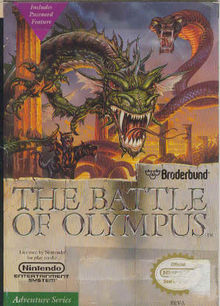 The Battle of Olympus was released by Brøderbund in 1988. Yes, Brøderbund! The Carmen Sandiego people! It turns out that, in addition to publishing a variety of quality edutainment titles, Brøderbund also publishd a number of Japanese games in the US for companies that had no American arm. This wasn't an uncommon side-business for American software companies in the 80s; Sierra On-Line, of King's Police Space Quest for Glory fame, published a few Japanese games in its early years, like Thexder and Sorcerian.
This explains why the game's plot is so very... odd. You play Orpheus and are trying to rescue Euridice from the underworld. To do so you must fight a hodge-podge of different monsters from Greek mythology. The mythological elements don't really fit together in a coherent way; you're left with a sense that the game's developers just threw in a slew of names from Bullfinch's Mythology at random. It's jarring to meet Prometheus and be told that his town is under seige by the snake-woman Lamia, but that if you can defeat her he'll give you the Staff of Fennel, which you can use to fight enemies. And which shoots fire! And all of this from the same company that brought you Where in the World is Carmen Sandiego?.
Brøderbund might have worked a bit harder on the translation. The game's various puzzles are obtuse enough without dialogue like "Here is the sandals. If you can find my father he knows how to use it," and "There may be a crystal ball that helps you see invisible things." In a way, it adds to the sense of accomplishment when you find something and figure out, retroactively, what the game's characters were trying to tell you. Nonetheless, once the retro charm wears off wrestling with terrible translations is one of the less fun aspects of playing older games.
So how does Battle of Olympus play? Exactly like Zelda II: The Adventure of Link. I played this game a lot as a kid and somehow never caught on to the fact that it was a Zelda II rip-off. Before picking it up again I'd heard people mention this fact occasionally, but I generally rolled my eyes and wrote them off as too cynical for their own goods. But no! It's Zelda II, only now Link's wearing a tunic and a wreath of laurels! The animation is the same, the controls are the same, the single-screen houses are the same, even some of the graphics are out-right stolen from Nintendo. It's Zelda II in ancient Greece.
Stepping back a bit, it's hard to really evaluate Battle of Olympus. As I played it, I realized that game design philosophy has really fundamentally changed since it was made. If you play a modern game, you'll find it's trying to be fun from the moment you turn it on. Modern games seek to engage the player and give them interesting things to do from start to finish. Battle of Olympus, and a lot of other games from its era, is a chore. The game is designed to be a challenge. The fundamental relationship between developer and player has changed since Battle of Olympus was made. Modern developers see players as consumers looking for entertainment, and ask "what can we do so that players will have fun?" Developers of the 80s saw players as adversaries, and asked themselves "How many roadblocks can we place between players and the goal of beating the game?" Modern designers make games to be fun; designers of the NES era made games to be hard.
I played Battle of Olympus a lot before writing this. I'd estimate I spent maybe 10 hours plugging away at it in my week with it, and I got maybe half-way through the game. In all the time I spent playing it, I can honestly say I never had any fun. At no point did the game cause me to feel joy. I felt no exhileration at what I was doing. What Battle of Olympus did make me feel was satisfaction. I died dozens of times trying to beat the Cyclops in Pelopennesus. When I finally beat him and got some bauble that made my incredibly vulnerable avatar marginally less weak, I was pleased with myself. The game had been beating me, hard, and I had just hit back.
Ultimately, I don't think Battle of Olympus is a very good game. The fact that it's challenging and not fun throws the shift in design philosophy into sharp relief, but that doesn't excuse the fact that it isn't fun. There are a lot of other game from the era that managed to be both challenging and entertaining.
I wouldn't pay more than $2 for Battle of Olympus. It's not terrible, there's some enjoyment to be squeezed out of it if you're willing to work at it and take pleasure in surmounting punishingly hard video games, but it isn't particularly worth it if there are more entertaining alternatives.
No musical selection for this game because the game's music is wholely foregettable. The one exception: When you enter a God or Goddess's temple the music that plays is an 8-bit chiptune rendition of Bach's Toccata and Fugue in D-Minor. Odd, considering that the piece wasn't written until around 2000 years after when the game is supposed to take place, but interesting and unique nonetheless.
Posted by Zach at 09:46 PM | Comments (0)
April 27, 2007
Nintendo Fills the Ponderous, Pretentious Religious Symbolism-laden RPG Hole in its Lineup
Nintendo has announced that it has purchased an overwhelming interest in Monolith Soft, an RPG developer founded (as all small Japanese RPG developers seem to have been) by former Square programmers. Previously owned by Namco-Bandai, Monolith will presumably now be making all of its future games for Nintendo platforms.
Monolith was founded about 6 years ago by a group of disgruntled Square employees who had previously worked on Chrono Trigger and Xenogears. As you know, Bob, Xenogears was a fantastically pretentious role playing game stuffed to the gills with self-important and bafflingly incongruous religious symbolism. The clearest way to get a sense of the plot is to imagine somebody playing MadLibs with a bog-standard Japanese RPG plot, and inserting randomly selected names from the Bible for all the proper nouns. Bam! Xenogears. Sadly, thousands of players mistook Square's random walk through the New Testament for some sort of incredibly deep and complicated commentary on Western religion, and the generated a swarm of rabid fans.
Square, however, was uninterested in making further Xenogears games, which led a big swath of the Xeno team to leave and form Monolith. Using some obscure loophole in Japanese copyright law, Monolith set about creating Xenosaga. Initially, Xenosaga was to be a five-game prequel to Xenogears. The games didn't sell well enough to justify the full series, though, so they quietly wrapped it up at three games.
Where Xenogears was a decent game soaking in an interminable plot, Xenosaga was the longest, most boring science fiction movie you've ever seen periodically interrupted by uninspired gameplay. To give you a sense: The game begins with a 20 minute movie. You then play a tutorial for about 15 minutes. This is followed by a half hour movie. Now you get an hour of exploring the ship and fighting enemies. Just when it seems like the game is about to start happening, you learn that you've essentially been playing the prelude and are treated to a two hour movie, which concludes with a half hour of playing an entirely new character in a new setting. Twenty minutes into the movie that follows this segment I realized that I would never, ever actually get to play the game. I turned it off and never returned.
Monolith also created Baten Kaitos, a card-based RPG for the Nintendo Gamecube that some seem to like, but that I never really got into. Apparently Monolith developed a close enough relationship with Nintendo while working on Baten Kaitos that Nintendo has decided to bring them into the fold.
Despite the fact that I haven't actually liked anything that Team Monolith has ever made, I confess to being a little excited about this news. Nintendo is exceptionally strong at making platformers and adventure games, but their RPG team is a little light. Heretofore that niche has essentialy been filled by their Fire Emblem team and Intelligent Systems (the Paper Mario people). Monolith will help make their first party line-up a little more well-rounded. They might not be the development team I'd have chosen if I had access to Nintendo's money hats, but they at least have the right idea. Now if Nintendo could buy a decent first person shooter developer that isn't integrally tied into the Metroid Prime franchise, they'd be pretty well set.
Posted by Zach at 07:49 PM | Comments (0)
April 26, 2007
Freebooter: Arena
Hopefully this will be the first of a series of posts where I point readers to entirely legal, free computer games to download. If that doesn't pan out, though, then please enjoy the one game that I'm pointing you to right now!
You have, perhaps, heard the great commotion all the country through for Oblivion, the massive, open-ended RPG from Bethesda Softworks available for the PC, XBox 360, and PS3. Playing the game, though, requires a minimum investment of $300 in a low-end 360 (and a maximum investment of multiple thousands of dollars for a gaming PC). Not to worry! Oblivion is the fourth game in the Elder Scrolls series, and Bethesda has kindly made the first game, Arena, free on their website. All the open-ended wandering of the Oblivion, with graphics scaled down to a level anyone can enjoy!
The trick with Elder Scrolls games is that the plot is not the point. There is a plot, yes, and you should probably get around to completing it eventually. But the games are filled with dozens of side-quests for every plot quest, and the game never tells you "You must go here now and do this to proceed!" Most games, even open-ended ones that emphasize exploration, will start you in a small area and gradually unlock more of the world as you complete the plot. Not Elder Scrolls games. The world is wide-open from boot-up. Moreover, there's generally a lot of freedom in terms of character advancement; rather than being locked into rigid classes, you're free to build your character in whichever direction suits your playing style.
I'd recommend anyone interested in computer RPGs give Arena a download. If nothing else, it'll give you an idea whether you're the sort of person for whom the significant investment necessary to run Oblivion would be worth it.
Posted by Zach at 02:49 AM | Comments (0)
April 17, 2007
Command and Color
I've been playing Command & Conquer 3: Tiberium Wars lately. It's fairly entertaining thus far, though it definitely trades heavily on nostalgia. The game plays essentially like every Command & Conquer game you've ever played, complete with FMV cut scenes briefing you for each mission. It certainly looks very nice and it's a fun Real-Time Strategy game, but it is definitely EA's way of saying "Command & Conquer is a series rooted in the mid-90s, and in the mid-90s it shall remain!" I'd say the biggest complaint I have is about the game's subtitle; the first Command & Conquer game was Tiberian Dawn, the second Tiberian Sun. This one, to maintain consistency, ought to have another heliocentric title (Tiberian Sunset? Tiberian Twilight?). And if we're going to be technical, all three Command & Conquer games have been Tiberium Wars, a nomenclature adopted internally within the game itself, so Tiberium Wars is a somewhat silly subtitle all around.
What I find most interesting about C&C3, and the Command & Conquer series in general, is that it has an enormous, overblown sci-fi plot that is essentially the after-effect of a gameplay kludge. To understand this, you have to go back through the history of Westwood, the company that created the series.
In the mid-90s Westwood was a small programming company that had enjoyed modest success doing contract work for larger publishers and developing its own original games, such as Eye of the Beholder. It had recently been acquired by Virgin Interactive, which gave it access to franchises that had previously been beyond its financial reach. For whatever reason, they settled upon Dune, Frank Herbert's science fiction epic, as the ideal subject for a video game. The game they created was an interesting mix of adventure and strategy; you played Paul Atreides and had to travel around Arrakis, maintaining the Atreides estate by dealing with problems that arose while managing harvesting and preparations for war. A fun game, fairly faithful to the book, but one that didn't leave an especially lasting mark on the world of video games.
Westwood decided to make a sequel, but this time they went off the rails and made a game that was, shall we say, unconstrained by the limitations of canon. Dune II: The Building of a Dynasty sees the Padishah Emperor Frederick IV fallen on hard times. Deeply in debt, he decides the only way to satisfy his creditors is to sell off House Corrino's most valuable asset: the planet Arrakis, known as Dune. The Emperor sets forth a challenge to the three great Landsraad houses: Whoever produces the most spice will be given ownership of Dune. There are no set territories and no rules of engagement.
So Dune's interesting plot elements are used as the basis for a flat-out war game. The game plays simply enough. There are a series of missions. With very few exceptions, the goal in each mission is to utterly destroy your opponent. As a rule, you will start each mission with a construction yard and an allowance of credits. Using that you can build a spice refinery. Every spice refinery comes with a harvester, which you can use to collect spice which gets transformed into credits at the refinery. Credits, in turn, are used to construct new buildings, like vehicle factories and barracks, and units, like troopers and tanks, which you can use to defend your base and crush your opponent. The system fits very well with the essential elements of the Dune universe, and if if fails at capturing the grand discussions of strategy, desert power, and so on and so forth, this can be excused as being due to the limitations of the technology.
The game was revolutionary, creating the Real-Time Strategy genre as we now conceive it. It has been argued that other, earlier games like Ancient Art of War, Stronkers, and Herzog Zwei are essentially Real-Time Strategy games, but Dune II is the game that established the genre conventions that are still in use today. If you play Dune II now, you will say to yourself, "Hey, this is a Real-Time Strategy game!" If you play Stronkers now, you will say to yourself, "Hey, this is sort of like a Real-Time Strategy game!"
Westwood wanted to capitalize on Dune II, and since they already had a lot of the legacy programming to build off of they could create new Dune-like games at relatively low cost. Rather than make another Dune game, they decided to create a new series unfettered by licenses, their own unique intellectual property. They created Command & Conquer.
Command & Conquer is another war game in the mold of Dune. It's set on Earth in the mid-90s, when the game was released. The plot concerns a covert war between an international peacekeeping organization called the Global Defense Initiative, or GDI, and an international terrorist organization called the Brotherhood of Nod. The game itself is Dune II. Granted, there are a lot of upgrades to the interface that make the game much more playable than Dune II, plus the graphics are better and the game featured (awkward) full motion video briefings before each mission, but the game is Dune II.
This raised an interesting game design problem. Dune's resource system made sense. Spice was the most valuable resource in the Dune universe, and the only resource anyone was interested in on Arrakis. It made sense that spice would be a universal currency used to finance a war. Similarly, it made sense that spice would just be lying around on battlefields waiting to be quickly harvested on the spot using dedicated harvesting machines. It was right there in the books. But Command & Conquer takes place in the real world, right now. Real military operations are funded with tax dollars, or dollars from smuggling contraband, or whatever, and none of that can be implemented in a game without making it too boring (manna-from-heaven in the form of periodic disbursements from a central organization) or too intricate (smuggling drugs or whatever).
What was needed was a universal resource that could just be found lying around on battlefields. You can come up with some real-world ones, but a lot of those are geographically-specific. Make it oil, for instance, and you're limited to battles in the Middle East, the Black Sea, and Alaska. So Westwood created a new resource: Tiberium. Tiberium is a mysterious green crystal, possibly from space, that is highly toxic, spreads rapidly once it enters an area, and is incredibly rich in minerals and, I don't know, energy or something. The GDI and Brotherhood of Nod both want it, they fight over it, and they gather it using big treaded vehicles called harvesters that take them back for processing at tiberium refineries. They barely even needed to change the graphics from Dune II!
Which brings me to C&C3. I didn't really play the second C&C game, but apparently the developers took the tiberium ball and ran with it. The game takes place in 2047. Now Tiberium has infested 80% of the Earth's land surface, rendering 30% of it entirely uninhabitable. War still rages between the Brotherhood of Nod, which operates primarily in the 50% of the Earth that's infested-but-habitable, and the GDI, which controls the 20% that's untouched by tiberium. Nod, which started as a generic anarcho-terrorist organization, has become an apocalyptic cult that worships tiberium and seeks to wipe out all life on Earth through the spread of tiberium. Also, apparently aliens are going to come eventually to harvest the Earth's tiberium and kill everyone.
I find it amusing that the stop-gap that Westwood used to allow them to keep Dune's mechanics in a contemporary war game has led them to turn C&C into a whole science fiction universe built around their kludge. It's like if somebody catches you in a small lie, and then you build an elaborate, implausible story to explain that, no no, this lie really is the truth, honest! We really were planning to build a whole universe around the conveniently spice-like resource we created, really!
Posted by Zach at 12:33 PM | Comments (0)
April 15, 2007
Trendy Journalism
I am sick and cranky, so this is a sick and cranky post.
Via Joystiq, we learn from Reuters that The Guitar is Killing Your Relationship. Not just any guitar, though: the guitar controller you use to play guitar hero. The piece cites minimal evidence, all anecdotal, and leaves the reader less informed for having read the it. Welcome to the exciting world of trend journalism.
Trend journalism happens when a journalist doesn't have an actual story but faces a deadline. The reporter rounds up some friends, gets a couple of anecdotes on the article's subject, then hashes out a few hundred word relating the anecdotes and trying to fit them into some broader trend. Does the trend actually exist? Who knows? Who cares? So long as you make your word count and don't buck conventional wisdom enough to draw attention to yourself you'll clear the bar of your minimum obligations and noone's the wiser.
This article's premise is that the proliferation of new and unusual video game controlers is putting a strain on relationships. For evidence we've got two anecdotes, some speculation by an expert, some background analysis by an expert, some speculation by a non-expert, a barely-related statistic, and a tangential anecdote. This article doesn't even meet the Trend Journalism Rule of Three ("If you can cite three anecdote, you've proven a nation-wide trend").
Let's look at the anecdotes first.
Consider Chris Blessitt. He had so much fun with his buddies playing "Guitar Hero II" he decided to buy his own copy of the popular music game -- and the nearly life-sized plastic guitar that goes with it -- much to his girlfriend Kate's dismay.As the 27-year-old stage actor went looking through the shelves at a Best Buy Co. Inc. store in New York this week, he recalled his girlfriend of nine-months' reaction when he approached her with the idea.
"She rolled her eyes," he said.
I'm not entirely sure this is on point; did the girlfriend roll her eyes at the specific addition of the controller to the boyfriend's collection, or did she roll her eyes for reasons unrelated to the trend? She may have rolled her eyes because she doesn't like that specific game and he plays too much of it, or because of a general aversion to video games. In either of those cases, there's nothing about the specific controller that differentiates it as more relationship-straining than any other video game. But let's grant the benefit of the doubt. Next:
Then there is the issue of safety.Maybe that's why self-confessed game junky Brenda Brathwaite, whose 10 or more video game consoles and over 20 controllers once ruined the living room decor, drew the line when her "Guitar Hero" guitar fell on her head.
Brathwaite, a professor and game designer at Savannah College of Art and Design and author of "Sex in Video Games," took it to heart after her husband -- a stay at home father of two who is definitely not a game player -- suggested her games and gear might be happier away from the family living space.
"I'm allowed to have my sprawl in my office," she said. "The living room is for the family.
"With all the new controllers, it's getting out of hand," she added, saying her living room once looked like "a large spider was crawling out of the television."
This seems like a genuinely on-point anecdote, to the extent that anecdotes prove anything. Getting hit on the head, while possible with traditional controllers, is less of a problem than with new ones, and while most controllers cause big messes of tangled cords in living rooms bulky specialty controllers have much more potential to take up space.
Finally we have some speculation by an expert, Carrie Sloan, editor-in-chief of dating magazine Tango. She claims that large collections of video game controllers are to women what large collections of shoes are to men. I suppose I can grant her expertise in the field, but I note that her statement is so broad, and the specific part about video game accessories is summarized rather than quoted, that I'm a little suspicious about whether what she actually said was on-point for the specific issue of new controllers.
Backing up this suspicion is the enthusiasm she shows for Guitar Hero in the story's closing anecdote:
Tango's Sloan, the authority on relationships, in fact recommends "Guitar Hero" and "Dance Dance Revolution" as games that could bring couples together.Sloan and her boyfriend were recently invited by another couple to a "Dance Dance Revolution" double date.
"So maybe the accessories are twofold: they may take up space, but also serve as a his-and-hers social elixir," Sloan added.
On balance, it seems that Sloan's testimony doesn't point one way or the other on the issue of whether new-fangled controllers are putting unusual new strains on relationships.
Then we have non-expert speculation from "game player Festus Williams": "For whatever reason, girls just don't like you spending time playing video games. And then you come in with a guitar or steering wheel, that could get people in trouble." This really feels like a quote that the author solicited from a friend of his because he needed some sort of extra evidence to add. It's not a story, it's not a particularly strong statement, it's just idle speculation.
Finally we have some background statistics related to sales figures on video game peripherals and an expert discussing why new peripherals are needed for games. These don't even pretend to speak to the trend at issue, they're just there to provide context.
Trend journalism annoys me because it tends to be shoddily researched and hastily written. Moreover, it almost always confirms some sort of conventional wisdom. In this case, the piece reinforces the idea that gaming and dating are incompatible, as well as providing weak support for the gender stereotype that games are enjoyed by guys, endured by girls. As for the trend itself, I'm dubious. I don't doubt that some non-gaming SOs have been put off by specific purchases of video game peripherals, but I'm not sure you can attribute any special animus to the new peripherals rather than to video games/obsessive hobbying in general.
Posted by Zach at 07:00 PM | Comments (2)
March 05, 2007
My Year of NES, Week 2: Batman
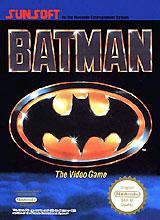
And now it occurs to me that a year of NES games might, perhaps, be a more difficult endeavor than I had at first imagined.
Batman was released for the NES in 1989 by Sunsoft as a movie tie-in for the first Tim Burton film. Sunsoft was known for releasing a lot of very odd licensed games in its heyday on the NES. They were very good at securing the video game rights to popular movies, yet not very good at doing anything worthwhile with them. Batman is exemplary: a mediocre game with only the loosest association to the license it's based on.
Batman is a generic platformer of the type that thrived on the NES. It's odd to think that at one point platformers were the norm for video games and everything else was a genre game. Platformers once roamed the shelves of the video game section of Toys 'R' Us much as the mighty buffalo once roamed the Great Plains of the American mid-west, and like the buffalo they have now been hunted to near-extinction. Well, not quite, but the point remains that fully half of my NES games are platformers, compared to about 15% of my present-generation video games.
One of the more interesting things about Batman is how little it has to do with the movie it is ostensibly based on. The game has five levels. You begin on the streets of Gotham. All well and good. Then you fight through a sort of chemical factory/power plant. Well, that makes sense, the Joker's chemical plant was a major part of the film. The third level starts as a sewer, then turns into a cave. The fourth level is the Joker's giant techno-fortress. The final level is Gotham Cathedral, so at least we finish with the actual climax of the movie.
The bosses are an interesting non-canonical bunch: A guy with a jetpack who flies around and shoots energy blasts, a conveyor belt machine that fires rockets, a pair of giant blocks that cirle around the room and need to be punched to death. The Electrocutioner makes an appearance at the end of the third level (surprisingly not the power plant stage). And who could forget Batman's battle with Fire Bat at the top of Gotham Cathedral before he faced The Joker? The answer, of course, is everybody, because none of these villains ever appeared in the film.
The final battle with the Joker is interesting. Point for realism: He has that really long gun, and it does huge damage if he connects with a shot. Demerits: The Joker can also call down lightning bolts from the sky.
At first I thought that maybe this game started life as something else, then was transformed into the Batman game at the last minute when the license was secured. As I played more, though, this seemed less likely. There's enough about the game that says "Batman" that it was probably a Batman game from start to finish; they just decided to throw in a bunch of things they thought would be cool.
There's the nugget of a fun game in Batman. The graphics are nice, if a bit dark, and the music is catchy (though not from the movie). You basically wander around punching enemies until they explode. You have a selection of weapons you can switch to which use a common pool of ammunition. There's the Batarang, a rocket gun, and some sort of spinning razor blade weapon. It's nice to have a selection, but the weapons aren't really different enough to justify their existence and you'll find yourself using the Batarang nearly every time you're not punching. You also have the ability to spring off of walls in midair, which is pretty well implemented. Controls are fairly responsive and you'll seldom find yourself blaming crappy controls for your death.
The trouble is that Batman is very half-assed. There are five levels that take no more than about half an hour to finish. The game isn't so much challenging as it is frustrating; it puts you in a lot of situations where there's no way to avoid getting hit or where you have to make blind leaps and hope that by luck the enemy at the other end of the pit/top of the shaft isn't firing just as you get there. The game also repeats itself a lot. The game designers apparently believed that if a given sequence was tricky to navigate once, it was worth forcing the player to navigate multiple times in a row. There are a lot of shafts, for example, that consist of the exact same set of enemies and gears repeated three times over to extend the length.
It's a shame, because Batman is a potentially fun game marred by a rushed production. It isn't nearly long enough, the level designs are careless and haphazard, and no effort at all was put into making it fit the license. It is quite fun, though, for about the first two levels. Once the giant mutant frog men appear in the sewer, though, the game just becomes tedious. I wouldn't pay more than $3 for this game.
Posted by Zach at 06:26 PM | Comments (0)
February 26, 2007
My Year of NES, Week 1: 1943
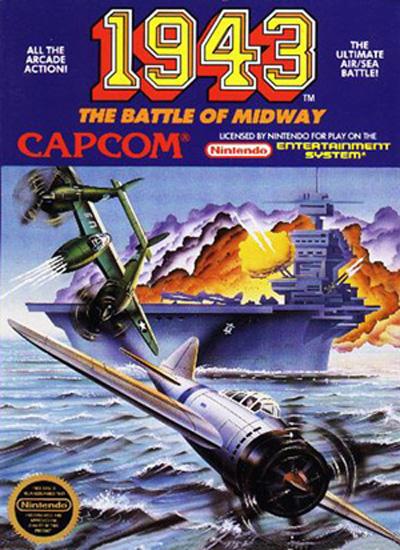
My Year of NES has gotten off to a painless start with Capcom's 1988 arcade conversion 1943.
1943 is a video game re-imagining of the Battle of Midway, if the battle of Midway were fought exactly as though it were a generic space shoot-em-up from a mid-80s arcade game. You fly a P-38 Lightning fighter in a series of vertical-scrolling levels. Each level is structured as a mission to destroy either a ship or a large aircraft. Missions generally come in two phases, a high-altitude flight to your target followed by an attack run. Bosses tend to be giant platforms covered in turrets; you blow up the ship by destroying all of its guns.
If you strip away the Midway theme, 1943 is barely distinguishable from any other vertical-scrolling shooter. If you replace the sea and clouds in the background with ground and the planes with space ships, you've got Xevious. Each mission begins by giving you orders that tell you the name of the ship you're to sink (accompanied by a morse code sound effect), but the ships are just random names made up by the Capcom staff; none of the targets were actual ships in the Battle of Midway. As is the case in all shoot-em-ups, you're flying a single plane, apparently the last one in the Air Force, against thousands of Zeros, all flying in neat formations that never deviate from pre-defined flight paths. You have a special screen-clearing lightning attack that you can use a limited number of times (taking the P-38's nickname quite literally) and you can upgrade your main gun in a number of ways, including a spread attack. Needless to say, in creating 1943 Capcom did not feel constrained by the theme when making design choices.
I had a lot of fun playing this game last week. You turn on the system and you're shooting down planes within 10 seconds. It has a distinct pick-up-and-play factor that's sorely missing from modern games. I can be half-way through the first level in the time it takes me to boot up my PS2 or Wii and navigate to the game start section of the user interface. I can be done with the first boss and on my way to the second before I would have started playing the average current generation video game. It's a challenging game, but it never gets frustrating. The screen never gets flooded with planes and bullets, so it feels like more a test of skill and less a test of ability to memorize where exactly you need to go to survive the bullet hell.
This game also raised my self-esteem to the heavens before crashing it down to earth, like a wrestler executing a gorilla press slam. I was able to master the first level with relative ease. The second level was a bit more troublesome, but after a few tries I was able to beat it, and I can now finish the level consistently. The third level has given me more trouble, but I figured I was fairly close to beating it when the week ended. Since this is a Nintendo game, and bound to be short, I figured the game had five, maybe six levels, about standard for shooters in general. I was making good progress towards completion. In preparing to write, I looked the game up on GameFAQs.
It has 24 missions.
The more I play the game, the more I like it. Browsing the walkthrough on GameFAQs I discovered that there were a lot of aspects of the game that I had missed (you can hold down the B button to charge attacks, by upgrading your Special Weapon ability you unlock new weapon upgrades for your main gun, etc.). The game's seemingly simple gameplay belies its considerable depth.
A final interesting fact about 1943. Capcom is a Japanese company. The game is about the Pacific air war during World War II, and specifically the Battle of Midway, a major defeat for the Japanese Navy and arguably the turning point in the Pacific Theater of Operations. This led to an intersting schoolyard rumor: The game, as released in the US, was a pallette swap of the original Japanese version. In the original, you piloted a Zero against the American fleet, shooting down P-38s and sinking American battleships and carriers. Capcom had changed the names and swapped the images for the American release in order to make it palatable to an American audience. It was intuitively obvious. Capcom's a Japanese company making games for a Japanese audience, and Nintendo of America was very heavy-handed in censoring games brought to the US. How could Capcom possibly have made a game about blowing up the Japanese Navy?
But it's all nonsense; you're an American fighting the Japanese in the American version, and you're an American fighting the Japanese in the Japanese version. Realistically, it had to be that way. The goofy lightning special attack makes some kind of crazy Nintendo Logic sense if you're flying a P-38 Lightning; it makes no sense if you're flying a Zero. Capcom made a game about the American side of the Battle of Midway and, whatever led them to make the game, that's what it is, here and in Japan.
So, much fun was had this week. 1943 is a good game, particularly if you're a fan of older shoot-em-ups. I'd highly recommend buying it if you should find it and have the means of playing it.
I'm going to try rating games on a dollar scale. I'll be setting the maximum amount I'd be willing to pay to own the game, if I didn't own it already. I would say $10 is a fair price for 1943. Considering that NES games on the Wii Virtual Console cost a flat $5, $10 is a pretty strong endorsement.
Next week: Batman by Sunsoft. Like 1943, it bears only the loosest resemblance to its source material. Unlike 1943, it isn't worth $10.
Posted by Zach at 02:16 AM | Comments (1)
February 17, 2007
Introducing: My Year of NES
If there's one thing that I enjoy unabashedly, it's grandiose projects undertaken for little or no reason. This love of pointless struggle inspired me, three years ago, to attempt to watch every blockbuster movie released during that summer. The effort failed in mid-July, largely because Hollywood went the entire summer of 2004 without releasing a single watchable movie. Before I gave up I had subjected myself to, among other cinematic suppositories, Van Helsing, Chronicles of Riddick, Troy, The Stepford Wives, The Day After Tomorrow, and Garfield. Now I've had another idea for a long and pointless endeavor.
I recently cleaned my room (somewhat), which led to a reorganization of the various media on my bookshelves. During the process I noticed that I have 51 games for the original Nintendo Entertainment System here in New York with me. 51 is a number that is very close to 52, and 52 is the number of weeks there are in a year. Bam! Why not, I said to myself, spend a year playing your NES games, playing one game each week for 52 weeks? And so my new project was born. Bonus: There's a book called My Year of Meats, so I can call this project My Year of NES and it would be almost pseudo-clever.
The idea is simple. I'll pick one game per week every week for the next year. I'll spend the week playing that game. Ideally, I will have a session playing that game every day of the week. In the best of all possible worlds I will beat the game that I have chosen before the end of the week; in the world we live in, this is highly unlikely. The first day of each game's week will be Sunday and the last day will be Saturday. After each week is done, possibly Saturday night or Sunday morning, I'll write a post about my thoughts on the game. And at some point I'll buy another NES game to bring my total up to 52.
I'm optimistic about my prospects of sticking to this. I enjoy video games, so presumably playing these games won't be a chore. Most old NES games have a pick-up-and-play feel that isn't present in a lot of modern video games, so if I'm busy it shouldn't be a problem to have a quick 15 or 20-minute game session without feeling like I'm just fulfilling my minimum obligations. Plus, and I don't mean to brag here, I have a pretty awesome set of games. Bionic Commando, Mega Man 2, Contra, Castlevania III, Kirby's Adventure, and so on. Moreover, this will give me a chance to actually appreciate a lot of the games I've been hoarding since childhood. I've spent a lot of money building a nice collection and getting my hardware in order so that I can play these games, but I hardly ever take advantage of it.
My plan, though I reserve the right to modify it at any time, is to play through my collection alphabetically. That means that the first week's game will be 1943, Capcom's vertical-scrolling shooter based on the battle of Midway. Are you excited? 'Cause I'm excited.
Posted by Zach at 04:14 PM | Comments (10)
January 31, 2007
Hey! I don't wanna go to work today. Wanna stay home and play on my video games.
I've decided that it's high time for another post in which I make video games boring. In this case, I'd like to do so by combining my love of history with my love of games.
There is something about the orthodox history of electronic games that has nagged at me for a long time. As you know, Bob, one of the most significant events in video game history was the Great Crash of 1982. At the end of 1981 video games were a huge business, the next big entertainment medium, soon to surpass television, film, and music both in terms of sales and cultural relevance. At the dawn of 1983 video games were a joke, a fad, a novelty. In between those two points was the Great Crash of '82. Video game stocks crashed, a lot of companies went out of business, and video games became a profoundly unprofitable business to be in. Something about the story, though, doesn't smell right to me.
I don't dispute that the Crash happened; clearly there was a big change in the perceived profitability of video games over the course of 1982. What I question is the orthodox explanation of the crash.
The standard story is something like this: Once there was just Atari. They made the first arcade games, they made the first (profitable) home video game consoles. There were some competing consoles, like the Odyssey, but they never sold close to as many units as the Atari VCS. And for a long time the only people who made games for the VCS was Atari. And they were good games, which made consumers happy and made Atari very successful.
Then a gang of disgruntled Atari employees left the company and formed their own business, Activision, which developed its own games for the VCS. Activision became the first third-party developer. Since Activision consisted of some of Atari's best employees, this meant a slight drop in the quality of Atari's product, but Activision made some darn good games so consumers were still happy and all was still well.
But Pandora's Box had been opened. Now the knowledge of how to program for the VCS was not wholely contained within the Atari corporation. Soon other video game companies appeared, hundreds of them, spurred on by reports of the astronomical profits Atari was receiving. And they made shitty games. Even Atari began producing dreck. Consumers grew more and more concerned.
According to this story, the straw that broke the dromedary was E.T. Atari rushed the production of the game (It went from blackboard to finished product in 6 days) then manufactured a stupid number of them (they made more copies of the game than there were VCSs sold in the US at the time; they anticipated that everyone with a VCS would buy one, plus new users would buy VCSs just to play it). And, as anyone who has played E.T. knows, it was garbage. Angry customers returned the game in droves for refunds, Atari (allegedly) buried several million copies of the game under a mountain of cement somewhere in Nevada, and Atari's stock crashed. Consumers lost faith in video games; they'd put up with crappy games from third-party developers, but now Atari itself was producing crappy games. By the millions, consumers who had been interested in video games were interested no longer. They took their money and bought bicycles and happy meals instead.
This last bit is the part I don't buy. Yes, there were a lot of bad games for the VCS. Yes, E.T. sucked. And quite probably there was a certain degree of burn-out among consumers. But does it really make sense that a glut of bad games caused everyone to turn their backs on video games entirely? Might I direct you to the shelves of your nearest Electronics Boutique, where you will observe five unplayable turds for every one game you might consider purchasing (and that's if you have pretty undiscerning taste in games). Hollywood cranks out dozens of terrible re-treads for every decent movie it releases, but consumers don't suddenly decide that they're sick of films and stop buying movie tickets.
It strikes me that a far more plausible story focuses on the supply side of the market rather than the demand side. There were lots of articles hyping the immense profitability of video games in 1981 and early 1982. A lot of companies sprung up from nowhere to make games that year. Wall Street and the video game industry had high expectations for the profitability of video games. Then they failed to meet those expectations. The market got saturated, far more games were supplied than consumers demanded, and a bunch of companies went under. Simultaneously, Atari, the market leader, had a number of high-profile flops and found itself in severe financial difficulty.
All of this would create the impression that the bottom had fallen out of the market, when in fact the problem was one of over-supply rather than under-demand. Now the whole thing looks a lot more like the internet crash of the late-90s; a hot new technology inspired a bunch of companies to get into the business without really knowing what they were doing, the stock market went crazy as a result of the hype for these new companies, and then the whole thing came crashing down when people realized that these businesses couldn't pay their bills.
What's interesting is that the video game industry has largely internalized the conventional wisdom explanation for the Video Game Crash and acted accordingly. When Nintendo cautiously entered the home video game market in the US in 1986, it heeded the claims that Americans were utterly uninterested in video games. Thus, they called their home console the Nintendo Entertainment System, packaged it with a light gun and a robot, and designed it so that you couldn't see the cartridges while they were loaded in the system (introducing a design flaw that systematically caused systems to stop working over long periods of use, but that's another boring story). Nintendo's entire marketing effort in the US, in the early years of the NES, was designed to convey the message, "This is NOT a video game system." Along similar lines, Nintendo was fearful of the prospect of a glut similar to that experienced by Atari in 1982. Thus, anyone who wanted to produce games for the NES had to be licensed by Nintendo and all games to be published had to be strictly vetted (hence the Nintendo Seal of Quality). Moreover, Nintendo limited the number of games published for the system by establishing a hard-and-fast quota: No company could published more than 5 games per year for the NES (so you'd better make them good).
It seems funny, in retrospect, because the whole demand-side explanation of the Crash of '82 seems so implausible. Nonetheless, Nintendo's licensing system has become the model for game publisher-console manufacturer relations, and was a necessary prerequisite to Sony's loss-leader razor-and-blades business model. If I were an economist, I would love to dig into the market data of the time and see if it confirms my supply-side suspicions or if the conventional wisdom demand-side story is borne out. Since I'm not, I'll just have to content myself with looking askance every time some video game columnist casually mentions the Crash of '82 that was caused when consumers got sick of too many shitty games.
Posted by Zach at 03:08 AM | Comments (0)
January 20, 2007
Custom Soundtracks
Vaguely continuing the video games + music theme of the last post, there's a game out, which I don't own and am unlikely to own, called ExciteTruck for the Wii. It's the long-awaited second game in the Excite[vehicle] series, which heretofore was assumed to be just a single game, ExciteBike.
ExciteTruck was a launch title for the Wii, which means that it's long on showing off the technical capabilities of the system and short on lasting gameplay value. It's a fairly simple monster truck rally game. There are a number of tracks, you pick one, pick your truck, and race around in circles for a while until someone is declared the winner. The main innovation in the game is that you don't stear with the direction pad or a control stick. Rather, you hold the Wii remote -
- horizontally, with the buttons facing towards you and hands gripping both sides of it. You then steer your truck by rotating the Wii remote clockwise and counter-clockwise, mimicing the motion of turning a steering wheel.
But that's not what I'm interested in. ExciteTruck, like most video games, has a soundtrack. Also like most video games, ExciteTruck's soundtrack is bad. ExciteTruck's soundtrack consists entirely of metal tracks by 80s hair metal tribute bands. Perhaps realizing how terrible the music they had put into the game was, the makers of ExciteTruck did something interesting: They let players create their own soundtrack.
The Wii has a port for an SD memory card, which is a fairly common memory card used mostly by digital cameras. ExciteTruck allows you to load MP3s from your personal collection onto an SD card, plug the card into the Wii, and use those MP3s as the game's soundtrack in place of the music the game provides. This isn't incredibly innovative; some PC games (though surprisingly few) have had this feature for years, and it's entirely possible that some other console, like the XBox, had games that let you do this sort of thing. Still, it isn't nearly as prevalent yet as it probably ought to be.
The idea of custom soundtracks for video games raises a lot of interesting possibilities. I tend to be more tolerant of video game soundtracks than the average player, but I also know people who out-right cannot play video games with the music on. Not only does this let people who dislike game music participate in the full multimedia gaming experience, it potentially unlocks a new level of fun tinkering for people who enjoy fiddling with things like I do. It adds a new game-outside-the-game that challenges the player to play the game, get the feel for it, and attempt to match music from her collection to the game experience. There are some games (and here I am thinking of ExciteTruck) where the game of creating the perfect soundtrack would probably provide more enjoyment than the game in itself.
Which is all well and good, but, as a practical matter, even if I this feature were to become commonplace I would probably wind up sticking to the games's original soundtracks. I actually tend to like video game music, which is why I have a bunch of free MP3s of video game music remixes and tributes on my harddrive. And which also means that, if I were to create a custom video game soundtrack, it would be likely to consist mostly of music from other video games.
Posted by Zach at 12:54 PM | Comments (0)
May 17, 2006
Mushroom Hunting
If you are a fan of old-fashioned 2D platformers, and also an owner of a Nintendo DS system, it would be a damn shame if you did not buy New Super Mario Brothers.
A damn shame.
Posted by Zach at 08:41 PM | Comments (1) | TrackBack
February 27, 2006
Games that Should be Played by You: Star Control 2: The Ur-Quan Masters
Now that I have a Summer sort-of job and my moot court brief is nearly crafted, I'll be able to do more outside reading and caring about non-law things. So to kick off my return to being a (somewhat) interesting person, I'm inaugurating a new series of posts on classic computer games that are seminal enough to be worth playing despite their age. Of course, that's actually a fairly large group of games, so I'll try to limit it to 1. games that can readily be found free on the internet and 2. games that are likely to actually run on a modern system. This may limit the selection down to a single game, but even if it does it's a game well worth talking.
Star Control 2 was released in 1992 by Accolade, and was developed by Fred Ford and Paul Reiche III. The sequel to the fairly unremarkable Star Control, it's a game with few original elements. The gameplay is a mixture of Computer Space (the first commercial video game) and Starflight/Elite/Privateer, with fairly generic adventure elements thrown in. But all the elements come together to form a cohesive whole that works extraordinarily well.
The plot is a mixture of sci-fi tropes and cliches, but it's well-written and fun. To summarize: The human race was once part of a big alliance of races that banded together with the purpose of fighting off the Ur-Quan Hierarchy. The war between the Hierarchy and the Alliance is Star Control I. During the war, a research mission crashes on an unexplored (but hospitable) planet. They lose contact with the Alliance and build a nice little agricultural civilization for themselves. One day they find an ancient starship factory hidden under the surface of the planet, which they activate. It begins automatically building a giant spaceship. After 20 years the spaceship is finished, and they place you in charge of it. You fly back to earth to discover that the Alliance lost the war and the Human race has been enslaved. The Earth has had a giant, impenetrable energy shield placed around it, and all of humanity is trapped there forever. Except for a small group on a Hierarchy fueling station that orbits the planet. You convince them to help you try to overthrow the Ur-Quan Hierarchy with your Big Ship, and that's the essential hook for the game.
You fly around to local star systems, landing on planets and gathering resources. You spend the resources upgrading your Big Ship and buying escort ships. You also fight against hostile ships in a pretty fun melee mode (which, thankfully, you can turn over to the computer if you are lacking in the coordination necessary for success) and search for allies in your fight against the Ur-Quan.
The early game is mostly exploring and resource gathering, though they helpfully throw in enough hooks to get you started discovering the plot. Just flying around and gathering resources is fairly fun and engaging; landing on the planets is a mini-game in itself, and there's just enough stuff to buy and find to keep you interested, but not so much that it distracts you from the meat of the game, finding and negotiating with other races and searching out clues to help you defeat the Ur-Quan.
The game is helped immensely by its writing. The game is quite deep in backstory; Ford and Reiche know a thing or two about world-building. All the plot holes and silliness you may have spotted in the brief summary I gave is actually explained in loving detail in the game, gradually and artfully revealed as you converse with aliens and uncover clues throughout the galaxy. Why are the Ur-Quan conquering the galaxy? It's explained over the course of roughly 30 pages of in-game text (not all at once, of course; they only reveal one small piece at a time, through a sort of back-story striptease). Why aren't the Ur-Quan around to beat you up for trying to overthrow them? Why is the Earth left largely unprotected, allowing you to begin your rebellion? Why, that's another 25 pages of back-story, which leads you to a massively important plot point that will be of deep concern to you as you progress. Where the hell did the starship factory that built your Big Ship come from? That would be the Precursors, an ancient, possibly extinct star-faring race now shrouded in mystery and back-story. And that's on top of 40 pages of story in the game manual plus 20 pages of race descriptions.
This makes it all sound very imposing. It isn't. As I mentioned, it's all given to you very gradually, in small doses. It's the kind of backstory that makes you really want the next piece, which you can't get until you collect another 50 credits worth of bio-units. And it's all told in an entertaining way. This is not a game that takes itself too seriously. Much of the story is infused with a certain Douglas Adams sensibility, most notably in the various races you encounter. My personal favorites are the terminally depressed Utwig. Millenia ago, the Utwig fell sway to a philosophy that held that raw emotions were an inhibition to cultural and social advancement, and that, while emotions should be acknowledged, they ought to be subdued and repressed at all times. The face is the most natural vector for emotional expression, and, as such, it came to be considered highly distasteful by the Utwig. Naturally, therefore, there developed a strong taboo against showing your face at all in Utwig culture. But of course, you lose a lot of opportunity for expression when you can't show your face. Hence the evolution of an elaborate structure of Mask Etiquette. Everyone wears a mask all the time, but the Utwig have developed thousands of masks that express every possible feeling or emotion that you might normally show with your face. When happy you might wear the Domino of Unrivaled Merriment, or perhaps the Mask of Rampant Jubilation and Jumping with Ecstatic Glee. Generally, when trudging off to law school or work at the office, you'd throw on the Mask of Gruelling but Necessary Activity. Bathrooms are all outfitted with dispensers of disposable Masks of Natural Bodily Excretion. If you had, for instance, screwed up your Moot Court oral arguments, you would don the Mask of Ultimate Embarrassment and Shame. Masks even have a place in courtship; a romantic evening may involve the Veil of Flirtatious Prancing, or perhaps even the infamous Lewd Monocle.
Also, going back and playing it now that I'm older, I've discovered some things I didn't quite get when I was in Middle School. For example, the Syrene, a race of seductive humanoid females who lure enemy crews into jumping out of their ships' airlocks, fly spacecraft that look like giant orange vibrators. So the humor's all over the map, maturity-wise. But what other game lets you fly a giant orange space-vibrator?
In any case, the game comes highly recommended. It doesn't do anything notably original, but it combines a lot of elements into a uniquely fun whole, and executes everything well. What's more, it's currently available in a form which is guaranteed to work on your computer, and it's 100% legitimately free. Ford and Reiche held the rights to the code of the game, while Accolade had only the copyright to the name Star Control. A few years ago Ford and Reiche released all the source code into the public domain, which led to the creation of The Ur-Quan Masters, an unofficial (but completely legal) port of the game, with modern front-end. It's guaranteed to work on your computer; there are versions for Windows 95/98/ME/XP/2000, Mac, Linux, and BSD. It runs as a Windows-native program, so no need to fuss around with decelerators or drivers. Just install and play. I'd recommend getting a copy of the manual and star map, which can be found here. Note that you shouldn't download the actual game from that site; not just because it's illegal, but also because the Ur-Quan Masters version is far better in terms of compatibility and ease of use. Also, Star Control 2 is distinctly a game that rewards thorough note-taking.
Posted by Zach at 01:40 AM | Comments (0) | TrackBack
December 14, 2005
Attic
Via Penny Arcade, I see that Vivendi Universal has allowed a fan group to make a new King's Quest game, King's Quest IX. My reaction is one of restrained jubilation. Generally speaking, the corporate attitude with respect to video game rights has been to protect them like misers. This includes, but is not limited to, refusing to allow fans to remake old games that the company owns the rights to, refusing to allow fan sequels to series that the company considers dead, and refusing to allow free distribution of games that the company has no intention of ever releasing again.
Now, I'm not a civil disobedience all-intellectual-property-is-theft damn-the-man pirate-software-for-the-sake-of-the-revolution type. If a company doesn't want to make its software free to the public, if it doesn't want to allow fan development of its intellectual property, which it either worked hard to produce itself or paid good money to legally acquire, that's its right, and I will respect its wishes. But that doesn't mean I won't criticize the decision. These are often games that companies have decided will never see the light of day again, or that they don't even know they own and have completely forgotten about, even if fans haven't. Now I don't mind them jealously guarding the rights to their games if they have vague plans to release the games in a compilation in the future, or if they think they may build on the brand again at some later point, but a lot of times companies sit on a golden horde of intellectual property that they care nothing about and plan to do nothing with, but that fans would love to get their hands on.
So this is quite the positive thing. Vivendi Universal, which now owns the King's Quest franchise, will allow a fan group to continue producing a King's Quest game. Hopefully, this will open the door to VU granting permission to fans to work with other of their software products. It might even convince other companies to (judiciously) release some of their own IP to fan groups. There are dozens of computer game series, and thousands of individual games, that are fruitful grounds for a fan sequel. Or a fan re-make. Or even, ala The Ur-Quan Masters, fan updates that allow old DOS games to run in a modern environment without the tweaking and twiddling generally necessary to get such games to run on a DOS emulator (That's a 100% legal free version of Star Control II that will run with all features in a modern Windows environment, by the way. For those that don't know, Star Control II was a sort of hybrid of Starflight/Elite/Privateer and Computer Space, and was probably one of the best computer games ever made). So this is pretty exciting.
At the same time, it would be foolish to get hopes up too far. Note the careful wording of the linked letter: "has been given approval to continue development." Last I heard, that's not a legal contract. That's "We have talked to our lawyers and decided to sit back and not sue you. Yet." That's not a promise to abstain from future lawsuits. And you can bet that if this game is at all popular things are going to get pretty ugly pretty fast, because the fan group will be distributing a video game based on an intellectual property they have no rights to. At best, after a cease-and-desist letter and expensive negotiations, VU and the group will reach a settlement that permits the group to distribute the game in exchange for a royalty. At worst, distribution will be shut off and the fans will have to pay incredibly massive out-of-pocket expensive for trademark infringement.1 The company still has all the power here. This letter is in no way a legal shield for the fan groups.
Still, though, I'm cautiously optimistic. I'm hopeful, given that VU is playing ball so far, that they'll adopt a flexible and reasonable approach if the game is successful. Perhaps, if the game succeeds, they'll reach an amicable agreement with the fan group to allow them to distribute the game for a small fee. This could, in theory, open the gates to VU and other companies deputizing fan groups as development contractors, who will work with the various companies' old and unused IP to create products that appeal to a small niche market on the cheap. Nonetheless, this is the best-of-all-possible worlds scenario, and I think it's far more likely that there's going to be a lot of acrimony between VU and the King's Quest IX group in the future.
1Trademark infringement damages are some of the biggest damages you can get. To start, the burden of proof is different; for most damages the plaintiff has to affirmatively prove what their damages were, and the defendant can refute them. For trademark infringement damages, the plaintiff just has to state what their damages were, without proof, and the burden is on the defendant to prove the plaintiff wrong. To do that defendant would generally need unfettered access to plaintiff's sales data, along with the ability to understand plaintiff's filing and organization system to actually find what's needed and figure out what it means. Generally speaking trademark infringement damages are a lot closer to what the plaintiff claims than to what defendant claims. Further, trademark infringement damages are defined as 1. Any loss to the company's direct profits from confusion (people think they're buying the legitimate product when in fact they're getting the knock-off) PLUS 2. any loss to the company's good name and public good will caused by consumers associating the low quality knock-off with the real product, and assuming this means the real product is of low quality PLUS 3. any and all gross profits acquired from the sale of infringing goods PLUS 4. the judge, at her discretion, may automatically triple the damages PLUS 5. within her discretion, the judge may also tack on punitive damages without limit. This country REALLY doesn't want you infringing on trademarks.
Posted by Zach at 12:22 PM | Comments (2) | TrackBack
December 12, 2005
My God, it's Full of Washed-Up Stars!
This isn't one of the big posts I'd been planning, but rather a tangential result of some background research for one of those posts. Nonetheless, in the spirit of avoiding the Torts final:
In the mid-90s it became feasible to take video and compress it into a form that could be watched on home computers. This, it was believed, would be the next big thing in video games. The compression was poor and it required games to come on 6 CDs, but damnit, now you could watch full motion video cutscenes, and isn't that a good thing? In the end, it was decided that the answer was no. There isn't a lot of overlap between the folks who produce video games and the folks who produce film, so making film for a video game requires hiring an entirely seperate crew to stage and shoot the cut scenes. Moreover, the budgets for video games tend to be small compared to those for films, so you can't really put together high-quality cut scenes. Further, the filming aspect tends to shift the focus of production toward the cut scenes and away from producing an actual game that someone would want to play on the merits. After a few flashy successes, consumers rapidly got bored and a lot of companies wasted a lot of money making expensive, barely-interactive video games that nobody wanted.
But the big success in all this was Wing Commander III. Wing Commander had previously been a popular computer game series, so it had a built-in fan base. Further, Origin, the company that produced the game, hyped the video aspect enormously, which got them some coverage by main-stream outlets like Entertainment Tonight.
But the big draw for the game was the star power. I didn't realize until I looked at its IMDB entry, but this game had more washed-up stars than most budget indie movies could dream of. It starred Mark Hamill (of Star Wars fame), and featured Malcolm McDowell (Of Clockwork Orange fame), John Rhys-Davies (Formerly of Indiana Jones fame, now of Lord of the Rings fame), Thomas Wilson (of Biff Tannen from Back to the Future fame), Jason Bernard (of A Bunch of TV Shows and Mini-Series from the 80s-to-Mid-90s Fame. Seriously, I actually did know him from V before I played the game), Ginger Lynn Allen (of Porn fame), and the voice of Tim Curry (Of... Wait, why IS Tim Curry famous? I mean, Rocky Horror, sure, but do most people know him from that?). It's kind of astounding how many formerly-famous people they got for the project. And altogether more astounding how many came back for Wing Commander IV, which cost 5 times more to make but sold about half as many copies.
As for the game: Eh. It was decent. I remember it was a pain in the butt to get working on my 486, but I enjoyed it. Not very challenging, but more effort went into making it a playable game than went into any subsequent Full Motion Video computer games.
Posted by Zach at 04:23 PM | Comments (0) | TrackBack
November 16, 2005
Dorkier than Thou
Victory!
After going to two video game stores, inquiring, being told they didn't have it, returning home despondant, nearly ordering it on Amazon, finding out that they had one in an Electronics Boutique on the Upper East Side, calling that store to ask them to hold it, taking the subway downtown, crosstown, and uptown, running through the rain to the store, then making my way downtown, crosstown, and uptown back to my apartment, I am now in possession of likely the dorkiest purchase I have ever made, let alone devoted 4 hours of my life to obtaining. Behold!

Here's a closer look at my glorious acquisition:

It's a Playstation 2 controller! Shaped like a Slime! From Dragon Warrior!
I guess that's about it.
Posted by Zach at 08:58 PM | Comments (3) | TrackBack
October 24, 2005
Good at video games means bad at life
And I'm very good at video games.
I got a Nintendo DS for my birthday and have been playing it in every spare moment I have (and many spare moments I don't have). At this point I have three games for it, Meteos, Wario Ware: Twisted, and Castlevania: Dawn of Sorrows. You may be aware that developers have peculiar naming conventions with respect to games on Nintendo systems; half the games released for the Super Nintendo had the word "Super" before them, e.g. Super Buster Brothers, Super Star Wars, etc. This created confusion for poor Super C, the sequel to Contra, which was for the regular NES. Nintendo 64 games tended to have "64" at the end of the title, creating a strong link in the minds of many gamers between the number "64" and the concept of crap. Game Boy Advance titles have "Advance" in the titles (The name of the system is Game Boy Advance, which, since the "Advance" lacks a D at the end, makes the word a verb, not an adjective. So the name means "Game Boy Move Forward," as opposed to "Game Boy Not Primitive."). Nintendo DS games have the peculiar tendency to feature contorted subtitles that have the initials "DS." Hence: Castlevania: Dawn of Sorrows and Mr. Driller: Drill Spirits. The most favored D word is "Dual," while the most favored S word is "Strike." Thus: Dig Dug: Digging Strike, Guilty Gear: Dust Strikers and Advance Wars: Dual Strike. If I were naming a DS game, I would use the subtitle "Dipthong Stratagem."
In any case, I've only opened one game thus far, Meteos. I opened it first because it seemed the least interesting of the games, and I like to work up from least-liked to most-liked in these things. Now I can't stop playing it. This surprises me, because it's a puzzle game. I have a mild affinity for non-frenetic puzzle games (Adventures of Lolo, Mario vs. Donkey Kong, Klonoa: Empire of Dreams), but a general distaste for the falling blocks school of puzzle games, which seem to have taken over the puzzle genre on console systems. So Meteos surprised me; it's a falling blocks puzzle game that I actually really like, and it makes good use of the DS's unique architecture. I never really got into Tetris, so it's probably the only falling blocks game I've liked since Dr. Mario.
The play all takes place on the bottom touch screen. Blocks of various colors fall from the sky and you can select them with the stylus and shift them around vertically within a column (but not horizontally within a row). The controls work flawlessly, and I've never found myself grabbing the wrong block or having a block that I'm moving get finicky and not go where I want it. It's not something you usually actively notice, but poor controls really make themselves known when they're there, and you can see where the potential for poor controls in a touch screen game are pretty high. So you have blocks falling, and your goal is to arrange them into triplets by color, either horizontally or vertically. When you do this, the matched meteos turn gray and blast off, turning the whole set of meteos stacked on top of them into a sort of rocket. The problem is that they generally don't have enough power to break into orbit; the meteo rocket shoots up, and any meteos that clear the top of the screen are destroyed, but then it stops and slowly drifts back downward. You then have to create more matches within the rocket (or push another rocket into it from below) to give it an extra boost to get off the screen. And, obviously, when the meteos pile up over the top of the screen you lose.
Further, you pick a planet to play on before you start. There are something like 50 planets, and each one has its own unique mix of meteo colors, it's own unique meteos (they come in various designs, from simple blocks to little colored aliens to japanese characters), an entirely unique soundtrack (there are no duplicate sound effects between planets), and its own gravity. On some planets your rockets move upward slowly, then drift back down. On others, they fly straight to the top of the screen, bang the top layer on the atmsophere, then plunge downward. On some world vertical matches immediately clear a whole column, on other worlds they barely get a boost.
In any case, I've been playing this game too much; I just took a nap (I've gotten two hours of sleep in the last 36 hours) and dreamed of meteos. I see meteos when I close my eyes now. On the other hand, this could just be sleep deprivation.
So far I'm really excited about the DS; I haven't even really used the second screen much, or any of the controller buttons, or Pictochat, or the wireless capabilities, or the microphone. But the touch screen is very cool for video games. I imagine it'll allow somewhat deeper gameplay, since the stylus-on-touchscreen works almost like a mouse, but is somewhat more intuitive. I'm also unreasonable excited about Phoenix Wright: Ace Attorney. It's a lawyer simulation video game! What sold me on it is that, as part of the game, you cross-examine witnesses. When your opponent is examining witnesses, you have to object if he gets out of line. In order to do this, you must shout "OBJECTION!" into the DS's microphone. I can't wait to get that game and play it on the subway.
Posted by Zach at 10:34 PM | Comments (0) | TrackBack
October 22, 2005
Things I Overheard in GameStop Today
Know-it-all Guy: "I heard they've got this game coming out, I forget what it's called, but they created a new perspective to view the game from. It's, like, got the best of a third person and the first person view. It's like a second-person perspective." (I believe a second-person perspective game would be a game seen from the perspective of the person you're shooting at)
The Same Know-it-all Guy: "You see, the Japanese get motion sick really easily."
Skeptical Counter Clerk: "Um... Really?"
Know-it-all: "Yeah, that's why they have to put all the motion-sick warnings in the video game manuals. Because of that Pokemon epilepsy thing a few years ago."
Counter Clerk Who Has By Now Been Listening To This Guy For 20 Minutes And Is Getting Impatient: "So, what're you interested in buying today?"
Know-it-all: "Oh, I don't have any money to buy anything. Just here to browse and chat."
Another fellow, upon seeing a poster advertising the soon-to-be-released (and, admittedly, very oddly titled) Magna Carta: Tears of Blood Role Playing Game: "Hey, man, look at this. They're making an encyclopedia video game!"
Fun pretention hint: If in conversation the Magna Carta should ever come up, be sure to refer to it as the "MAG-na CHART-ah." It'll let everyone know that you think you're smarter than them!
Posted by Zach at 06:32 PM | Comments (1) | TrackBack
October 21, 2005
Two-Fisted Justice
I'm really torn over whether to see Doom: The Movie. On the one hand, I never really liked the game. On the other hand, I feel a powerful calling to support video games in movies (c.f. Penny Arcade, March 15, 2002 I would include a link to the comic, which is more to the point, but for some reason the comic appears to have been deleted. Curious). On the first hand, this movie does look like it has the potential to destroy the souls of all who watch it. Based on the previews, it appears that large chunks of the movie are shot from the first-person perspective, with the only thing you see of the actor the gun at the bottom of the screen, ala the game. I suppose when given such infertile ground for a film as Doom you have to come up with some gimmick or hook, but the effect it seemed to create, from the previews, was of sitting and watching someone else play Doom for 2 hours.
Still, though, I might end up seeing it. It seems a tragedy to watch something like Doom when there are genuinely good movies out, but I feel I have to support video games in film, even if the genre of Films based on Video Games has yet to produce a film that even rises to the level of mediocrity. I suppose the best I can hope for is that it's fun in a really bad way.
Posted by Zach at 09:18 PM | Comments (0) | TrackBack
Nintendo World!
I went down to 34th Street today to get a New York Non-Driver's ID from the DMV there. No luck. They wouldn't accept my notorized copy of my Social Security Card; only the real deal will do. This sucks because, as tomorrow's my 23rd birthday, my dependant Military ID, the only picture ID I have with my date of birth, expires at midnight. This also technically means that today is my last day to get onto military bases with said ID, but since I don't know of any near here it's an empty privilege lost. So now I'm going to have to wake up early and haul myself down there again next week once I get my legitimate Social Security Card, plus I'll probably have to scrounge together a couple of random other pieces of ID in case they won't accept my expired Military ID as proof of identity anymore (which they won't). Good thing I anal retentively saved all my check stubs and W-2 forms from the library and brought them with me to New York.
I'm currently not exercising wonderful judgment because, as of now, I've gone... 27 hours without sleep. This is due to having stayed up all night finishing a written assignment for Contracts that we were supposed to do in an hour. Not that I spent all that time doing it. Afternoon classes were cancelled yesterday, and I came home at noon planning to do it right away. So of course, I opened the assignment at around 10:30 PM, started working at midnight, got about a sentence done, then painfully stretched the rest of the assignment out until 6 AM. By that point I was worried that falling asleep was an invitation to sleep past 4, thereby missing both the deadline to turn in the assignment and the closing time for the DMV. So I decided to keep myself awake, print my assignment out at the library at 8, then head downtown.
So after I'd finished failing to get my Non-Driver's ID at the DMV, I decided, because I was sleep deprived and exercising poor judgment, to head over to Rockefeller Center and check out the big Nintendo World store they have there. When I got there they were filming The Today Show. That's where they film The Today Show, I guess. I didn't know what was going on, so I wandered around staring curiously before I figured it out. It's possible I might have ended up gettting seen through that big glass window they have in the background.
So: Nintendo World. Man. I walked in there and got a smile on my face that was transfixed until I left the store. And bear in mind it's not THAT great a store; lots of systems for playing games, lots of dead space, very little merchandise. Heavy emphasis on stylish design and architecture over functionality as a store. But man. There were techno remixes of songs from Nintendo games playing over the speakers, so many DSes with custom faceplates and GBA minis and giant egg-shaped chairs with built-in surround sound speakers and I just loved it. I got to try out two games I had previously had no intention of buying, Donkey Kong: King of Swing for the GBA and Battalion Wars for the Gamecube, and came away quite impressed. Upstairs they had a little mini-museum of Nintendo hardware, including Gameboys signed by Shigeru Miyamoto, a Gameboy that survived a rocket attack in the first Gulf War (And still works!), and an old Nintendo Advanced Versatile Computer (the Japanese precursor to the Famicom/NES). There was merchandise there that I had no idea I deeply needed until I discovered it there. I ended up limiting my purchases to a cheap game I'd been meaning to buy for a while (Animal Crossing for the Gamecube) and an imported Samus Aran action figure (It's Samus in blue body suit, sans power armor, from Metroid: Zero Mission). I felt a weight in my chest as I left the store. I realized that I never wanted to leave. It didn't help that they started a techno version of the Fever music from Doctor Mario just as I headed out the door.
So then I walked home. From 48th street to here is probably 3 1/2 miles. But it was fun! Even though I'm now barely awake enough for coherent thought. Anyhow, classes are cancelled today, due to professors being at a conference in North Dakota, so I'm going to catch up on lost sleep.
Posted by Zach at 12:33 PM | Comments (0) | TrackBack
October 16, 2005
Curse you, Sid Meiers!
And speaking of History, I just found out that the latest game in the Civilization series, late-night wanking material of history dorks and strategy game nerds alike, is being released in a week. I didn't even realize it existed until a couple of hours ago, and now I've already pre-ordered it. And with its arrival will go the last vestige of hope that I will study to a satisfactory degree for law school courses. Ah well. These events are greater things than we mere mortals can hope to fight against.
But my God! Civ IV! Now instead of just picking a government style, you craft your government from 5 options along 5 different vectors! You don't just pick a government type (Democracy, Monarchy, Communist, etc.). You also pick your legal system, your economics, the degree of religious involvment, and your relation with labor. And religion! Religions act as independent entities, starting in one city and slowly spreading through the world, making it easier to work with cities of your religion and hard to work with foreign religions. You can also help this along by building missionaries and forcing your religion on others. Gah! The intricacies! When this game arrives, I will cease to exist as a person.
Posted by Zach at 06:21 PM | Comments (6) | TrackBack
October 07, 2005
Prescience
I'd just like to point out that today's Penny Arcade is on the exact subject that I rambled incoherently about last week. Finally! I have grounds for a crackpot copyright infringement case! I have achieved internet self-actualization.
Posted by Zach at 08:59 AM | Comments (0) | TrackBack
September 30, 2005
Molten Boron Rambles Disjointedly About Video Games, Episode 1: Plot
I have a question for those of you who play or have played video games: Do you pay attention to the plot? If so, how much?
I ask because I've always payed attention to the plot, read all the dialogue, etc. I even scrounged around for the readme file that had the plot in Doom (yes, Doom did have a plot!). As I've encountered more people who play video games, though, I find that I appear to be at the extreme end of the spectrum in this regard.
I noticed it when a former roommate was playing through Final Fantasy X. He just breezed through the dialogue and didn't bother finishing the game, even when, with the amount of leveling up he had done, it would have taken him about 5 minutes, as the culmination of, I'd estimate, 40 hours of play. He played for the play element, and that was it. He had a general idea of how things were going, but didn't really care enough to read/listen to all the dialogue or see how it all turned out.
My subsequent roommate was so impatient with plot elements that he skipped through the introduction and 30 second level intros for Katamari Damacy. The plot was entirely extraneous to the game experience.
The first roommate justified this with a quote from John Carmack, the technology guy behind Doom. I'm not sure what the exact wording was, but the gist of it was that plot in video games was like plot in pornographic movies. The creators felt obliged to put it in, but no-one really payed attention or cared. Carmack and his friends at ID software led the movement towards less plot in games, beginning with Doom, which had just the barest thread of a plot, and culminating in Quake, which I believe was the first ever video game with no plot whatsoever. You were a dude in an arena and you killed things. Killing things was good, getting killed was bad. That is all ye know in life, and all ye need to know.
I probably take plot too seriously, but I still feel like it ought to be there. I can't get interested in a game if I don't have any motivation whatsoever for what I'm doing, even if the motive is something silly and nonsensical, like the president's been kidnapped by ninjas or my pet frog jumped on a barrel of radioactive waste in my backyard, mutating and growing in size, then falling through a hole in the ground, and I have to rescue him by pursuing him through the massive underground kingdom under my house, in a miniature pink jumping tank named Sofia III.
At the same time, paying much attention to the plot does feel somewhat dumb. Great writers don't work in video games. Plots tend to vary from "something the designer scribbled on a napkin to justify the action" to "elaborate pre-teen melodramas that also, coincidentally, involve saving the world." Whether there's a lot of plot or a little, it's all pretty bad when you put it in perspective.
There's been some grandiose talk of video games as the next great medium. Interestingly, though, a lot of people who approach video games from other media take plots as their starting point. You hear of people like Steven Spielburg approaching games and thinking of them almost like choose-your-own-adventure novels, where the player is controlling the story. The problem with approaching it from that perspective is that there's a great deal of talent in the industry, it seems, for designing games that are fun to play, to look at, to listen to, but not a lot of talent for storytelling or writing.
But that just raises a question: Should video game designers focus on plots? Probably not; video games are plenty entertaining now with gameplay and graphics at the forefront and plot an afterthought. Frankly, the Spielburg idea sounds like it would make for a terrible game, and I think that's the point. A game with a great plot and terrible gameplay is a bad game. A game with great gameplay and a terrible plot is a good game. Approaching video games like interactive movies betrays a fundamental lack of understanding of what video games are about. It's seeing video games as a sort of quirky modification of the medium of film, rather than as a unique medium all its own.
At the same time: Should video game designers put more effort into plots? Almost certainly. The gameplay has to come first, of course, but there's an entirely undeveloped vector, albeit a secondary one, that designers are ignoring now. Video games, I feel, can't be truly an artform unless there's a serious effort to explore everything they're capable of, and that includes plot.
Moreover, it feels like plot is the best way to draw outsiders into video games. Non-video gamers are, by their nature, accustomed to non-interactive media, in which the plot is the primary draw. When you see reports in other media about the rise of video games as a medium, you don't see talk of developments in gameplay and interaction; you see talk of increasingly sophisticated and mature (both in the sense of actual maturity and in the sense of violence/language/sex) plots.
So. Um. I take plot too seriously, because plots as they exist now tend to suck. But this is a problem, and game designers should pay more attention to plot. At the same time, they shouldn't do this to the detriment of the other aspects which are more primary to game quality. Thoughts?
Posted by Zach at 10:41 PM | Comments (8) | TrackBack