February 18, 2008
(Significantly More Than) One Week
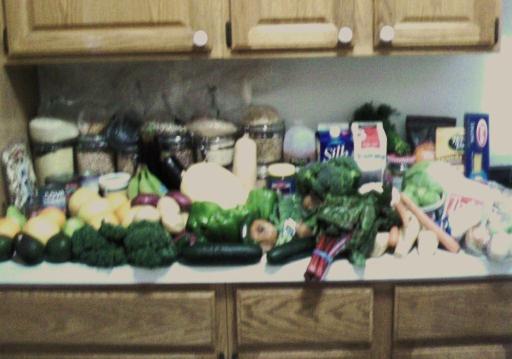
I finally got things together to do the One Week photo thingee that Dianna did a couple of months ago. It didn't quite turn out as well as I'd hoped, but this is what I've got:
Glak.
Alright, first: I had a problem with the whole one-week time frame. I just had groceries delivered yesterday and I tend to buy all my food for 2-3 weeks at once. At the same time, I didn't want to leave out any of the delicious fruits and vegetables and leafy greens I'd gotten. So I threw everything in there.
Even more pronounced is the grain/legume issue. I resupplied myself with bulk grains and legumes at a health food store a couple of weeks ago. Those will last me multiple months, but I couldn't very well scatter handfulls of chickpeas and bulgur and millet around, so I put the full cannisters/sacks in there. In addition to each individual item being overrepresented, the variety is also overrepresented. I eat all of the grains and beans pictured, but it's unlikely that, in any given week, I'll eat millet and quinoa and rice and bulgur and couscous and barley and chickpeas and lentils and adzuki beans and turtle beans and so on. So, yeah. Grains and beans are grossly overrepresented, moreso than produce.
Packaged goods, on the other hand, I did a more reasonable assessment of. I mean, peanut butter's great, but it's hard to get excited about showing off all of my jars of peanut butter. One serves the purpose just fine.
So with that caveat, I set about arranging the food for the photo. At first I relocated all the food from my kitchen to my living room, to show it off on the coffee table. But there was too much, so I cleaned off the kitchen counter and arranged things there. I carefully took all of the produce out of the plastic bags I store them in and artfully arranged it on the counter. It took about an hour, but by the time I was done everything was perfectly arrayed; it all fit on the counter, you could see everything, and the colors were carefully ballanced. I also arranged the food thematicaly, so pakaged goods were in one area, grains and beans in another. I had areas designated for fruit, root vegetables, cruciferous sprouts, and members of the nightshade family, with leafy greens placed near the front.
Then I got out my camera and it exploded. Not literally, but at this point I'm resigned that it will never work again. It turns on fine, you can review photos taken, but if you try to take a photo it instantly turns off. Changing the batteries didn't help, turning it on and off a bunch didn't help. Apparently something in the photo-taking mechanism has shorted out.
Thus: I had to take this picture with my flash-less, low-resolution cell phone camera. It's washed out and blurry and almost impossible to tell what anything is. And it doesn't have a timer, so I couldn't take a picture with myself in it. Blah.
So, this is (significantly more than) one week of food for me. Using receipts as a baseline and estimating the amount of depreciation, I'd guess that a one-week portion of that food cost me about $50.
On the plus side, the poor quality of the image makes it possible to play a diverting game of "what exactly is in that photo?" in the comments section.
Posted by Zach at 06:51 PM | Comments (0)
February 13, 2008
Vegan Recipe: Chocolate-Oatmeal Macaroons (Zero-Calorie Carob-flavored Rice Cake Snacks)
I've just made some delicious, saccharine-sweet chocolate-oatmeal macaroons. Or at least, I think I did. But clearly I can't have; I'm vegan, and therefore am anorexic. And no anorexic would eat a recipe that begins by calling on the cook to melt 1/2 cup of margarine and 1/2 cup soy milk with 2 cups of sugar. Obviously calorie deprivation has gotten to me; what's sitting in my fridge right now must clearly be some sort of zero-calorie rice cake snack. The brown color must come from carob, chocolate's evil twin brother.
In any case, here's the non-recipe for the high(low)-calorie desert I didn't just make:
Chocolate-Oatmeal Macaroons (Zero-Calorie Carob-flavored Rice Cake Snacks)
2 cups sugar
1/2 cup margarine (non-dairy)
1/2 cup soy milk
2 1/2 cups oatmeal
1 cup dried coconut
8 tablespoons cocoa powder
1 tablespoon vanilla extract
Start by mixing 2 cups of sugar with 1/2 cup of margarine and 1/2 cup of soy milk in a saucepan.
(a brief aside: I submit that it is impossible for a recipe that begins "Start by mixing 2 cups of sugar with 1/2 cup of margarine and 1/2 cup of soy milk," to turn out badly. Seriously, go to your kitchen and do it now. Then taste the sweet nectar that results. This is a solid foundation on which to build an empire!)
Heat the mixture to boiling, then remove from heat.
Meanwhilst, mix the oatmeal, the coconut, and the cocoa.
When the liquid mixture's off the heat, stir in the vanilla extract. Combine the wet and dry ingredients, stir, and let cool.
Assuming the mixture has cooled before you have eaten it all (not a particularly safe assumption to make), portion it off and put it in the refrigerator. You could put it on a pan like a cookie, I guess, but I found it easier and less messy to spoon it into a muffin pan in 12 roughly-equal portions. Cover it in plastic wrap or something similar to keep it from drying out in the fridge.
Voila! Delicious, high-fat, high-sugar vegan macaroons. Sadly, my calorie deprived mind is only capable of recalling the (clearly imaginary) delicious macaroon recipe, and I can't think of the actual recipe I must have used to make the rice cakes I no doubt made. You'll have to look elsewhere for a recipe for Zero-Calorie Carob-flavored Rice Cake Snacks.
Posted by Zach at 11:13 PM | Comments (1)
October 20, 2007
What's For Dinner Last Night?: Something Carribo-South Americanianish
I haven't posted pictures of what I've been cooking for myself lately, so I figured I would indulge my urge to share my creations. Last night I threw together a dish that I will call, for lack of a better term, Something Carribo-South Americanianish.
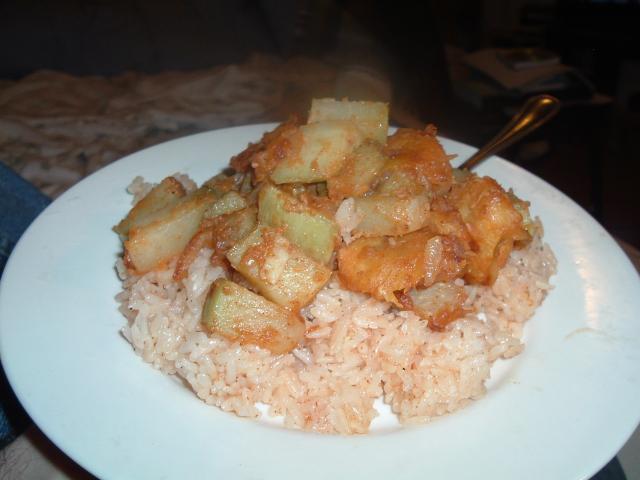
Ingredients:
2 cups rice
1 cup water
1 teaspoon salt
Several drops Louisiana hot sauce
1/2 teaspoon chili powder
2 tablespoons peanut oil
1 small yellow onion, sliced thinly
1 clove garlic, minced
2 chayotes, cut into cubes
2 ripe plantains, sliced
2 teaspoons brown sugar
1/2 teaspoon cinnamon
1 teaspoon chili powder
1/2 teaspoon cayenne
1/2 teaspoon ground white pepper
1 tablespoon Louisiana hot sauce
Coarse salt to taste
Please note that none of the above measurements are precise; they are merely post-hoc estimates of how much I used. Adjust any of the proportions to suit your taste.
This meal originated because I had some plantains. I haven't worked much with plantains and unfortunately most of the recipes I found online involved deep frying them. Deep frying is sort of an ordeal, so I found a recipe for sauteed plantains and used that as a guide to make my own recipe. I also had some chayotes in the fridge, which are a Central and South American vegetable that look sort of like a pear with a butt. They taste not unlike zucchini or summer squash when cooked, but are a bit tougher so you don't have to worry as much about overcooking and getting a soggy zucchini mess. I decided to make something vaguely Cuban and South American. Fusion, if you will.
I started by making rice. I'm lazy, so I just threw two cups of rice and a cup of water into the rice cooker, along with some salt, a dash of chili powder and a few drops of hot sauce. Then I sliced up an onion, heated some peanut oil over medium heat, and commenced sauteeing. After a couple of minutes I added the garlic, and a minute later the cubed chayote. I let that cook, stirring, for about five minutes before adding the plantains. After a further ten minutes sauteeing, around when the plantains started to get golden-brown, I sprinkled on some brown sugar, a little cinnamon, some chili powder, some cayenne, a dash of white pepper, and some coarse salt. Finally, I poured in about a tablespoon of hot sauce, which deglazed the pan nicely. I cooked a minute more, turned off the heat, and voila! Something Carribo-South Americanianish! Serve over the rice.
Note that this is an easily substitutable dish. You can easily use squash in place of chayote, regular salt in place of coarse salt, black pepper in place of white, whatever. I can also think of some interesting additions to the dish; it might taste good with some chopped spicy peppers, maybe a little habanero. Some allspice powder or raisins might also give it a nice Jamaican flavor.
Also, note that I don't want to pretend that this is in any way an authentic Cuban, South American, or any other cuisine's dish. It's just something I threw together from ingredients from those regions and flavored with spices I'm familiar with from the area.
Posted by Zach at 05:30 PM | Comments (0)
July 18, 2007
Dearest Omnivores
While I greatly appreciate your concern for my health and well-being, I do not actually have any pressing need for your nutritional advice. When, for example, we are dining at a steakhouse as part of a (mandatory) firm event, and I surreptitiously ask the waiter if it would be possible to get a meat-free, dairy-free meal, it is not my subtle way of asking you to give me a lecture on the importance of protein in a healthy diet and the inability of the human body to absorb iron not contained in red meat.
Since we are on the subject, while I appreciate your love of red meat, could we, perhaps, have a lunch outing that isn't at a steakhouse? And while prix fixe menus are the height of haute couture, could we perhaps get a prix fixe menu that includes at least a vegetarian option, to say nothing of a vegan option? This is not to complain, mind you. I love that this summer has given me the opportunity to go to New York's fanciest, trendiest, priciest dining hot spots and order the not-on-the-menu plate of grilled vegetables. I have now eaten half a dozen of the finest plates of grilled vegetables that New York City's steakhouses have to offer. But, I don't know, how about some Lebanese? Or Indian? Or, if you're feeling really daring, Ethiopian?
I know we can work out our differences. All I ask is a little understanding and to not have to eat at another fucking steakhouse next week.
Sincerely,
Z. Alexander Slorpe, Esquire.
Posted by Zach at 11:47 PM | Comments (2)
June 04, 2007
Leaves of Grass
I love my job, but I wish they would stop buying me food.
As you know, Bob, I am a vegan. That means no meat, no dairy, no eggs, no animal products at all. But that doesn't mean I'm picky! I have adopted a fairly lax set of rules for eating out, particularly when I'm eating with others. I don't eat obviously meaty/dairy-y food, but I don't grill the waiter for an ingredient list when I order. If something generally has stealth-dairy or meat (like onion rings or baked beans, respectively) I'll ask before ordering, but usually I'll just be casual about it. I've probably eaten more than a few restaurant meals with butter or cheese in them by accident since I became a vegan, but on the whole I think I do a good job. And if I order something and it comes with some surprise dairy item (for example, a plate of pasta that the chef decides to sprinkle with an unadvertised dollop of parmesan cheese) I take a can't-unshit-the-bed attitude and just eat it. I'll remember in the future to specify no cheese, but my sending it back won't decrease the restaurant's net cheese usage. My feelings would be different with unadvertised meat, but that's a different kettle of fish, if you'll pardon the expression.
So I'm about as accommodating when eating out as a vegan can be, and I generally don't make a big deal out of things. The problem with this accommodation, though, is that it makes it easy for the omnivores I work with to ignore my diet in selecting restaurants.
Thus: two weeks ago I had a choice of two restaurants for lunch: Just Chicken, the restaurant that serves chicken and nothing else, or Maria's Cuban restaurant. Now, Cubans are a fine people and I have nothing against them, but their cuisine, at least as instantiated in Americanized Cuban restaurants in New York City, is not particularly Vegan friendly. I had a choice of ten chicken dishes, five pork dishes, two goat dishes, and an ox dish. Among the appetizers there were three chicken dishes and two pork dishes. Sides were similarly meaty.
I eventually found the three plausibly non-meat dishes on the menu, rice and beans, fried plantains (green) and fried plantains (sweet). I'd say there's a greater-than-even chance the beans were cooked in some sort of animal fat and the plantains had whey in them, but I did what I could.
Last week some other interns and I worked late three nights in a row, and our attorney bought us dinner each night. Which, I hasten to add, was very nice of her. The trouble, for me, was that the first two nights we got food from a Vietnamese place with one non-meat dish, the third night from a dinner which had a few veganable items, provided you were willing to order a chef salad, hold the cheese, hold the eggs, hold the bacon, hold the chicken, hold the dressing. Which got you chopped lettuce and some cherry tomatoes.
What annoyed me most, though, was that my attorney started making snarkastic comments about how long it took me to find something to eat. Things to the effect of, "I realize this is the most important decision ever for you, but could you hurry it up?" I was tired and hungry at that point and barely kept myself from snapping "Well, it takes a while to search a two-hundred item menu for the one item that doesn't have meat in it."
Relatedly, for anyone who finds themself in this position in the future: Yes, I realize that your meat item tastes good, and yes, I am sure that I would not like a taste. While there are undoubtedly vegans out there who don't eat meat or dairy because they detest the way that meat and dairy tastes, similar to the way that I don't like onions, I am not one of those vegans. The fact that your chicken is very tasty is an utter non sequitur when levelled as an argument against the reasons I will not eat it. So, if in the future you feel a desire to ask whether I would like to try your chicken, even if just one bite, pretend that you have already asked the question and I have already replied "No, thank you."
I wish I had a vegan cupcake right now
Posted by Zach at 07:08 PM | Comments (0)
May 18, 2007
Nothing Satisfies Like Baby Cow Tummies
According to the BBC, the Masterfoods company, maker of the Snickers, Milky Way, Mars, and Twix candy bars, among others, has begun using rennet in their milk chocolate products. For those who don't know, rennet is an enzyme found in the mucus of mammal stomachs. It allows mammals to digest milk. One upshot of rennet is that, if you extract it from a mammal's stomach and add it to milk, it'll cause the milk to curdle. Rennet is a fairly common element in the cheese-making process, and is more generally used to create whey, which you often find in snack foods.
The trouble is the part where it comes from mammal stomachs. Whey-making rennet comes from cow tummies. Baby cow tummies. The operation to extract the rennet from the cow tummy does not leave the cow in any sort of shape to continue with the whole living thing. This makes rennet, and products that contain it, not generally suitable for vegetarians. You can curdle milk using non-animal rennet, but it's somewhat more expensive. I don't think it's too much more expensive, given the reasonable availability of non-rennet cheeses and whey products, but I am not an expert.
So: Now a wide variety of Masterfoods candy products are no longer suitable for vegetarians. This is annoying.
What irks me most about the article is the part where the Masterfoods spokesman defends the switch to animal rennet as a "principled decision." I would be interested to hear exactly which principle it was that motivated Masterfoods to turn products that did not require the killing of animals into products that did require it. While "wishing to maximize our profit margins," is, technically, a principle, to use it as Masterfoods does here does violence to what is commonly understood by the term "principled decision." If a company is going to make a decision based on hard fiscal calculations, I would rather they just come out and say it. "We conducted a study and determined that the cost savings from switching to animal rennet outweigh the expected loss in sales of candy bars to vegetarians, so we decided to make the switch," at least has the virtue of being forthright. Instead, they went with, "after many nights spent tossing and turning, we have finally slain our demons and stand before you now to say 'For too long our candy bars have contained a repugnant lack of baby cow tummies! This must not be!'"
Having now voiced my opposition to this move, I must now confront the fact that annoyed bleatings on the internet are the only way I can punish the company. Since I'm a vegan, the "milk" part of their milk chocolate products has kept me away from them already. I can't spend any less than I'm already not spending on their products. I could write an angry letter, though:
"Dear Sirs,
I find your decision to include animal rennet in your products morally repugnant. I already found your decision to include milk in your products morally repugnant, but this is altogether moreso. I will continue to not buy your products just as though you had not made this decision, but now my non-purchases shall be conducted with greater gusto, perhaps accompanied by a sad shaking of the head and a clucking of the tongue.
Yours sincerely,
Z. Alexander Slorpe, Esquire."
Posted by Zach at 11:10 PM | Comments (0)
May 13, 2007
De Gustibus
I have a question for anyone out there who might be a photographer:
How do I make pictures of food not look bad?
You may have noticed that I have this sort of ongoing thing with posting picture of dinners I have made of which I am particularly proud. Generally speaking, these dinners look quite tasty on my plate, which is what causes me to say, "Why, this is the sort of thing I should take a picture of and share with the internet!" And then I take a picture and it looks like this:
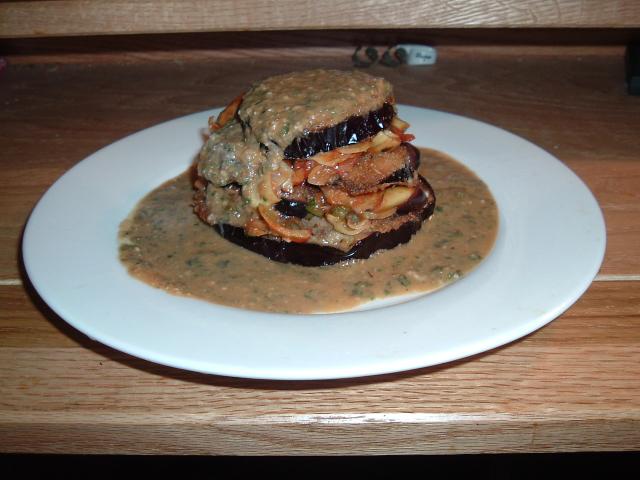
That was my dinner last night, eggplant and artichoke alla napoletana with sundried tomato pesto. Part of it seems like it's the flash's fault. The bright light makes otherwise-normal food look irridescent. The trouble is that I can't really get enough natural light in my room to take pictures without a flash, as can be seen here:
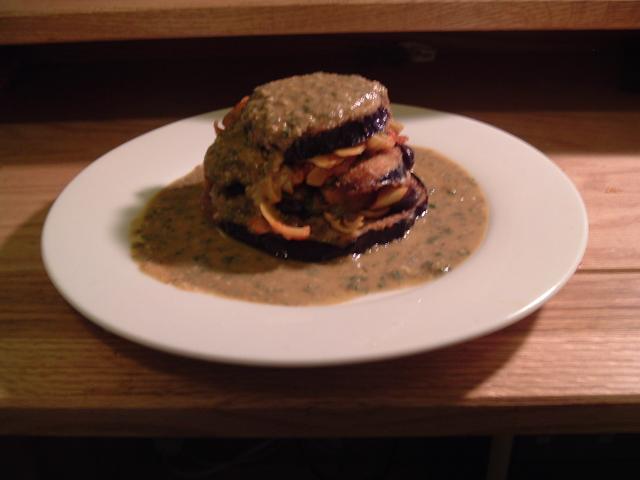
And that's with overhead lights, my desklamp, and a small spotlight trained on the food. Maybe it would help if I had white light instead of yellow. Also, confessedly, the food could be more artfully arranged than it is, and the sauce is an unfortunate mixture of green and red that, while tasty, is not quite photogenic.
Any suggestions on how to stage a food shot so that it doesn't look gross?
Posted by Zach at 11:05 PM | Comments (0)
May 05, 2007
Revolution Has Been Done!
Tonight's dinner: Revolutionay Spanish Omelet with Roasted Red Pepper-Almond Sauce!

And for desert: Banana Muffins, recipe courtesy of Dianna
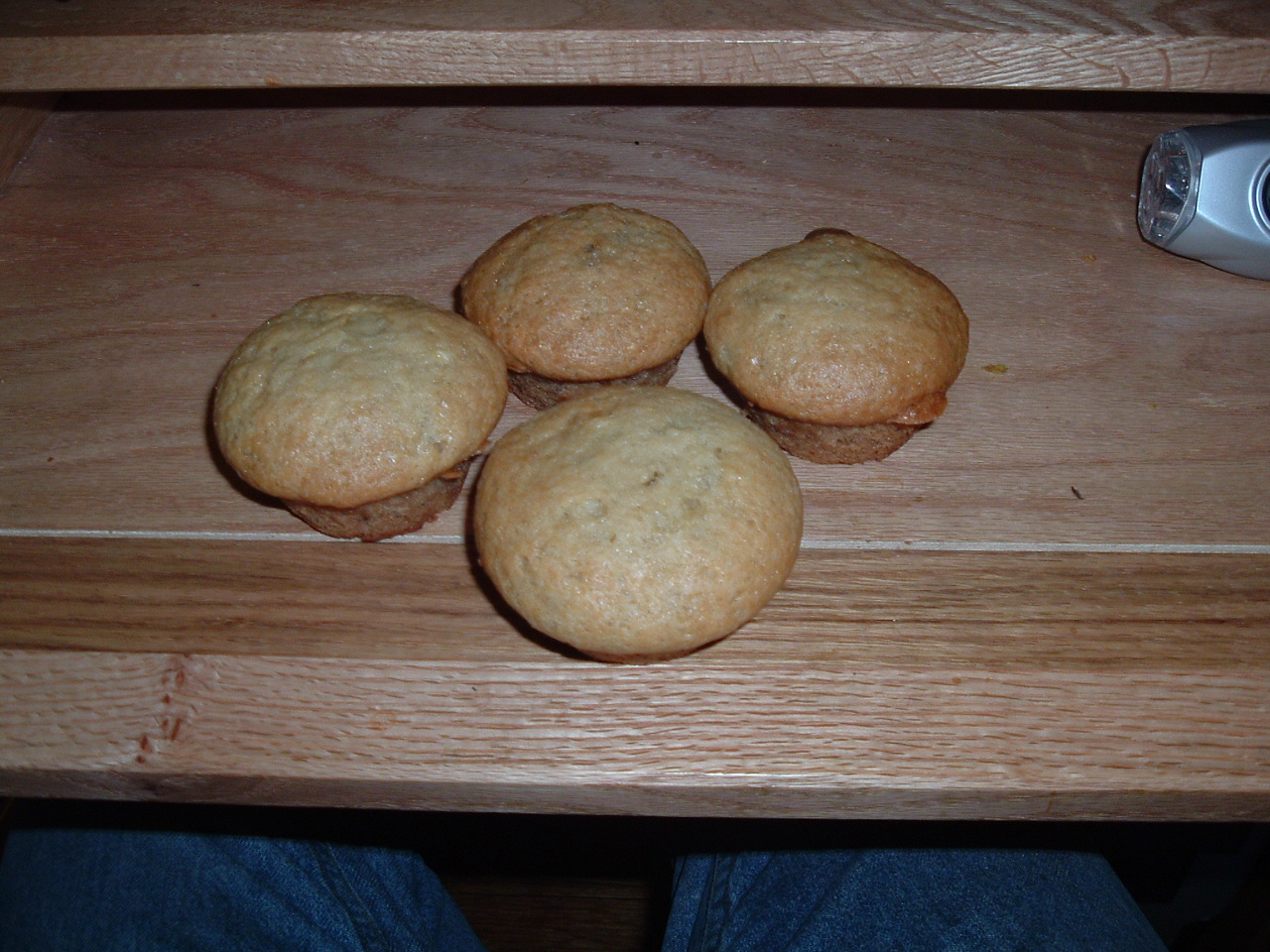
Posted by Zach at 10:54 PM | Comments (0)
April 22, 2007
Vegan Restaurant Review: Burritoville at 72nd St.
I complain often and loudly that New York has no decent Mexican food. That doesn't prevent me from eating New York Mexican food, though, because my need for salsas and fried beans must be met somehow. Thus: Burritoville, a New York City Mexican chain.
Burritoville is an omnivorous restaurant, but only barely. In a refreshing inversion of the norm, vegetarian fare seems to be the standard there, with vegans amply accomodated and meat on the menu as an afterthought. About three-quarters of the menu is vegetarian (complete with a crossed-carrot symbol to indicate the absence of meat), plus the counter is littered with posters advertising daily specials, none of which contain meat.
Moreover, they put a lot of thought into their vegetarian menu items. A lot of times the vegetarian options at an omnivorous restaurant are meat items with the meat left out (my favorite example of this being the Veggie Whopper at Burger King, which is a regular Whopper with no meat, and nothing to replace it. So, a lettuce and ketchup sandwich). Burritoville's vegetarian selections use a variety of meat substitutes that ensure the end product is both flavorful and substantial. You'll find options that use marinated tofu, chorizo-flavored TVP, seasoned tempeh and seitan.
Burritoville also cares about vegans. Dairy-free menu items are highlighted, and every item that includes dairy on the menu can be made dairy free; they'll substitute soy cheese and soy sour cream for their dairy analogues.
Since this is New York, and since vegans are used to paying high prices for restaurant food that accomodates them, you'll pay through the nose for Burritoville's fare. A burrito and a soda comes out to about $10.
I can't speak for Burritoville's other locations, but the 72nd street location is a little small for the customer traffic they get. The interior design is also a bit much for the size; I found myself bumping my head on some of the wall decorations as I maneuvered my food to the table. Service was notably slow, with a single burrito when I was the only customer waiting taking about ten minutes to make.
I was disappointed in their chips and salsa. They've got an awkward set-up by the counter with a basket of chips, some jars of salsa, some paper plates, and some cups. The cups, they insist, are not for salsa. This leaves the customer to pile chips on a plate then put salsa in pools next to them. The trouble with this, as I discovered, is that the plates they use are not quite hearty enough to withstand their highly liquid salsa. Some of the salsa had leaked through the plate and pooled on the table before I finished with my chips. The actual chips were decent enough, they had a good corn flavor and were crunchy without being hard. The salsa was adequate; a mild tomato salsa and a spicy tomatillo, both of which did the job but neither of which were particularly noteworthy.
The burrito, on the other hand, was excellent in the way that only greasy mexican food can be. You don't realize how much cheese and sour cream enhance a burrito until you have a burrito smothered in them after a long period of abstinence. Sure, it was soy sour cream and soy cheese, but a burrito isn't exactly the place for subtle distinctions in flavor and texture. My burrito was awesome, and its veganity made it all the more so.
Burritoville is now my favorite mexican place in New York City. The atmosphere sucks, the service is bad, and the prices are high, but they offer a variety of vegan burritos that I can't even get in Southern California and a quality that makes it well worth the trip. Highly recommended.
Posted by Zach at 12:07 AM | Comments (0)
February 06, 2007
Dualism
A short list of things that sound like a better idea in theory than they are in practice:
Bagel sandwiches
Airline food
Angry/Spiteful e-mails/blog posts/comments
Classes taught by famous professors
Most movies by Sam Raimi
Most video games by Troika Games
Most books that you read because it's a book that you should read rather than a book that you want to read
Any other suggestions for the list?
Posted by Zach at 08:31 AM | Comments (1)
January 23, 2007
Capsaicin OD
Note to self: When a recipe for corn chowder calls for two seeded jalapenos, do not throw in six unseeded jalapenos because you are a self-proclaimed "HARD CORE SPICE ADDICT!" It's too spicy, even for you.
I just ate a bowl and a half of my corn chowder, which is probably 50% pureed jalapeno by volume. It is very tasty, but now my face is all tingly and I can no longer feel my nose or lips.
Posted by Zach at 06:06 PM | Comments (0)
January 12, 2007
When All You Have is a Hammer, Everything Looks Like a Nail
And when all you have is a deep fryer, everything looks like it needs to be deep-fried.
I got a deep fryer for Christmas and have been excited by the prospect of using it to deep fry some things. Unfortunately, I did an uncommonly good job of clearing out my food stores before I left on vacation, so my stock of easily-fryable items is perilously low. Nonetheless, I remain undeterred; I have a well-documented history of bringing bad cooking ideas to life, and this deep fryer promises to open an entire exciting new vector for terrible, terrible food-making decisions.
Right now I have potatoes and onions lying around, but those wells have already been pretty thoroughly tapped in terms of frying. I have some serrano chili peppers, and I know frying jalapenos is pretty common (or was a few years ago; I haven't heard of fried jalapenos as much lately) but those are generally combined with some sort of cream cheese filling. I have beans, but I'm not sure that frying beans actually involves a deep-fryer. I've tortilla chips, but those are already fried. I've got a few suspect cucumbers in the refrigerator, though one of them felt a bit too squishy for comfort and I'm worried the others may turn on me, as well. Plus cucumbers are a bit liquid for frying. What else have I got? Some sticks of Earth Balance non-dairy buttery substance, half a jar of dijon mustard, a carton of apple cider... Right now the best bet seems like the jar of mustard, but that seems like it would be more like a proof of concept or a performance art piece than an act of cooking ("Why did you deep-fry a jar of mustard?" "Because I had a deep fryer and a jar of mustard. Duh.")
Now I'm getting more desperate. I could deep-fry my flip-flops. Or my pants. Or a lightbulb! It would bathe any room in delicious, artery-clogging goodness!
At this point, I think I'll just have to go out and buy something that can be fried. Suggestions?
Posted by Zach at 02:18 PM | Comments (0)
January 09, 2007
Stop Being Helpful!
Today I was in the drug store and picked up a sack of Pringles Select potato chips. These are fancy new chips that Pringles is marketing. I read the ingredients for two varieties, first Sundried Tomato and then Teriyaki Barbeque. Both of them had ingredient lists that looked fine until the very end, "Natural Flavors (includes milk products)".
Most products, particularly highly processed snack foods, contain the catch-all "natural flavors." Pringles, however, has decided to start helpfully informing the reader when "natural flavors" includes milk products. In theory, this is very nice and convenient for me. In theory, whenever I see "natural flavors" on an ingredients list I should call up the company's customer service line and ask whether that includes whey, casseine, or any other milk or animal products. In practice, though, I tend to fudge on this. If it says natural flavors I generally just go ahead and eat it, since I can plausibly deny the presence of animal products. So in practice this means that I would have just eaten the Pringles chips if they hadn't told me that their natural flavors included milk products and I would have been very happy. Now, though, knowing that they do contain milk products, I can't eat them.
It is nice, though, that Pringles has started being mindful of those whose dietary restrictions preclude consumption of dairy products. At the same time, it would have been nicer if, rather than helpfully informing everyone that their chips contain less than 1% Natural Flavors, of which a small portion are milk products, they would have just stopped putting the sprinkling of whey/skim milk powder/whatever the hell in.
I haven't looked at the ingredients for standard Barbeque Pringles yet, but I'm a little scared that they may have started pointing out the milk products in them, as well. In the mean time, I settled for a bag of barbeque Lays, which may or may not contain milk, but which at least don't say that they do on the package.
Posted by Zach at 07:10 PM | Comments (2)
December 14, 2006
I Like Vegetables
Hey! According to the BBC, a study has shown that high IQ correlates with vegetarianism. The study gave IQ tests to a group of over 8000 children in the 70s, then went back and took their demographic information when they hit 30. The average IQ of the children who grew up to be vegetarians was 5 points higher than the average IQ of the non-vegetarians.
Some caveats: First, the demographic data gathered in the second stage counted everyone as a vegetarian who claimed to be one, rather than defining a criterion for vegetarianism and determining who was one based on that. This makes sense, because there are a great many flavors of vegetarianism, so to speak. This means that people who eat meat or fish, but who self-identify as vegetarians, are counted as vegetarian. In any case, it doesn't seem to have made much difference in the results.
Also, it's hard to tell how much of a correlation vegetarianism specifically had. Apparently, a good amount of the IQ differential could be accounted for by class and educational differences. When class and educational difference are controlled for, however, there is still apparently a positive correlation between vegetarianism and higher IQ. They don't give the post-control values for that, though.
I like the quote at the end from Dr. Frankie Phillips of the British Dietetic Association: "It is like the chicken and the egg. Do people become vegetarian because they have a very high IQ or is it just that they tend to be more aware of health issues?"
First, it's an interesting choice of simile, given the topic. Second, I'm not sure if he's using Chicken-and-Egg right, here. Chicken-and-Egg tends to be "Does A cause B, or does B cause A?" Here, he's asking whether High IQ causes Vegetarianism or whether High IQ causes Health Consciousness, which causes Vegetarianism. So his question is more "Does A cause B directly, or does A cause C, which in turn causes B?" The proper Chicken-and-Egg formulation of the High IQ-Vegetarianism correlation would be "Does having a High IQ cause you to become Vegetarian, or does becoming a Vegetarian cause you to have a High IQ?"
Posted by Zach at 08:20 PM | Comments (0)
October 17, 2006
Letter to the Editor
To the editors of the Wall Street Journal:
I am a long-time subscriber to your fine periodical. Each morning as I rush out the door to the class that I am five minutes late to, I am greeted by your illustrious newspaper on my doorstep. The sight fills me with a profound sense of shame, shame at my utter failure to adhere to my plan of waking up an hour earlier each morning to skim your paper's headlines. This, however, is entirely a failure on my part, and in no way reflects upon the quality of your journalism. On the infrequent occasions when I have the chance to glance through the Journal, typically on weekends, I am quite pleased by the content. Moreover, I have found other, highly valuable uses to which to put the paper.
It is often remarked, on the subject of the timeliness of newspapers, that today they provide news, tomorrow they provide fishwrap. Given my current dietary restrictions, this adage is not literally true in my case. I have, however, discovered that the Wall Street Journal is excellent for pressing tofu. As you are no doubt aware, tofu must be well-pressed in order to maximize its flavor when marinaded. The curd of the soy bean has very high natural absorption, but in order to make room for whatever flavorful marinades one wishes to fill the tofu with one must first expunge as much water as possible. This is usually accomplished by placing some sort of towel or cloth beneath the tofu, another cloth above it, and some heavy object on top of that. The tofu is then left to slowly expunge its fluids over the course of about an hour. The trouble with this method is that it leaves one with towels that are soaked in tofu juice. The towels must be washed quickly or the tofu juice will dry, imbuing the towels with a rather unfortunate odor. Omitting the towels just leaves one's counters covered in tofu juice.
It is here where the Wall Street Journal has proven my savant. I take the first two sections, fold them in quarters and place them under the tofu, and after dealing with the second two sections in a similar manner place them above the tofu and below the heavy object. An hour later I am the proud owner of a bone-dry square of tofu, a clean counter, and a soggy Wall Street Journal, which is soon placed in the recycle bin in the hall. My tofu pressing problems are solved.
For the most part. It has come to my attention that tofu possesses certain properties not unlike Silly Putty. I learned this one afternoon when I was chopping up tofu to grill and found myself confronted with a story on the current Hewlett Packard spying scandal, pressed across the broad side of my bean curd. This, you can imagine, has caused me some concern.
I am writing to request that you modify your printers to use a non-toxic ink, the better to assure that I am not poisoning myself when I press my tofu with your paper. Failing that, I would request that you switch to an ink possessed of a more pleasing taste; the one that you currently use has been conferring a slightly bitter, tinny flavor to my tofu. I am, as mentioned, a great fan of your periodical, and would hate to be forced to switch papers over a problem so easily resolved as this one. If, however, you fail to rectify your current ink problems, I may have no choice but to cancel my subscription and start purchasing the New York Times.
Yours, etc.,
Phineas T. Bumbershoot, Esq.
Posted by Zach at 09:15 PM | Comments (0)
September 16, 2006
What's Cookin'?
Scrambled Tofu with Vegan Chorizo! Recipes from Vegan with a Vengeance


Posted by Zach at 02:07 PM | Comments (2) | TrackBack
September 12, 2006
Cel-Ray Books
I was at the supermarket this evening in search of various things to make bean-and-tempeh sausage patties. Well, several supermarkets to be more accurate. One of the curious commercial adaptations to New York's pedestrian culture is that you get very few giant supermarkets like you get in the suburbs (and most other cities). It's simply not practical to travel several miles to a giant supermarket and haul home a dozen bags of groceries without a car. So instead, New York has lots of small supermarkets. I live between two, each no more than five minutes away. It makes it convenient to do quick hit-and-run grocery trips to do shopping, rather than buying a massive store of food, whittling that down, then stocking up again in one massive trip.
The downside is that, since the stores are a lot smaller, the selection tends to be limited. It's not unusual to find yourself wandering from store to store in search of someone that sells an uncommon food item. And if you've got even a moderate-sized list, there's a good chance you'll find yourself jackassing a load of groceries along with you as you gradually pick up the items you need.
Thus I found myself out in search of non-dairy bread crumbs, tempeh, white beans, and tamari. D'Agostino's proved a disappointment, as D'Agostino's tends to. Soy sauce, but no tamari. Tofu, but no tempeh. And the tofu they had was outrageously priced; $3.50 for a package of a notably low-quality brand. To give you a sense of the inflation there, a somewhat better quality tofu can be bought at a health food store a couple of blocks away for $1.79 per package. And while they had six kinds of bread crumbs, they all had whey in them. D'Agostino's is notably vegan-unfriendly; for any given product, if you can imagine some way to put dairy into it, D'Agostino's will stock only the brand that does so. They did, however, have dry white beans.
Morton Williams, on the other hand, has a better selection and is friendlier to vegans. Still no tempeh, but they had non-dairy bread crumbs and three brands of tamari. And they had something more, something I'd never seen before.

Doc Brown's Cel-Ray Celery-Flavored Soda. From the moment I saw the cans I resigned myself that I would be buying a six-pack. The same impulse that causes me to make things like hot-and-spicy oatmeal compels me to buy food products that cannot possibly be good (like Grapples, half apple, half grape!).
I should point out tha I'm not even really a big celery fan. It's alright, I don't dislike it, but it's always an ingredient that I have to go out and buy separately when a recipe calls for it because I don't make a practice of keeping it around. Still, celery flavored soda was too intriguing to pass up.
And the verdict?

Meh. I've had worse. It's a bland, ginger ale-like experience, only instead of tasting vaguely like ginger it tastes vaguely like celery seeds. This strikes me as one of those products that probably has a very small niche market, possibly an entirely New York-based market, and persists only through the loyalty of people who grew up on it.
Posted by Zach at 10:28 PM | Comments (8) | TrackBack
September 11, 2006
Sun-Dried Potatoes
Tonight for dinner I had an astoundingly delicious eggless fritata, with onions, asparagus, serrano peppers, and sun-dried tomatoes. I'd have taken a picture of it, but somebody ate it before I could get out the camera. Ahem.
That's all I've got.
Posted by Zach at 09:47 PM | Comments (2) | TrackBack
September 03, 2006
The Simple Joys of Summer
Quite possibly the tastiest sandwich it is possible to make is the simple tomato and butter sandwich, provided the tomato is fresh and flavorful, as one gets during peak season in summer. Simply toast two slices of bread, spread butter on one slice (Earth Balance works superbly as a substitute), sprinkle said slice with pepper, put a few drops of hot sauce on the other slice, put on a slab of tomato (I prefer an heirloom tomato like brandywine), sprinkle the tomato with a small amount of salt (be very light about it; when you're done, you shouldn't be able to see any salt, as it should all be absorbed by the tomato's juice) and merge the two bread slices into a sandwich-like configuration. Enjoy!
Posted by Zach at 01:01 AM | Comments (4) | TrackBack
August 13, 2006
Plenty of Roughage
I have links to the latest entries in a recipe blog set as one of the items on my Google homepage. One of the current headline recipes is for Chicken Cacciatore. This first caught my eye as I was quickly passing through to another page, and I thought it said Chicken Carcassonne. This made me think of a roasted chicken with cardboard tiles artfully arrayed around it, perhaps with a stuffing of colorful little wooden meeples. I wonder if you can make a Vegan Chicken Carcassonne (Seitan Carcassonne?).
That is all.
Posted by Zach at 03:43 PM | Comments (0) | TrackBack
August 11, 2006
Peanut Butter Balls
This recipe comes to me from my grandmother, who used to make these all the time as a treat for the grandkids when we'd go over to her house. I've modified it very slightly to make it vegan, but otherwise it's the same recipe she used.
First, you mix together two cups of peanut butter (smooth), 1/4 pound (1/2 cup or 2 sticks) of Earth Balance (or butter), and one pound (one box) of powdered sugar. Probably the hardest part of the whole thing is wrangling two cups of peanut butter out of the jar and into a bowl, as peanut butter does not like to be measured. I suppose this is one of those things where the easiest way to do it is to throw it into a measuring cup filled with water and measure the displacement, but then you get soggy peanut butter.
Anyhow, mix the three ingredients together by hand. In the end, you should have a nice, not-very-stick batter, like so:

Now line a baking sheet with wax paper. Roll the batter into little balls, perhaps an inch in diameter, and lay out on the baking sheet, like so:

You'll note that some of the balls I have are quite smooth, while others are more rough. This is because I got lazy. Small amounts of the batter will stick to your hand as you are making it. As you get more detritus on them, it becomes harder to make a smooth ball. This means you have to periodically wash your hands to keep everything smooth. I did not, so my balls are pointy.
Stick a toothpick in each ball, then place everything in the freezer, like so:

Let them freeze a couple of hours. When they're getting about done-ish, melt yourself some chocolate chips. Use a double boiler, or make your own. Just take two pots, one slightly larger than the other. Put an inch or two of water in the larger pot, then put the smaller pot inside of it. Voila! Double boiler. Put the chips in (use whatever type of chocolate you like, though I used Guittard semi-sweet chocolate)
and heat at medium heat. The double boiler configuration gives you a bit more leeway in terms of heat; generally you wouldn't want to heat chocolate any higher than low or you'd risk burning it. It should all look something like this:

Now comes the second-hardest part. You need to do this part relatively fast. Don't rush it or anything, but be aware that you can't goldbrick while doing this. Your goal is to get the balls out of the freezer, dip them in chocolate, then freeze them again. The problem is that you'll be holding the balls by the toothpicks, the balls will slide off if they get too warm, and you'll be dipping them in warm chocolate. If you move too slowly, the later balls will have thawed enough that they'll fall off into the chocolate when you dip them. So, with all deliberate speed, take each ball by turn, dip it in the chocololate, swirl it so that it's between half and two-thirds coated, then put it back on the wax paper. You can either take the toothpicks out now or wait until later. They'll slide out more easily now, but your chances of destroying a ball in the course of removing the toothpick are somewhat elevated.
Now your balls should look like this:

Freeze them again, clean up the mess, take them out, remove any toothpicks that you may have left, and there you go! Peanut Butter Balls!

Note that the decrease in the number of balls is due to my getting hungry and eating some, and also packing up a few (store in plastic bags in the refrigerator) before remembering to take a picture.
Posted by Zach at 11:36 PM | Comments (0) | TrackBack
July 31, 2006
Theoretically Secret Recipes
Relatives! And, in particular, relatives who lived in Pittsburgh! I'm sure you recall Grandma's peanut butter balls. I was thinking of posting the recipe on this blog. But the thought occurred to me that this might have been a family secret sort of recipe. If grandma had intended for the recipe to stay within the family, obviously I won't post it. Any ideas?
Posted by Zach at 03:14 PM | Comments (6) | TrackBack
June 08, 2006
Tonight's Menu
Grilled Vegetable Kabobs, courtesy of Fresh Direct:

Also: About a cup out applesauce, eaten with a spoon straight out of the jar, and a handful of raisins. Putting away food is hungry work!
In other grocery news: I think I must have been seriously in need of sweet last night; today's shipment included raisins, peaches, strawberries, bananas, applesauce, a quart of Chocolate Soy Shake, Six Jell-O Instant Pudding packages (three chocolate, three vanilla), a pint of coconut sorbet, and two quarts of Chocolate Peanut Butter Soy Ice Cream.
Posted by Zach at 11:03 PM | Comments (2) | TrackBack
May 14, 2006
Mr. Robert A. Ganush
I survived my last law school final of the first year, and have been celebrating not having anything to do by not doing anything. Sort of. For the last week thoughts of the eggplants in my refrigerator have loomed at the back of my brain, pushed aside to focus on the Rule Against Perpetuities, Easements, and Testatrixes. But thoughts of the eggplants have never left my mind. I knew they were in there, plotting against me in the crisper, preparing to rot and turn my entire vegetable bin against me. So today I struck at them preemptively by turning them into a tasty baba ghanush, to be served with homemade pita bread. Observe!

Posted by Zach at 06:37 PM | Comments (2) | TrackBack
April 28, 2006
Tonight's Menu...
Vegan Thai Coconut Soup

For the recipe, I direct you to Dianna's blog.
Posted by Zach at 01:43 AM | Comments (0) | TrackBack
April 16, 2006
Hot Crackers!
This is a cheap and simple recipe that will give you tasty, salty, slightly spicy crackers.
1 Cup Flour
2 tablespoons Earth Balance or Butter
1/2 teaspoon Salt
1/4 cup Water plus more as needed
Cayenne
Garlic Powder
Crushed Red Pepper Flakes
Preheat oven to 400 degrees.
In a food processor, combine the flour, Earth Balance, salt, and spices to taste (I put in a couple shakes of garlic powder, about five dashes Cayenne, and three dashes of pepper flakes). Pulse until well mixed (it'll still look like flour, but a bit more clumpy and darker in color). Add in about 1/4 cup of water and process. It'll probably be pretty loose still, so add water, about a teaspoon at a time, and pulse. Stop once it's cohesive but not sticky. If you haven't a food processor, just do the same thing in a bowl with a spoon. It won't be as easy, but it's not notably hard, either.
On a lightly floured surface, roll out your ball and flatten it with a rolling pin until it's quite thin, about the thickness of a pie crust. Transfer to a baking sheet, then lightly score with a knife so that you can break apart the crackers easily when done. Place in the oven for 10-12 minute until it's a light brown; don't remove too early or you'll get soft crackers. If you remove them too late, though, you'll have melba toast, which may or may not be a good thing. In any case, take them out and let them cool.

These fresh young fellows were made with Earth Balance and a 50/50 mix of white and wheat flour. I scored them before putting them on the baking sheet, which made the flattened dough impossible to transfer in one piece. So I broke them up before baking, which led to some getting carbonized while others were baked nicely. Nonetheless, all are quite tasty.
Posted by Zach at 07:21 PM | Comments (0) | TrackBack
April 10, 2006
It's Not a Matter of Getting It or Not Getting It; the Question Is, "Is It Worth Bothering to Get?"
I am known, to some, as a baker of bread. For many months have I abstained from the joys of the oven in favor of more academic pursuits, but this evening I have succumbed once again to the black arts of Bagelry. And I took pictures!
The majority of this post will be aimed at the novice bageler. You will pardon me for being a bit elementary. Let me begin by addressing perhaps the most important question: Why bother baking your own bagels? Can't bagels be gotten with ease at your local bagelry for highly reasonable rates? I have several answers to this. First, the very act of baking bagels is fun, just as baking bread generally is fun. But I'm a baking fan, so your mileage may vary. Second, baking your own bagels (with certain caveats)is actually cheaper than buying them from a bagel shop. Bagel shops tend to charge 65-75 cents per bagel. With judicious ingredient shopping, however, homemade bagels cost less than 15 cents each. What's more, homemade bagels are tastier than store-bought ones, because stores almost all make a peculiar brand of puffy and bland bagels, whereas homemade bagels (using my recipe, at least) are dense and flavorful. Finally, homemade bagels are vegan, whereas store-bought ones might not be (it depends where you buy them; some stores use a spritz of water to give their bagels a sheen, while others use an egg-white glaze to get them shiny).
Now that you've decided to bake your bagels, let's start with a few ground rules about ingredients. First, the flour. I prefer white flour, though I've heard some get good results with a 50/50 white/wheat mix. Bear in mind, though, that wheat flour will make the kneading more labor-intensive. In either case, the white flour you use should be eithr all-purpose or bread flour, and shouldn't be bleached. Unbleached flour will come out nicely white, and bleached flour sacrifices flavor for aesthetics.

Next, consider the yeast. I tend to use dry yeast, and there you have a choice between instant and active dry. There's an important distinction: Instant yeast can be thrown in with the flour and other dry ingredients, and that's the last you have to think about it, while active dry yeast should be proofed first. To proof yeast, measure out the yeast you'll need for the recipe and stir it into a quarter cup of luke-warm water (should be in the 80s fahrenheit on an instant-read thermometer), then wait about 10 minutes. The air should permeate with a bready/beery smell, and the mixture should foam up, like so:

Active Dry yeast, once proofed, should be added in with the wet ingredients. Instant Yeast, as mentioned, should be mixed in with the dry ingredients.
Another important point about yeast: If you don't do your shopping right, the yeast will be the most expensive ingredient in the baking process. This is because many grocery stores only stock packaged yeast, which is one of the biggest rip-offs in modern groceries. Do not buy yeast in packets; the price is marked up to about ten times what it is if you buy in bulk. Either get your yeast in bulk from a health food store or get a big vacuum-sealed sack from CostCo. The following visual aid should prove illustrative:

Bad!

Good!
For this recipe, you'll need
3 1/2 cups of flour (plus some extra for flouring your various work surfaces),
2 teaspoons salt,
1 teaspoon yeast,
2 tablespoons sugar,
1 1/4 cups water,
Oil to grease the baking pan (canola or vegetable oil is best).
Now, there are two essential ways to do this. One is through the use of various machines. The other is by hand. If you've a large enough food processor (should hold 5 cups) I really, really recommend using that. It's easier, it's cleaner, and it makes a better dough. The trick is that dough is a mixture of flour and water. The more flour you use, the more solid and dry it'll be. The more water you use, the more liquid and sticky it'll wind up. Putting more flour in makes it easier to handle, so the temptation when kneading by hand is to use too much flour. The food processor chops at such a speed that it doesn't make a difference; you can use exactly the right amount and wind up with dough of the perfect consistency.
If using a food processor, this is very easy. Add the flour, salt, sugar, and yeast (if using instant yeast) to the bowl. Pulse with the steel blade a couple of times to get everything mixed together. Then, with the processor running, drizzle in the wet ingredients (1 1/4 cups water if using instant yeast, 1 cup of water + the proofed yeast mixture if using active dry) and allow to run until you get a big solid ball, about 30 seconds. The dough should be cohesive and very slightly sticky. Add a touch of flour if it's too wet, add a teaspoon of water if it's too dry, and process until it comes out right. Remove and knead on a floured surface until it's a big rubbery ball.
If working by hand, it's a bit more complicated. Throw the salt, the sugar, the yeast (if instant) and 1 3/4 cups of flour into a mixing bowl. To that, add the wet ingredients and stir with a spoon. Once combined, mix in flour gradually, about 1/2 a cup at a time, not adding more until the last batch has been completely assimilated into the dough. Stop at 3 1/2 cups. The trick with hand-mixing is that eventually it'll become too sticky to handle with a spoon; it'll be one huge sticky mass. Unfortunately, the point at which the dough becomes un-stirrable happens before the point when it becomes kneadable by hand. The trick is to soldier through and stir the damn stuff until it's absolutely impossible to stir any longer; only then should you dump it out and start kneading. Make sure your hands are well-covered in flour before you knead, or you'll end up with fingers coated in gobs of sticky, liquid dough. This is why I recommend getting a food processor. In any case, add flour and knead until it's a rubbery, non-sticky ball.
Whether kneading by hand or mixing in a food processor, the end result should look something like this:

Smooth it out, then put it in a bowl and cover it loosely with a towel to rise.

You've actually got a couple of options here. You can heat an oven to about 100 degrees and throw the bowl in there; this'll help it rise faster, in an hour or less. You can leave it where it is, in which case it'll be done in about two hours. Or you can put it in the refrigerator and let it rise, slowly, in there for about twelve hours. The longer you let it rise, the more chance the yeast will have to develope and the richer the flavor of the end bagels will be. You might consider making the dough the afternoon before, putting it in the fridge, then waking up early to bake your bagels the next morning. In any case, by the end of the first rise your dough should have roughly doubled in bulk, like so:

Take it out and punch it down, then form it back into a ball. Leave it to rest for another ten minutes, covered, on a floured surface.

Now it's time to turn your big lump of dough into smaller, bagel-shaped lumps of dough. Cut it into eight or twelve pieces (I prefer eight, just because it's easier to get them even, though you'll note I failed at that this time around). Role the mini-doughs into balls.

Now take each ball and punch a hole in the middle with your thumb, then work the dough into a roughly even bagel-like shape.

Sprinkle some flour on the doughs, then cover and let them rise for half an hour.

While they're rising, set a pot of water to boiling and pre-heat the oven to 400 degrees. Set out a wire rack on which to (eventually) dry and cool the bagels. I tend to use an oven rack set on top of the sink. Once the bagels are risen and the water is boiling, drop in your bagels four at a time. Keep the heat high enough to maintain a rolling boil. Let the bagels boil a minute on one side, flip them over, boil them a minute on the other side, then remove to the wire rack to drip dry. Repeat until all your bagels have been boiled.

Hopefully by now your oven is up to temperature. Grease a baking sheet with canola oil and place your bagels on the sheet. If you've a spray bottle, like so:

Spritz a little water into the oven at this point to get a steam. Slide in the bagels. In five minutes, spray again. This'll give the bagels a nice sheen, but it's not essential. In any case, the bagels should bake for a total of 20-25 minutes (that's 20-25 from the time you put them in, not from the second spray). Take them out when they're nicely browned. Spray a bit more water on for extra-shiny bagels, then put them back on the wire rack to cool.

Serve when cool enough to eat but still nicely warm. I recommend against toasting, but to each her own. Serve with butter and cream cheese, or Earth Balance and Tofutti if you are so inclined.

If you want non-plain bagels, either fill a plate with the ingredient and mash the bagels in it after boiling, before baking, or mix your ingredient of choice in with the dry ingredients before mixing/kneading. But for the love of Pete, bagels are a savory food; don't put raisins, fruit, chocolate, or other such nonsense into them. In any case, eat and be healthy!
Posted by Zach at 11:15 PM | Comments (6) | TrackBack
April 09, 2006
Kennedy Stewed Chicken
When I first moved into this apartment, there was an old lady who lived on the first floor and was moving out. I helped her move by packing the things she wanted and taking the stuff she didn't to the basement. She let me take my pick of whatever she was throwing out, and that's how I got a huge amount of the furniture in my current apartment. It's also how I got a lot of things that I have no idea what I'm going to do with. She was a kindly grandmotherly sort, and could be quite insistent when she gave me things. Hence the various herbal bath supplements in my closet, the big box of transparencies in my drawer, and the huge bottle of fish oil tablets in my refrigerator.
She also gave me about five pounds of frozen chicken parts. I'm not really in the habit of buying meat; I haven't bought any since I moved to New York. But here I was with a huge pile of it filling my freezer. I had hoped my roommate might use it, and I offered it to him on several occasions. No dice. The roommate, apparently, doesn't cook. Ever. I don't think he's even turned used our microwave or our toaster, let alone turned on the stove. I'm kind of curious how he can eat out every meal on a student loan budget, but I suppose we all prioritize our purchases differently. In any case, nine months after moving in, the chicken was still there, adversely possessing my freezer. If I didn't do something soon, the chicken would gain legal title to the contents of my freezer, including, but not limited to, a smattering of frozen bean burritos, a sack of brussels sprouts, and a loaf of Godless Communist brown rice bread. Moreover, I have a very strong moral compulsion against waisting food. Throwing out rotten mushrooms brings a tear to my eye; surely they're not THAT bad! It's already a fungus, so a little extra mold on it isn't the end of the world, right?
In any case, in re: the chicken, something had to be done.
I was watching The Two Towers Friday night. Half-way through is a scene in which Gollum brings Sam and Frodo a pair of dead rabbits, and Sam cooks it into a stew whilst complaining of the lack of potatoes. "Mmmm," thought I, "Potatoes." "Wait!" I added "I've got potatoes! And carrots! And celery and onions and other stewable vegetables! Plus there's that chicken in the freezer!" and so that idea was hatched: Chicken Stew. I would use the chicken bones to make stock and the chicken meat to make stew.
And that's pretty much how I spent my weekend; making stock on Saturday and making stew today. I was reminded of why I don't buy meat; I really, really hate working with it raw. Anyhow, here are some pictures:


One piece of advice: if you're going to make soup/stew/whatever, for Pete's sake make your own stock. I know it takes a long time, but canned stock is quite possibly the worst thing ever. Even just boiling a few carrots, onions, and celery stalks in salted water for a couple of hours produces a better stock (and less salty) than you'll get from a can.
The stew itself was tasty. I threw in whatever I could think of, so there are potatoes, carrots, parsnips, turnips, a couple of peppers, garlic, mushrooms, peas, and okra. Plus the chicken. I also make some biscuits over top of which to spoon the stew, and those were warm and tasty, too. All in all, a weekend well spent. Plus I've got left-over stock to make cabbage soup tomorrow.
Posted by Zach at 11:08 PM | Comments (2) | TrackBack
March 09, 2006
Awwww, Dip!

Or at least, some sort of vaguely dip-like substance. It's actually not too bad. Very spicy, but that's because I threw in lots of peppers (and threw out many more).
Nonetheless, it has a large number of ingredients that the Laws of God and Man say should not go together. It has, pureed together, peppers, tofu, turnips, rutabagas, tofutti, garlic, horseraddish, some red pepper flakes, salt and pepper. To that was added chopped artichokes, onions, and spinach. I also threw in some parmesan cheese that I inherited from the old lady on the first floor that I've been meaning to get rid of, but I don't think it's essential at all. Oh, and oil. I put in oil.
After pureeing and combining, everything went in a slow-cooker and I cooked it on low overnight. Now it's done and it tastes... very creamy, very spicy, but with a nice spinach/artichoke flavor. The root vegetables add nicely to the creaminess; they actually seem like a natural for veganized dips. That is, pureed turnips/rutabagas are like less flavorful, more liquid mashed potatoes, so they act as a nice base for more substantial and flavorful vegetables you might care to puree with them.
I like it. If I were serving it to company, I'd use a lot less in the way of peppers, and probably another can of artichokes, but it came out alright. I'm glad, in retrospect, that I didn't try to incorporate the butternut squash; I don't think it would have integrated well. Hopefully it'll last until I get back.
Posted by Zach at 07:14 PM | Comments (0) | TrackBack
March 08, 2006
Dark Alchemy
I'm going away on vacation for a week Friday afternoon, and I'd like to use all my perishable food items before them (or at least transmute them through cookery into a freezable form that I can eat when I return). This means a lot of cooking tonight, and possibly means making odd partners of my various comestables.
Right now I would like to, in one fell swoop, dispense with:
About a pound of serrano peppers.
About a dozen habanero peppers.
About a half-dozen jalapeno peppers.
A pound of turnips.
A half-pound of rutabagas.
a 3-pound butternut squash.
A 14-ounce container of firm tofu
I also have various things that could conceivably be added, though it is by no means necessary that I use them:
A jar of artichoke hearts.
Various frozen vegetables (a package of spinach, a package of brussels sprouts, a package of okra, a package of peas)
A loaf of bread (Plus the Godless Communist Brown Rice Bread, still frozen)
Assorted condiments (Deli mustard, ketchup, several kinds of hot sauce, wasabi sauce inherited from an old lady who lived on the first floor, soy sauce)
Long-Grain Rice
60% of a container of Tofutti
A wide assortment of spices, plus various baking material (chocolate, sugar, baking soda and powder, yeast, etc.)
Any ideas? My plan right now is to chop things pretty coarsely, roast them, then puree them into some sort of.... dippish... thing. Maybe a pasta sauce. If you don't hear anything from me within 12 hours, avenge my death.
Posted by Zach at 05:01 PM | Comments (3) | TrackBack
February 22, 2006
Hot Pot City
I got a new set of cookware from Amazon, and it arrived today. Up until now I've been getting by with some very cheap generic non-stick cookware that I bought from the student store, seen here:

As you will note from the photo, the non-stick is peeling off the bottom. This, it hardly bears mentioning, is a bad thing. The teflon would tend to come off whilst cooking, peppering my dishes with non-stick (possibly carcinogenic) flakes. What's more, it made cooking a pain; after the initial flakes came off, water would soak in to the pot, squeezing in between the teflon and the metal. Later, when I would cook something else, the trapped water would evaporate and expand, forming bubbles beneath the teflon that would eventually explode. This is highly disconcerting, particularly if you're using the pot to heat oil, an activity about which I am already unduly paranoid. (Note: I know how to handle teflon. I've been using teflon cookware for years. I know not to use metal implements or abrasive scrubbers, and I know not to heat it to high, particularly if there's nothing in it. This, however, is cheap teflon that just started peeling off after a few months regular use. Bear in mind that this 7 piece set cost, I believe, $20) A few days ago, I decided to toss the cheap pots and pans and get something decent.
I already had a Cuisinart hard-anodized skillet that I was very fond of, along with a 2 quart saucepan of the same make and model. I also had a nice stainless steel stockpot with pasta strainer. So I wouldn't be starting from nothing. After looking around Amazon (which has some nice deals on cookware sets right now) I decided on a 10-piece set of Cuisinart hard-anodized cookware. I'd end up with a duplicate 8-inch skillet, as well as an 8-quart stockpot that I didn't need, but it was still a good deal for what I was looking for.
The set arrived today. You can tell it's high-quality because it arives in Matryushka Boxes:

So here it is, my new 10 piece set:

It has an 8-inch skillet, a 10-inch skillet, a 1 1/2 quart saucepan with lid, a 3 quart saucepan with lid, a 3 1/2 quart sautee pan with lid, and an 8 quart stockpot with lid. The pots themselves have three layers; the interior layer is aluminum. The exterior is anodized (meaning coated in a hard aluminum oxide compound) and the interior is a substance goofily named Quantanium. It is, essentially, a hybrid of titanium and teflon. The upshot is that it's non-stick like teflon, but more firmly attached to the pan and resistant to the various things that cause teflon to come off. My impression is that quantanium coating is a sort of middle-ground between the cheap teflon of my old pans and the high-quality never-comes-off teflon you get in Scanpan cookware. They claim that you can use metal implements in these pans, but they follow that up with a disclaimer that essentially says "but don't go nuts." I get the impression that you can use, for instance, a metal whisk or a spoon in it, but that it would be foolish to take a knife to it or use a fork to scrape food out.
I've been very happy with the way my other hard-anodized cookware works. No problems with the teflon at all, the material has a nice heft without being too heavy. The frying pans have curvy edges that make it easy to get under the food with a turner. The pans heat quickly and evenly, so you don't get hot spots and cold spots. And the handles are very firmly attached, unlike the loose handles you get on cheap teflon cookware. The one complaint I have is that the handles are metal and tend to heat up a bit along with the pot. They seldom get untouchable, but I find myself having to use an oven mit to handle them more often than with other pots. Otherwise, though, I've been quite happy, and I hope to be equally happy with my new cookware.
So that's that. It joins the old cookware that I'll be keeping:

And now I need to do something with the old teflon stuff. Would anyone like some free, disintegrating, possibly carcinogenic teflon pans? Any interesting ideas of things to do with old pots? Or should I just throw them out? I'll be trying out my new cookware making Dianna's Some Kind of Caribbean Rice and Bean Skillet Thing.
Posted by Zach at 09:19 PM | Comments (2) | TrackBack
February 19, 2006
More Food (Now with Action Cooking Shots!)
More shots of my dinner. I know some out there may be sick of pasta-based dishes, but I'm not. Tonight I made fettucini with a sort of tomato-based zucchini and mushroom sauce.
It's nothing too elaborate; I sliced up some zucchini and salted it, then sauteed it in olive oil. I started slicing the mushrooms after I put the zucchini in; this is important because mushrooms cook down quickly in comparison to zucchini. If you put everything in at once, you'll wind up with dried, shriveled-up mushrooms. Along similar line, I threw in a few cloves of minced garlic just before the mushrooms. While that was going, I put the sauce together, a can of tomato sauce, some olive oil, salt, a bit of basil, oregano, cayenne, and garlic powder (While I had them out, I dashed a little basil and oregano on the sauteeing vegetables, to give them a bit more flavor). I also put a pinch of sugar and a dash of cinnamon in the sauce.
Here we have the vegetables just before I put them in the sauce:

From there, after building up the heat to just under a boil, I left the sauce to simmer with the lid on. Here's the sauce:

Meanwhile, I had a big stock pot of water boiling, and I cooked the fettucini in the usual manner. The one slightly odd thing: After the pasta was done cooking and I had taken it out to drain, I took half a cup of the starchy pasta water and added it to the sauce. This replaces some of the moisture lost while simmering and also adds starch and flavor to the sauce.
From there, I put pasta on plate, put sauce on pasta, and served:

There you go. Dinner. And sauteeing the vegetables had the added bonus of overpowering the smell of cigars from my roommate's poker party last night. Counterbalancing bad smells with good smells is far preferable to my roommate's method of fumigation, opening all the windows in the middle of the night when it's 16 degrees outside. That was not a pleasant surprise when I opened my bedroom door this morning.
Posted by Zach at 09:39 PM | Comments (2) | TrackBack
February 14, 2006
What's for Dinner on Valentine's Day
Long-grain Rice with Sauteed Mushrooms and Mixed Peppers

It's spicy. Like my love!
And it serves one. Also like my love, sadly.
And it's filled with mushrooms. Again, like my love.
Prep time: About 30 minutes. Which is in the ballpark of my love.
Posted by Zach at 08:43 PM | Comments (4) | TrackBack
February 12, 2006
Rabbit Food
I present my dinner tonight, Curried Carrots and Parsnips Braised in Orange Juice. (Click image for curried glory)

It's a fairly easy dish; simply peel and chop about a pound of carrots and parsnips (I made a huge amount, so I actually used four pounds of mixed carrots and parsnips. The ingredient ratios, however, are adjusted for one pound). Place your chopped root vegetables in a sauce pan, and to it add a quarter cup of orange juice, a tablespoon of vegetable oil, a teaspoon of sugar, and a bit of salt and pepper. Turn the heat to high until the juice boils, then cover and turn the heat back down to the low side of medium. Allow it to cook for about five minutes. Remove the lid and turn the heat up a skosh. Now add a teaspoon ground ginger, a teaspoon ground coriander, a teaspoon cumin, a teaspoon cardomom, half a teaspoon cayenne, and a half teaspoon ground mustard (the spice, not the condiment). Stir until the spices are blended in. Keep an eye on it and stir periodically until the juice has evaporated and only the oil remains. Leave it on a bit longer, making sure the carrots and parsnips are tender (they should give no tangible resistance when you stick a fork in them). Turn off the heat, stir, and serve once cool enough to eat.
This dish is very flexible; if you only have carrots, use carrots. If you only have parsnips, use parsnips (though I find the mixture of the two works quite well). If you don't have all the spices, it's not a big deal. If you'd like, you might also throw in cinnamon, turmeric, or similar spices(I'd use a bit less than a teaspoon of cinnamon and somewhat more than a teaspoon of turmeric, if I were doing that). And of course you can adjust the spices to taste. I actually put in somewhat more Cayenne, but I think half a teaspoon is probably a reasonable amount; it adds spice without overwhelming the dish.
The dish tastes best when hot, but you can refrigerate it without too much loss in flavor. If you have tortillas handy, leftover curried carrots and parsnips make a fine filling for a burrito.
Here's a list of ingredients, but please don't avoid making the dish if you lack any of them.
A pound or so carrots, parsnips, or a mix
1/4 cup orange juice (you can use water if you like)
1 tablespoon vegetable oil
1 teaspoon sugar
Salt and pepper to taste
1 teaspoon ginger
1 teaspoon cardamom
1 teaspoon coriander
1 teaspoon cumin
1/2 teaspoon cayenne
1/2 teaspoon mustard
Posted by Zach at 12:31 AM | Comments (3) | TrackBack
February 08, 2006
My Dumb Stove (NOW WITH ACTION VIDEO!)
Since I moved into this apartment, I've put up with what I feel to be a sub-standard stove. I'm not 100% sure, though, so I'd like to get the opinions of other renters out there.
This is a gas stove. Nothing wrong with that. In fact, after years of using an electric in Berkeley I'm finding that I quite like the instant heat control that gas affords. What's wrong with it, though, is the heat control.
As I understand it, this is how gas stove heat control works: It starts at Off, meaning no gas is flowing. As you turn it, the vents very rapidly open to allow full-strength gas flow just as the knob hits "Light." While the knob's on "Light," the electronic sparker (This gas stove has an electronic ignition) does its sparky thing. You hold the knob there until the gas ignites, then keep turning the knob. The next setting is High, and from there as you continue the move the knob it gradually constricts the vents, decreasing gas down to the lowest simmer setting, where the knob stops. At simmer, there's enough gas flowing to keep the burner ignited, but just barely so you get a minimal flame.
My stove is just like that, except for all the stuff after the word "High." It goes to High, and that's it. You can't turn it further. Technically, when you use my stove, you have two heat choices: Full Blast, and Off. This seemed quite curious to me, so I looked up my stove's manufacturer on-line. It's out of business. And has been for 15 years. Nonetheless, from looking around I've found a few references to stoves like this. According to the manufacturers, the inability to set the heat to anything but high is a safety feature; when you set it lower, it increases the chance of the flame going out, thereby flooding your house with gas and causing your premature demise. You don't want that, do you?
This, clearly, is bullshit.
For one, my parents have a gas stove at home. It works in the way I described above. They had a gas stove before that. It also worked in the way described above.
The manufacturers recommend you learn to shift your pots and pans back and forth. Since you can't get a low flame, if you need to simmer something you just put it on a high flame for thirty seconds, leave it off for a minute or so, then put it back on, and so on. By learning to rapidly shift pots and pans around, you can work miracles with your piece of shit stove!
Obviously, this is unsatisfactory.
So I called the building manager. She sent her assistant, the fast-talking lady who first gave me my keys and showed me the apartment. I tried to explain the problem.
"There's no problem with this stove. Look, you turn it, it turns on!"
"But I can't keep turning it. It only gives high heat."
"Oh. Well, look, like this, you can turn it backwards, see! Past light!"
"You mean between light and off?"
"Sure! Perfect flame control."
"...But normal stoves, with normal heat control, have slow valve controls so you can get precise heat control."
"So? You don't need that!"
"... And they stop it so you can't accidentally lose the flame, but still have gas running. Setting it between Light and Off seems like a great way to flood the apartment with gas."
"Nah! You just gotta be careful!"
"I still don't think this is right."
"Well, this is how all gas stoves work!"
"No, every other gas stove I've seen has worked the way I described."
"Well, those must have all been, like, fancy expensive restaurant stoves!"
"No. They weren't."
"Look, there's nothing wrong, and you're not getting a new stove. You gonna sign my work order saying the problem's solved?"
"But it isn't!"
"And it's never gonna get solved, but I can't leave 'till you sign the order."
"... Fine."
So anyhow, I think she's wrong. But I could be wrong; maybe most gas stoves do work this way and I'm making a big deal about nothing. But if I'm overcome by cooking gas, or die in a giant oven explosion, I'm going to haunt the living fuck out of that lady.
To give you a clearer idea: Here's a video of me operating the stove. Enjoy!Download Stove.avi
Posted by Zach at 09:43 PM | Comments (8) | TrackBack
January 29, 2006
Fresh Direct Adventures
After putting it off for far too long, I ordered a nice stock of groceries from Fresh Direct on Friday, and they came today. Some interesting things in the order:

I ordered some turnips, and they ended up being quite anemic. I'm used getting turnips from Fresh Direct the size of baseballs or larger; three turnips usually provides enough turnippy goodness for 2 or 3 meals. This time, I got turnips just barely larger than golf balls. That'll be enough for one turnip dish, if that. I mean, I obviously was charged less for them, since I'm paying by weight, but it's still a bit frustrating.

This is somewhat compensated for by getting way more daikon radish than I anticipated. I ordered one on a lark, because I like to experiment with new vegetables. I knew vaguely what a daikon raddish looked like, but I don't think I had a proper conception of the size. It's a cubit long! This thing barely fits in my refrigerator; I have to lay it on the bottom shelf at an angle in order to be able to close the door. Hopefully I'll find something tasty to do with it.

These are not tomatoes. It's pretty rare that I buy fresh tomatoes from the store; I tend to find them acidic and flavorless and generally not worth the effort. Heirloom tomatoes in the height of summer, though, are well worth it. Other than that, I stick to canned.
But these are not tomatoes. No, these are habanero peppers. A pound of habanero peppers. They will go nicely with the serrano, jalapeno, and poblano peppers that also came in my order. I'm inclined to predict there will be a significant increase in the capsaicin of my dishes in the immediate future.

Fresh Direct examines your orders and periodically throws in samples of products it thinks you might like. The idea is that if you like the sample, you might buy more of the product in the future. I can't help but wonder, based on the product they've thrown at me here, if Fresh Direct thinks I'm gay. The bright pink can, the ad copy ("Fuel to be Fabulous!") etc. Not that there's anything wrong with being gay, and not that they're neccessarily off base, but I can't help wondering what I've been buying that made them draw the conclusion. Perhaps it's the 18 inch long phallic radishes.
As for the Tab Energy? Eh. It's alright. I'm not really a Red Bull drinker, and it has that same quality to it. It has something of a strawberry flavor, which I don't associate with Tab. I'm also a bit surprised that the Coca-Cola corporation, the owner of the Tab brand name, would resurrect it for an energy drink. I don't mind Tab, per se, but I know a lot of people who do. In any case, it's a brand that's been on life support for about 20 years now. What gives?
UPDATE: Hey! Where's my eggplant!
I ordered an eggplant. I paid for an eggplant. I received no indication that there would be no eggplant. It's on my packing receipt. Fresh Direct claims to have given me an eggplant. But lo! There is no eggplant at all! That's a buck-fifteen they charged me for an imaginary eggplant, which, I feel, is a lot to pay for an imaginary vegetable.
Some may say that this isn't that big a deal, and I'm making too much of this. To them I say, without fear of exaggeration, that this is the greatest crime in American history. For when we are forced to pay for eggplants that don't exist, we sacrifice our freedom of choice, to choose to pay for real vegetables, and not imaginary ones. The slide into grocer tyranny is both readily apparent and inevitable.
Seriously, though, is this worth calling to complain about? I guess so; I paid for it and they didn't give it to me. But it's just about a buck, and I'll feel kinda silly having a driver come all the way to my house to give me an eggplant. I didn't really have big plans for the eggplant in any case.
Posted by Zach at 04:25 PM | Comments (4) | TrackBack
November 23, 2005
Limited Batch Flavor
I had an odd dream last night, one part of which I recall vividly. Transcription follows:
My sister Kelsey, my dad, and I are walking through the frozen section of the supermarket.
Kelsey: Ooo, let's get some Ben and Jerry's! I need Chunky Monkey.
Dad: (Normally he's not cruel in this way, but these are the lines my dream's script gave him) Haven't you been complaining about being fat lately? All that pig fat will go straight to your butt.
Me: Pig fat, dad? Don't you mean milk fat?
Kelsey: Ha ha.
Me: Although it could be a new Experimental Flavor. Makin' Bacon! Bacon grease ice cream with fat swirls and chunks of real bacon!
Posted by Zach at 11:49 AM | Comments (3) | TrackBack
November 08, 2005
My Trip to the Soup Nazi
Yesterday I went downtown to east lunch at Al Yeganeh's Original Soupman Restaurant. Mr. Yeganeh is the real-life inspiration for the Soup Nazi from Seinfeld. For those not familiar with the Soup Nazi, the makes fantastic soup but enforces draconian punishments on people violating the rules of his line. This includes kicking people out of line for a moment's hesitation in ordering, after that person has just waited 45 minutes for soup. I've tried going down there a couple of times before, but he's been closed; apparently he goes to Argentina for the Summer. This time I was going to get my soup.
Something happened on the subway ride down that doesn't happen on BART. I stepped into the car and found myself in the middle of a mariachi band serenading the car in the hopes of getting donations. I had to smile at the delightful incongruity o fit. What an odd city.
I eventually got down to the Soup Nazi's new location at 42nd Street just off 5th Avenue, across the street from the New York Public Library. Al Yeganeh wasn't there. At least, he wasn't out front. Apparently he's gotten a big corporate financier and is trying to turn his restaurant into a national franchise. This 42nd Street location is the cornerstone of his new Soup Empire. He's also got a new corporate manager, who handles the business side of things.
As such, the store's lost a lot of its authenticity. It used to be a standard Midtown hole-in-the-wall lunch place, little more than a counter with a cash register. Now it's bright and cheery. They serve the same soups, but also have a salad bar and sell pannini sandwiches. There are TVs showing video clips about food (and a generous number of puff-pieces about and interviews with Al Yageneh). You're served by a friendly crew clad in Soupman uniforms (inspired by McDonald's uniforms, by the way, not S.S. uniforms, in case you were wondering). There are signs with the Soup Nazi's rules posted, along with things like "My rules must be followed 101%, not 99%!"
But it's all a show. If you break the rules, somebody might eventually tap your shoulder and give you a friendly reminder. Nobody gets kicked out of line, everyone gets their soup. The authoritarianism is strictly for show, a kitschy wall decoration like they put up in T.G.I. Friday's.
I'm sure this is standard management operating procedure. You can't create bad will by kicking customers out. But you can market the whole Soup Nazi thing to bring in customers.
I don't like it, and I don't like it for two reasons. First, the middle-class liberal well-intentioned ephemeral reason: They've taken something quirky and unique and turned it into something standardized and corporate. But I have a more practical objection. Al Yeganeh didn't make the rules because he was evil. You know what the rules are? 1. Have your order ready when you reach the register. 2. Have your cash out and ready to hand to the cashier when you order. 3. After ordering, walk to the far left to receive your order and get out of the way of the next customer. Nothing unreasonable, all designed to keep the line moving, because Yeganeh gets a big line. More stores should have such rules. The only difference between Yeganeh and others is that Yeganeh strictly enforces his rules, while most places just give gentle reminders. So the upshot of lax enforcement at the new Soup Nazi's place is that people ignore the rules. They fish for their cash, they flounder at the register deciding what to order, they start conversations with the cashier, and it slows the line way down. These aren't hard rules to follow, and they're just polite. Not enforcing them rewards jerks at the expense of people who can follow simple instructions.
So how was the food? Really good. Amazing. I had the butternut squash soup (the only one that had plausible deniability for veganism. All the other vegetarian soups had cheese in the name) and it was exquisite. Rich and creamy and perfectly seasoned. The soup came with sesame bread and a pear, which were both quite good, and I say that as someone who really doesn't like pears. So regardless of the corporatization, the food quality doesn't seem to have suffered. So that's good, at least.
Posted by Zach at 04:44 PM | Comments (2) | TrackBack
November 04, 2005
Two unrelated food things
Tonight I created a new kind of food! Soon it will bring doom to all.
We're all familiar with the experience of buying more vegetables than you can use before they start to go bad. I bought a big load last time and actually did pretty well. But the other night I noticed my remaining vegetables were starting to get rotten patches, and decided I needed to do something. So tonight, in honor of the arrival of fresh vegetables, I combined all my remaining vegetables into one super-dish.
Except I was tired and low on creativity, so I just sort of threw them all in the Cuisinart and pureed them, then added some oil and spices and cooked them. Not bad in and of itself, but the vegetable content of the resulting substance was roughly one part mushrooms and three parts spicy peppers. Of those peppers, there were a couple of what Fresh Direct calls "Long Hot Peppers," half-way between Jalapenos and Habaneros in terms of spiciness. There were also about 20 jalapenos and a dozen Habaneros. And bear in mind that I did not core, seed, or otherwise diminish the spice capacity of any of them. So the dish is sort of a greenish-brown mud that is more spicy than a flock of flamenco dancers.
It's not altogether untasty, though. It's now in tupperware in the fridge and I'm debating what, exactly, it is. Right now I'm between "pasta sauce" and "dip." I have people coming over tomorrow to play board games. I might test it out on them.
In related news:
I have a new God, and it is Fresh Direct's sour kosher pickles. Their regular kosher pickles leave much to be desired, but the sour ones, oh man. A big mass of vinegary deliciousness in every bite. The brine just drips out of them as you eat. They mess up your shirt and you don't even care.
Now, some might say that my new-found God has its disadvantages. What do the pickles have to say about how we ought to behave? What are our origins? Where are we going to? On these questions the pickles are silent. On the other hand, unlike some other gods I could name, my God is close at hand. I know where to go to find them and speak to them at any time, they comfort me in my times of need, and they always answer my prayers (provided those prayers are of a vinegary character). And whenever I feel lost and lonely in the absence of Their briney presence, I know that my God is only a credit card charge and a delivery away.
Posted by Zach at 10:38 PM | Comments (2) | TrackBack
Apple Review: Macoun


The big fall apple harvest came in for Fresh Direct, and to celebrate I bought $45 ($45!) of apples. I got Macouns, Empires, Northern Spies, Cortlands, Jonagolds, Staymans, Macintoshes, and Ida Reds. 8 of each, so 64 apples in total. With the exception of the Macintosh, I've never tried any of them before. I'm going to use this opportunity to explore the world of less supermarket-friendly apples. With luck, I'll fall in love with an obscure seasonal available only in Maine 2 weeks of the year, and can use that to flaunt my hard-core apple fandom over the ignorant neophytes, with their Red Deliciouses and Granny Smiths.
I'm starting with the Macoun, which I've heard raves about. It's pretty interesting. The first thing I noticed, biting into it, was how amazingly light and crisp it is. Crisp like a Granny Smith, but without the density. In fact, as I was trying to come up with ways to describe this apple, almost every phrase that came to mind was of the form "____ like a Granny Smith, but without ____." It's sort of Granny Smith Light, which suits me fine because I've always found Granny Smiths (Grannies Smith?) a bit too harsh for my taste. It's smaller than a Granny Smith, and a mottled red. The interior is a bright white, like the models teeth on those teeth whitening ads. The flavor is tart, like a Granny Smith, but not as tart as a Granny Smith. Almost the same flavor, but much less strong. The texture is crisp and light, where a Granny Smith is crisp but hard and dense.
I like it. I'm not a huge Granny Smith fan, but I can get behind Macouns. They're much more subtle then the Granny Smith, and the texture works better. I'm tempted to try baking a pie with a few of these and see how it turns out. The flavor seems right, but the lighter texture might not work as well for baking. I would say that if you like Granny Smiths, you'll probably enjoy Macouns a lot (though, depending on how married you are to the strength of the Granny Smith, you may find them a bit weak for your tastes). If you're not a Granny Smith fan, the Macoun might be a good gateway apple, or even an alternative to the Granny Smith. For myself, I see no reason to buy Granny Smiths anymore if Macouns are available; every dimension on which they differ from Granny Smiths is, to my way of thinking, an improvement. The Macoun isn't, I would say, a contender for favorite apple, but it's earned a place as a regular in my apple rotation.
Posted by Zach at 06:40 PM | Comments (4) | TrackBack
November 01, 2005
Food, Glorious Food!
 I'll give you three guesses who made roasted carrots, turnips, parsnips, and garlic for dinner. Here's a hint: It's me.
UPDATE: Corrected mistake. Also: A practical upshot of Operation Roasted Root Vegetables is that now the cheap booze smell in the apartment has been replaced with the aroma of roasted carrots and parsnips. Hooray!
Posted by Zach at 08:09 PM | Comments (5) | TrackBack
October 11, 2005
Dear Molten Boron,
I am writing to register a very small complaint. Let me begin by saying that it is wonderful that you have begun chopping up a variety of peppers to add to your various evening meals. The habanero and serrano peppers you combined with tonight's rice added just the right mixture of spice and flavor to an otherwise conventional dish. Allow me to further congratulate you for remembering, this time, to wash your hands after chopping those peppers. The lack of searing pain when you rubbed your eyes twenty minutes later was greatly appreciated by all, and we'd like to thank you for a job well done.
Having said that, I would like to suggest that it might be prudent in the future to also wash the cutting board after you finish chopping those peppers. I realize that things are hectic between getting the various elements of the dish cooked, and you may not have time to wash the board immediately after you put the peppers in the frying pan to sautee. Fair enough. Still, do you think you could maybe remember to wash the cutting board before you put a loaf of tasty banana bread on it to cut up? This is assuming, of course, that it was not your intention to create the World's Spiciest Banana Bread.
Again, congratulations on a job well done, overall, and if you could just work on those little things, I'm sure everyone involved would be a lot happier.
Sincerely yours,
Molten Boron.
Posted by Zach at 01:04 AM | Comments (1) | TrackBack
October 08, 2005
Avocadro's Number
Suppose, for the sake of this post, that you are a just-ripened avocado. Being an avocado, it is your life's dream to be made into the tastiest dish possible, and then consumed. Being just-ripened, it is crucial that you be made into this dish as soon as possible, to avoid spoiling. What, then would you recommend that I, your owner, do with you, and how would I go about doing it? For the sake of this hypothetical, assume that you are an avocado with internet access and the ability to reply to posts in comment sections.
Posted by Zach at 05:48 PM | Comments (5) | TrackBack
September 30, 2005
Lord of the [Bak]ings
I am peculiarly dangerous when I am near a kitchen, because I am frequently seized by very, very bad cooking ideas which a normal person would quickly dismiss, but which I find myself compelled to act upon. Because, hey! I have a kitchen! And what's the worst that could happen?
Some examples: The Peanut Butter & Jelly & Ham sandwich. Savory Oatmeal (that is, oatmeal with no sugar, somef salt, some garlic, some pepper, a dash of hot sauce...). The idea that haunts my dreams and which will become a reality as soon as they come into season: Grapefruit Meringue Pie. I mean, why not? They make lemon meringue pie, they make key lime pie. But no orange pie, and no grapefruit pie. Perhaps no orange pie because the sweetness makes it unsuited to the pie format, but why not grapefruit? Down this dark path I shall soon venture, but that is not for today.
So tonight I was baking oatmeal cookies. I was chatting with my sister, and mentioned I was baking "oatmeal cookie." Note the typo, my failure to capitalize. This planted the germ of an idea, however. Why not, instead of making a second batch of cookies, just pour the rest of my dough onto the baking sheet to make one giant cookie, the One True Oatmeal Cookie?
Here we see the cookie in its doughy genesis:

And here we see it after it had been forged in the fires of Mt. Doom (my poorly constructed and likely to explode gas oven):

Look upon my works, ye Mighty, and despair!
Posted by Zach at 12:57 AM | Comments (11) | TrackBack
September 19, 2005
Better Living through Hot Dogs
There's a curious type of store in New York City that you don't see anywhere else: The combination fruit smoothie and hot dog stand. For reasons that shall become clear, these stores all have "Papaya" in their name, e.g. Gray's Papaya, Papaya King, Papaya Dog, Chelsea Papaya, etc.
From what I can piece together from websites and the various clippings they post on their walls, the first of these was Gray's Papaya. Apparently one Mr. Gray decided to open up a tropical fruit juice stand, centered around the Papaya, then believed to be Nature's Wonderfruit, a veritable fountain of youth. So he opened what was ostensibly a health-food juice bar, think Jamba Juice for the 1920s. And, of course, what healthier complement is there to fruit juice than hot dogs? Gray's was apparently popular enough to inspire a competitor, Papaya King, in the 1930s. It's also in the 30s, in order to help fight against the competition, that Gray's started running its Recession Special, which it continues to run to this day: Now it's two hot dogs and a small fruit drink for $2.75. Now you have these restaurants all throughout the city, selling cheap hot dogs and tropical fruit smoothies, and all with "Papaya" somewhere in their name.
The interesting thing about it all is that not only do these places survive, they thrive, based on the number of them that the market supports, despite the fact that they're not actually very good. I've sampled the hot dogs at Papaya King and Gray's Papaya, and the veggie dogs at Papaya Dog, and they're all pretty universally blah, not much better than the dogs you can get from the street vendors all over town. As for the fruit drinks... Let's just say that Jamba Juice didn't need to worry about too much competition from the Papayas when they moved in. They're gritty and not at all tasty; I suspect they're just the fruit pureed and then watered down and chilled. And the signature papaya drink is disgusting because, as all good-hearted people know , papayas suck.
I think it's a tribute to the power of inertia. One guy struck it rich riding the papaya fad in the 1920s. He sells a product that's popular enough to weather the wintery economic climate when papayas are no longer the favored fruit they once were. Soon every hot dog store in the city is an imitator of his store. So when New Yorkers go to get hot dogs, they take for granted that they get tropical fruit smoothies with them. Nobody particularly likes them, but eh. That's what you get with a hot dog. That's how all the places do it. Any new hot dog stand here has to sell fruit juice, because that's how things are done here. It's now how they do it anywhere else, because lord knows there's no rational reason for it. But dagnabbit, that's how hot dog stands work here, and that's how they'll always work here! We did it this way before, so we need to keep doing it now.
I'm intimately familiar with this line of irrational reasoning, because it is the primary justification for 90% of all court rulings in the United States.
Posted by Zach at 09:27 PM | Comments (4) | TrackBack
Apples!
I love apples. I have three kinds in my fridge right now (Macintosh, Red Delicious, and some Macoun). Macintoshes are my favorite variety these days, as I've soured (so to speak) on Red Delicious, the apple I grew up with. That's not to say I don't still enjoy a Red Delicious, but the Red Delicious farmers of America long ago traded flavor for a brighter skin, more sheen, and longer shelf-life. I think the Macintosh apples I have must be organic or heirloom or something (I wasn't paying close attention when I bought them); they're small and slightly gritty and mushy, and they lack the brightness and gleam of standard Macintosh apples, but they're so deliciously tart and tasty when you bite into them. Every time I eat one I think I should be baking it into a pie, but by now I don't have enough left to make a pie. I'll need to make another trip to the store for that, but believe me an apple pie is on the way.
I have one question: Do all Red Delicious apples come from Washington? Because around here our peaches and other fruit (Except bananas) all come from New Jersey or upstate New York, but our Red Delicious apples come from Washington.
EDIT: It's also annoyingly hard to find out when Macintosh apples come in season, because of stupid Apple Computer and their stupid Macintoshes.
Posted by Zach at 08:42 PM | Comments (2) | TrackBack
September 15, 2005
Semper Fudge!
Vegan-types! (Read: Dianna) Can you make proper fudge with vegan ingredients? That is, I have some experience with failing at fudge. There's a chemical reaction involved that, if it doesn't occur properly, causes the fudge to turn out dry and crumbly and gross. My question is whether soy milk or some similar can be substituted for cream and still have it fudge properly. Is milkfat an essential element in the process of enfudgeulating, or is it just there to enhance the flavor/texture? Because if substituting soymilk would just change the flavor/texture, I'll go ahead and do that. On the other hand, if it will cause the whole fudging process to fail I'll just find another use for my chocolate.
Posted by Zach at 04:50 PM | Comments (10) | TrackBack
September 04, 2005
Paging Tom Baker
In other news, I found a store that sells the most exquisite candy that the world has yet conceived, Jelly Babies. They're expensive, but well worth the price. I'm now on track to eat $17-worth of them in a weekend. Now if only I could buy them without the foul Black Currant flavor...
Posted by Zach at 10:35 PM | Comments (0) | TrackBack
August 26, 2005
Pronunciation
A quick note: Quinoa is pronounced Keen-Wa. This is just to help prevent you from having your pronunciation corrected by jackasses like myself who interrupt you to correct your pronunciation.
Posted by Zach at 06:44 PM | Comments (0) | TrackBack
August 25, 2005
Quinoa!
This started out as a reply to Dianna's comment below, but it ended up long enough that I decided to make a post of it.
I should begin by saying that I'm not, based on past evidence, the world's greatest quinoa advocate. I think my heart's in the right place, but I haven't found the proper way to put into words why it's so good. On multiple occasions my advocacy has begun "I love quinoa! It tastes sorta like grass, or maybe corn husks!" To elaborate: Quinoa has a nice fluffy texture once cooked, with an interesting subtle crunchiness. It's tasty and fresh and moist, and it honestly does taste a lot like grass. But in a good way!
Quinoa also has the advantage that it cooks up notably faster than any other grain I've encountered. There's no need to roast or sauté it beforehand, and once you've boiled the water and reduced to a simmer it only takes about 15 minutes to cook. One note: Be sure to rinse your quinoa a couple or times before cooking. It has a natural insect repellant husk that doesn't cook and is really hard. They generally get all the husks off by the time it gets to market, but you're better off erring on the safe side and washing it. The way to cook it, basically, is just to combine 2 parts water or stock to 1 part quinoa, seasoning to taste, heat to a boil, then reduce the heat, cover, and allow to simmer. It also seems to have a much friendlier margin of error than other grains; I've screwed up millet, kasha, polenta and rice, but never quinoa. As a side note, I've never screwed up barley either, but that's because I've cooked barley on its own maybe twice. Fibrous though it may be, it's far too bland for my taste.
I'm afraid I don't have a lot of recommendations for integrating it into meals or more elaborate recipes; I tend toward very simple cooking with a minimum of ingredients (largely because my pinch-penny nature keeps me from buying embellishments for my meals. Just staples for me, thanks). I compensate for this by keeping a well-stocked spice cabinet. Quinoa is somewhat light and sweet in flavor, but I find pepper, both black and cayenne, can be combined with it safely. Garlic works fine with it, and if you lack stock, putting a bay leaf or two in the water initially can help. I could see curry powder and other combinations of Indian spices working with it, but I tend to prefer those on a denser grain, like Millet. I could also conceive of trying to make it a sweet dish with sugar and sweet spices, like cinnamon, though I make no warranty about this as I haven't tried it yet.
Also, according to Mark Bittman, you can make a sort of quinoa pilaf by using stock to cook it in and sautéing some onions with it. I haven't tried this myself as I don't really get along very well with onions, but it seems worth a short.
To conclude, quinoa has rapidly become my favorite grain, supplanting millet. It's tasty, nutritious, has a great texture, and I never get tired of it.
Posted by Zach at 10:44 PM | Comments (0) | TrackBack
August 24, 2005
Trial-and-error Peanut Brittle
Originally posted 8/23/05:
I have now tried to make peanut brittle twice. The last time I tried it was about 2 years ago; the horror of that experience is the reason behind the lengthy delay. In any case, I'm still not quite "there" with peanut brittle, but here are some lessons I've learned:
1. Don't get impatient waiting for the sugar to melt and turn the heat up to high. This causes the sugar to smoke and catch fire, forcing you to run around the apartment, arms flailing in panic, before finally disconnecting the smoke detector and turning down the heat.
2. But don't turn down the heat too low, or the temperature of the sugar won't be high enough and it'll get too solid before you have a chance to get it out of the pot and onto the baking sheet, leaving you with a pot full of fossilized peanuts in amber.
3. And, for the love of Pete, no matter how tasty the liquid sugar looks, don't taste it. First of all, it's hot and will instantly liquify your taste buds. More importantly, the relatively low temperature of your mouth will rapidly cool the liquid sugar, causing it to almost instantly harden into a cast mold of your teeth which you will be unable to dislodge short of slowly sucking it off, which is really embarrassing when your roommate walks in just then.
4. Keep the heat on the low side when melting the sugar. Too low, and the sugar just forms into crystals. But too hot, and the liquid sugar very rapidly goes from golden to brown, which is fine if you want Carbon Brittle (Now with peanuts!) but not so great if your goal is peanut brittle.
5. A more general lesson: Mark Bittman (of How to Cook Everything) always prescribes about 2/3 of the sugar you actually need for a sweet recipe, tells you to cook said recipe at about 1-2 steps lower heat than is actually needed to cook it, and estimates cooking time by picking a number that seems remotely plausible if you've never cooked it before and have no idea what's involved, but which will become a source of endless comedy when you return to the recipe later.
Posted by Zach at 10:18 PM | Comments (2) | TrackBack