June 19, 2007
Mayor Mike
Hey, look at that. Mayor Mike Bloomberg has renounced the Republican party. He also appears to be setting himself up for a presidential run, given that he made the announcement while in California, and apparently did so in a speech decrying "the gridlock in Washington." Given that there have not, to my knowledge, been many beefs of late between the city government and the feds, this seems like a message aimed principally at those outside of New York City.
He's now declared himself an independent, which is frankly what he's been all along. For those unaware of New York's recent political history, Bloomberg's a billionaire media mogul who was a Democrat in his personal politics. In 2001 he became a Republican to run for mayor of New York, his first elected office, because the NYC Democratiic Party machine makes it very difficult to win the Democratic nomination if you haven't spent your life working your way up the ladder. Bloomberg won in 2001 after receiving Giulianni's endorsement following September 11. Since then he's governed New York as a moderate-to-liberal politician. He's won a lot of support in the non-white communities that Giulianni had alienated. He's balanced the city's budget, to the point where the city had a large surpluss this year that led to a property tax cut and some modest spending increases. Crime's been down despite cuts to the police budget. And he pushed through the big smoking ban which, if nothing else, was certainly a courageous move. He won re-election in 2005 by a pretty overwhelming margin.
I have to say I like Mayor Mike. He seems like a firm and effective administrator, and he's weathered city politics very well. I would vote for him for president, if I thought he had any chance of winning. Granted, I know nothing of his planned policies, but I have a great deal of faith in the man as being more than qualified for the job.
Also, if nothing else, I think it'd be fun to see a three-way presidential race between Bloomberg, Giuliani and Clinton: The Mayor of New York City, the former Mayor of New York City, and the Senator from the State of New York. Take that, rest of America!
Posted by Zach at 10:42 PM | Comments (0)
May 16, 2007
Set-Up
Kristen's first press conference reminds me: the other day when I was scounting out Justice for my job I saw the SDNY's US Attorney outside 86 Chambers Street giving a small press conference. He had a little podium set up on the sidewalk and about a dozen newspeople in front of him, intently holding up microphones and listening to him speak.
Flanking him were, to his left, a man in a t-shirt that read "Community Action Now!" and, to his right, a monk in full-on brown hooded cloak.
I haven't looked into what that press conference was about; whatever it was can't possibly compete with the fevered scenarios I have imagined for it.
It also, I think, sounds like the set-up for some sort of joke. "A community activist, a monk, and a US Attorney walk into a press conference..."
Posted by Zach at 10:07 PM | Comments (0)
May 12, 2007
In Other News...
Via Teresa Nielsen Hayden, Korean Skywalkers Cross Han Solo.
Posted by Zach at 01:51 PM | Comments (0)
April 29, 2007
My Blood Boils, in Theory
Via Joystiq, we sort of learn that it may be possible that Sony slaughtered a goat as part of a promotional event for their new greek mythology-based platformer, God of War II. To be more specific, at a press event held at the Parthenon in Greece they slaughtered a goat by cutting its throat, leaving the head to dangle by a thread, then sliced open its stomach and had actors and guests feat on the offal within. The party also allegedly featured topless women serving guests by feeding them peeled grapes.
First let me say: Disgusting! Barbaric! I had been considering buying God of War II, but if this is story is true I can promise you I will never play it. Moreover, I have heretofore maintained general neutrality in the Sony vs. Microsoft portion of the console war (I love Nintendo, but have been open to the concept of buying a second console once prices come down a bit). If this story is accurate, it pushes me towards buying an XBox 360 rather than a Playstation 3, when the time is right.
But I'm not really sure the story is accurate. On the one hand, the story seems over-the-top. Topless women I can believe; that's par for the course in video game marketing. But slaughtering a goat? Eating the offal from its stomach? Really? On the other hand, the article at least paints a plausible picture for how it could happen: Sony turned regional marketing for the game over to an independent Greek company, which took things out of hand. Said Greek company may have incorrect ideas about what sort of images it is appropriate to associate with a multinational electronics conglomerate. The story then got reported by another outsourced Sony project, Official UK Playstation Magazine, which is ostensibly the source for the Daily Mail's article.
But here's the thing: If this really happened, it was the world's quietest press event. This event supposedly happened a month ago, yet we're only hearing about it now? What's more, and this is what I consider the most suspicious, there are absolutely no accounts on the internet about this event other than the Daily Mail article and articles that link to the Daily Mail as a source. The Mail article, in turn, appears to be based entirely on a phantom issue of Official UK Playstation Magazine which, according to the article, was recalled before it hit news stands. Now, allegedly, issues of the magazine have already been mailed to subscribers, so maybe confirmation will start to arrive in people's mailboxes over the next few days.
Still, suspicious! If this were a press event, you'd expect for a few press accounts to exist, or even a press release. Instead, the first the world learned of it was in a second-hand account of a photo spread from the news pages of a magazine that hasn't been distributed to the public yet.
It is possible, though, that all of the existing press accounts are in Greek, which would explain their not showing up on google searches. Perhaps news of the event managed to stay in Greece until Official UK Playstation Magazine reported on it for the first time in the English language. I suppose it's possible. I'm less sure that it's likely.
At the same time, the Daily Mail seems to really be sticking its neck out if this is a fake story. The Daily Mail may be a tabloid, and thus prone to sensationalism, but there are a lot of very specific claims made about Sony's behavior that would expose them to Britain's harsh libel laws. Moreover, the photo included at least looks like a Playstation Magazine-style layout. I'm particularly swayed by the inclusion of the Playstation logo in the corner; if the Daily Mail has created a mock-up of an OPM photo spread, including the actual Playstation logo is an open invitation to Sony to sue them for however much its heart desires.
The fact that we haven't heard anything official from Sony yet other than what's in the Mail article makes me very skeptical. I would say this story is slightly more likely to be false than true. Nonetheless, I am conditionally outraged.
UPDATE: Goat sacrifice confirmed. According to Sony, the party did happen, and there was a dead goat involved. However, the goat was slaughtered beforehand, not as part of the festivities, nobody actually feasted on the goat's offal, or entrails, or anything actually from the goat. Rather, they were served a meat soup that they referred to as offal, sorta like that game at Halloween parties where they pass the peeled grapes around and pretend they're eyeballs. The goat was apparently returned to the butcher from whence it came after the party.
So: Dead goat, yes. Slaughtered on-site, no. Offal, no. Topless serving women, yes. I still fundamentally object to the use of a slaughtered goat as a centerpiece for a PR event, but other than the apparent blood and gore involved I suppose it's not fundamentally different than a suckling pig. I also object to the topless women. I still plan on not buying God of War II as a result of this, but I may hold off on universal Sony condemnation. Your mileage may vary, though.
Posted by Zach at 11:09 AM | Comments (0)
April 11, 2007
Chronosynclastic
Kurt Vonnegut has died. I've only ever read one book by him, The Sirens of Titan, but I enjoyed it and have meant to read more. The world has lost a kind and interesting person today.
Posted by Zach at 11:53 PM | Comments (0)
December 13, 2006
Urge to Post... Rising...
This article has created a minor ripple in the feminist blogosphere. I'm a little too tired and have too much studying to do to write a long post about it, but I'd be interested in what people think of it. I'm also interested in people's reaction to the reaction, examples of which can be found here (at Salon; must watch ad to read), here, and here.
Posted by Zach at 06:17 PM | Comments (0)
November 09, 2006
I Am Off My Sleep Schedule
Staying up late on election night has fowled up my sleep schedule. This left me with several hours last night/this morning when I couldn't get to sleep. This gave me the opportunity to answer a question that has surely been burning in everyone's brain since the results of the election became known: What will happen in the incredibly unlikely event that there is an exact tie in the electoral vote on election night, 2008, and simultaneously absolutely no seats in either house of congress changes parties that night?
First, an overview of hour Our Big Dumb Electoral System handles ties. In the event that no candidate receives an absolute majority of votes in the electoral college (Possible if a third party actually wins electoral votes, and also possible if the two major-party candidates split the elecoral college vote down the middle, getting 269 votes each) the decision of who will be president is thrown to Congress. But it's thrown to Congress in a really goofy way.
We first throw out the entire vote by the people as a whole; that whole election we just had doesn't count. That's why, in 1824, John Q. Adams, a member of the House of Representative, became President by a vote of his House colleagues, despite having come in well behind Andrew Jackson in both the popular and the electoral vote. It's like we're having a whole new presidential election, where the only people allowed to vote are Congresspersons.
But the goofiness doesn't end there. It's not a strict one-congressperson, one-vote election. It's an Electoral College style vote: We take a vote of all the congresspersons from a given state, then whichever candidate gets the majority wins that state's whole vote. And, as another concession to our founders's anti-democratic impulses, we have a Senate-style Wyoming-is-just-as-important-as-California equalizing system: Every state gets exactly 1 vote. Moreover, in order to win a candidate must receive an absolute majority of states. If no candidate receives (with the current number of states) 26 states, they hold another vote, and another, and another, until someone does have a majority.
The fun doesn't stop there! The President is voted on by the House, the Vice President by the Senate, so a split ticket is highly possible. Moreover, if, within a state's delegation, the votes for the two candidates are exactly even the state is considered deadlocked and abstains. But that doesn't reduce the number of states the candidate needs to win; you need 26 regardless of how many states deadlock. Deadlock wouldn't be too common in the House, but it'd happen quite a bit in the Senate, making VP selection rather thorny.
So: In the event of a tie, the President will be determined by the party that has the majority of House members in a majority of the states. The Vice President, in theory, will be determined by the party that has both senators in a majority of the states. As a practical matter, so many states will have split Senate delegations that the number of abstentions means neither party will have a majority, so the VP will be picked through massive Senate politicking.
So, what result from our current Congress? Let's find out!
Assuming straight party-line voting, the Democratic candidate would win the presidency, with support from the states of Arkansas, California, Colorado, Connecticut, Hawaii, Illinois, Indiana, Iowa, Maine, Maryland, Massachusetts, Minnesota, New Hampshire, New Jersey, New York, North Carolina, North Dakota, Oregon, Pennsylvania, Rhode Island, South Dakota, Tennessee, Vermont, Washington, West Virginia, and Wisconsin.
The Republican Candidate would get support from Alabama, Alaska, Delaware, Florida, Georgia, Idaho, Kentucky, Louisiana, Michigan, Missouri, Montana, Nebraska, Nevada, Ohio, Oklahoma, South Carolina, Texas, Utah, Virginia, and Wyoming.
The states of Arizona, Kansas, and Mississippi would be deadlocked. New Mexico, right now, could swing either way: It has three house seats, one is definitely Democratic, one is definitely Republican, and the third is currently close and being recounted, with the Republican enjoying a lead of a couple hundred votes.
So the Republican would get 20 states (21 if they get New Mexico), the Democrat 26 states (27 with New Mexico).
The Vice President would be quite goofy; there are 17 states with two Republican senators, 18 with two Democratic senators, and 15 with split delegations. So the Democrats would have a slight advantage in the struggle to convince people to vote for their candidate, but it could really go either way.
Conclusion: Our system is dumb. Also: This is another reason not to get too excited about third-party Presidential candidates. Barring a big reform of the system for handling less-than-majority electoral college votes, any candidate successful enough to win electoral votes massively increases the chance that Congress will pick the President.
Posted by Zach at 11:13 AM | Comments (0)
November 08, 2006
Schadenfreuderific
Well, without wishing to jinx it, it rather looks like come January the United States will have its first female Speaker of the House and its first Mormon Senate Majority Leader.
The House is very important, as changes in House membership tend to be glacial. I'm much more interested in the Senate, however, as it's the body that acts on judicial nominations. There's a very large difference between a barely-Republican Senate and a barely-Democratic one, and hopefully it will mean a significant moderation in the candidates nominated.
Now all that remains is to wait on Montana and Virginia. I think that the coming recount battle in Virginia could offer a great deal of fun for left-leaners, if approached in the proper spirit. Now the proverbial shoe is on the other foot, as the Democratic candidate with a narrow lead in the first count prematurely declared himself the victor, and the Republican candidate is left to look like a petulant loser, whining about unfavorable results.
Also, George Allen is an idiot who can't get through a sentence without vomiting out a football metaphor. I guarantee that he will be on TV tomorrow blathering nonstop about how we're at fourth and inches and need to make the on-side kick after our quarterback sneak and then we're going into overtime to give some tight ends a pounding.
Posted by Zach at 03:18 AM | Comments (0)
November 07, 2006
[Insert Only Quote Anyone Knows From Godfather III Here]
If I might be permitted to kibitz briefly on California elections? I cannot recommend highly enough a vote of No on Proposition 90. And not just because I recommend a vote of No on all propositions as a matter of general principle.
Prop 90 is one of several measures on state ballots across the country reacting to the Supreme Court decision of Kelo v. New London, Connecticut. Kelo is complicated, but basically says that the Federal courts will afford state and local governments great leeway in determining what a public purpose is for eminent domain takings. Eminent domain lets the government seize private property for public use, provided they compensate the original owners. Eminent domain has a long, boring history in the United States that I won't get into. The point is that generally to be a taking the government has to literally take your property away from you, it has to use it for the public good, and it has to provide you with compensation.
Kelo held that government should be given broad leeway in determining what the public good is. In that case, they seized a bunch of houses to turn over to, God, I forget, some big damn chemical company I think. Whatever. Anyhow, they were taking people's land and giving it, in part, to a corporation. The case was more complex than that and the city's action was a lot more reasonable than the one-sentence summary makes it seem, but the rule that came out of Kelo was that the Federal courts won't throw out a taking unless it's egregiously not for public use.
People got mad about this, understandably. The thing about federal eminent domain law, though, is that it's a floor, not a ceiling. You can't have fewer rights vis-a-vis your state government than the Federal courts give you, but you can get more rights. Thus: State constitutional amendments and laws to tighten the eminent domain standards.
Prop. 90 addresses some concerns of Kelo, providing a strict definition of Public Use that requires the government give a specific, articulated statement of what public use the property will be used for. It gives the property owner a cause of action in courts, allowing them to take it to a judge to determine if a use is, indeed, a public use. It also gives property owners the ability to go to a judge to determine what Just Compensation is, and guarantees the highest reasonable value when determining compensation. And it requires government to sell off property when it's no longer being used for its articulated public use, and to give the prior private owner the right of first refusal in that sale.
All well and good. You might disagree with some parts of that (I do), but it's nothing to get too exercised over. Then we come to the sneaky bit in the definitions section of the law. The proposition would amend Article I, Section 19 of the California Constitution to add, among other things, Subsection B, Clause 8, which would read:
(8) Except when taken to protect public health and safety, “damage” to private property includes government actions that result in substantial economic loss to private property. Examples of substantial economic loss include, but are not limited to, the downzoning of private property, the elimination of any access to private property, and limitations on the use of private air space. “Government action” shall mean any statute, charter provision, ordinance, resolution, law, rule or regulation.
Prop. 90 doesn't just change the meanings of Public Use and Just Compensation; it dicks around with what constitutes a Taking. This makes it so that state and government regulations that could adversely affect the value of a piece of property are now accounted as takings, appropriations by the government for which you must be compensated. Most directly, this means essentially any zoning laws would become takings. Right now the very house you sit in could be used as a widget factory, were it not for meddling government zoning laws. Why, the fact that you can't turn your house into a widget factory in the middle of your quiet residential neighborhood is just as though the government ripped those potential future widget-related dollars straight out of your wallet!
And those are just the easy cases. It's not at all hard to read this law as requiring that any government rule or regulation, anywhere that affects anybodies profitability be judged a taking that requires compensation. Minimum wage laws? Taking from rightful business owners. Clean air laws? Taking from lawful car owners and plant operators.
And the trick is that the bill isn't compensating you from the actual losses you suffer from regulation; it's compensating you for your expected future economic losses. So it's not "I have to re-tool my plant to comply with environmental regulations, and that will cost money," it's "Complying with environmental regulations will result in my plant being less profitable than it would be otherwise, and I should be compensated to the level of profits I would be making if the law weren't in place at all."
There are a lot of ways to fix Kelo, but Prop. 90 is a notably bad one. It's using the anti-Kelo movement as a cover for sneaking in anti-regulatory measures that would probably be more harmful to California's treasury than Prop. 13's property tax limitations.
In other news, I can't get Beethoven's 7th Symphony out of my head, which is not entirely unpleasant. Also: Did you know that the fourth movement of Beethoven's 2nd Symphony was written as a musical simulation of Beethoven's gastric distress? Now you do!
Posted by Zach at 10:44 AM | Comments (0)
November 06, 2006
Apolitical Politics
On the eve of American elections, I thought I'd discuss another nation's electoral system, in an entirely non-partisan sort of way.
So: You know who has a really cool electoral system? Germany. It's an incredibly clever system that combines the best of proportional representation parliamentary systems and American-style first-past-the-post single-member districts. It's somewhat complicated to explain, but bear with me.
First, the broad structure. Germany has a Federal system, ala the United States. It's divided into 16 self-governing states (Or Bundesländer). One cool thing about this, by the way: 13 of those are traditional States in the American sense of "vast tracts of land with cities and countryside and such." But three of them are just cities that get counted as states in themselves. It would be like if, say, New York City, Los Angeles, and Chicago each got two senators each, separate from New York, California, and Illinois. The three lucky cities are Berlin, Bremen, and Hamburg. The other 13 states, which I will recite because I memorized them in high school German class, are Brandenburg, Sachsen, Sachsen-Anhalt, Mecklenburg-Vorpommern, Schleswig-Holstein, Niedersachsen, Rheinland-Pfalz, Nordrhein-Westfalen, Saarland, Hessen, Thüringen, Baden Württemberg, and Bayern.
Each state selects representatives to send to the upper house of parliament, the Bundesrat. Bundesrat representatives are selected by the state governments, like US Senators were before the Seventeenth Amendment. So people only select their Bundesrat representatives indirectly, based on who they put in charge of their state government. Each state gets equal representation in the Bundesrat. The Bundesrat's powers, however, are heavily circumscribed; they basically only have a say in matters where the federal government needs cooperation from state governments. So the Bundesrat is basically just the state's emissary to the federal government.
The big show, as it were, is the Bundestag, the lower house. There are roughly 600 seats in the Bundestag. Half are single-member districts, and the other half are proportional balancing seats. Germany is divided into 299 electoral districts, just like American house districts. When you go to the polls, you place two votes. First, you vote on which candidate you want to represent your district, and they have regular American House-style elections, with parties putting up candidates in each district who try to sway voters based on the force of their personality.
After choosing who in the local election the voter wants to represent them, the voter is then asked which party they want to cast their vote for. This determines the party representation in the final parliament.
Here's where things get tricky. First, they go through each of the electoral districts and figure out who won in each one. Once that's done they have half of the parliament's seats decided. They then look at the party votes. They figure out what percentage of the population voted for each party, figure out how many seats out of 600 the party should therefore get, and distribute the other 300 seats to make the party totals match their portion of the vote.
It's a bit confusing because the 300 proportional representation seats are designed to balance with the 300 single-member-district seats, rather than being a separate pool. An illustrative example: Suppose in an American election the Republican Party wins precisely 51% of the vote nation wide, while the Democrats get 49%. Suppose, astoundingly, that the vote is exactly evenly spread throughout every district; the Republicans receive 51% of the vote in every individual election across the country. Under the American system, the Republicans would win each individual election and thus have 100% of the votes in the House. The German system would handle it differently. First they would look at each race individually. The result would be 299 Republicans elected from the Single-Member District pool. Then they'd look at the party vote, 51% to 49%. 51% of 600 is 306. The Republicans already have 299 from the single-member-districts, so of the remaining 300 balancing seats they'd get 7 while the Democrats would get 293. The final make-up of the Bundestag would be 306 Republicans and 293 Democrats, exactly in proportion to the national popular vote.
What's neat about this is that it means that you get the practical outcome of parliamentary voting, so parties can't be screwed by gerrymandering, rotten boroughs, and run-of-the-mill aberrant vote distribution. At the same time, each individual district gets to have a representative in the Bundestag that they voted for in their own separate election. You have the national political advantages of a parliamentary system, complete with viable third parties and coalition building, coupled with the local representation and the ability for the voters to pick individual politicians that you get in the American system. At the same time, you don't have to worry about local personalities and idiosyncratic district campaigns determining national politics.
This isn't to say the German system is perfect, but it does seem to have been the beneficiary of being a late-mover on the whole democracy thing, affording it the opportunity to craft a system based on the experience of what had worked well and what hadn't in countries that were a bit more enthusiastic about popular participation in government.
Posted by Zach at 11:40 PM | Comments (1)
November 05, 2006
One Tiny Political Post and That's It
Does anyone else of a leftish inclination feel somewhat nervous about this coming election? I know all the news about it is unabashedly good end every sign points to Democrats taking control of at least the House and quite possibly the Senate as well, but then I think back to the weekend before the 2004 election and how excited I felt then and how everything looked great through election day and right up until Democrats lost the presidency and lost seats in both houses of congress. For the last day every time I look at politically-related news, even as everything looks good, I get the same schpilkis I had on election night two years ago.
So what do people think? Anyone else feel put off by all the good news lately?
Posted by Zach at 05:14 PM | Comments (0)
October 26, 2006
Hands Up
Now that New Jersey's Supreme Court has decreed that the legislature must provide something functionally equivalent to marriage for same-sex couples, there's an interesting geographic pattern developing with respect to gay rights. First Vermont legalized same-sex civil unions. Then Massachusetts provided for same-sex marriages. Now New Jersey and Connecticut have or will have same-sex civil unions. And somewhere along the line Canada legalized same-sex marriage. If you look hard enough at a map of New York and its surroundings...
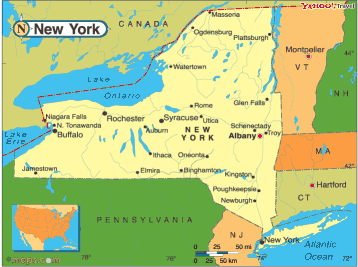
...you'll notice that all of the North American political regions that have recognized same-sex intimate partnerships border on New York state. And yet, thanks to New York's Court of Appeals and a legislature that's dragging its feet on the issue, New York itself has not allowed for same-sex unions. All that's left is for Pennsylvania to legalize marriage or same-sex unions and New York state will be entirely surrounded by water and land where gay people can be married/united.
On the plus side, though, at least New York doesn't have a law on the books expressing public opposition to same-sex marriage and forbidding recognition of same-sex unions created in other states, unlike certain Californias I could mention.
Posted by Zach at 09:51 AM | Comments (3)
June 27, 2006
Ain't No Rag
America has once again narrowly avoided a serious embarrassment; the vote was close, but the flag-burning amendment has again been defeated in the Senate. The Flag-Burning Amendment has become an annual American tradition. Each year just before the Fourth of July it's reintroduced so that congresscreatures can go home to their constituents and brag about how they've once again voted to protect the flag, mom, and apple pie from the desecration of those godless communist hippies. Fortunately for proponents of the Amendment, they've never quite mustered enough votes to actually pass it. If they did, they'd lose one of their favorite bloody shirts to wave in their various opponents' faces.
It should be pointed out that it failed this time by the narrowest of narrow margins: 66 votes for to 34 against. It's already passed the House, and would almost certainly get through the 3/4 of state legislatures required to be added to the Constitution (since, gladhandling though our national representatives are, state and local representatives are even more tied to their localities, and are thus more susceptible to quick and easy patriotic drivel like this). Particular brickbats are due to Senator Mark Dayton of Minnesota, who is retiring from politics this year and thus voted for this amendment without any compelling reason, and Dianne Feinstein of California, who voted for the amendment despite representing a state that will never, ever replace her and probably doesn't even support the thing. Kudos to Senator Bennet, Republican from Utah, for bucking his party and voting against the amendment, though.
This whole nonsense goes back to the Supreme Court case of Texas v. Johnson, in which a man was prosecuted under a Texas statute that banned flag-burning. The court ruled, 5-4, that content-based restrictions on free expression, including restrictions on what you may do with a flag, are unconstitutional. The dissenters were Chief Justice Rhenquist, Byron White, Sandra Day O'Connor, and John Paul Stevens (somewhat surprisingly). Rhenquist, White, and O'Connor were principally interested in the history and prevalence of flag desecration laws, so if we've been doing it all along, why not keep doing it now? Stevens has an odd separate dissent where he claims that he's opposed to all content-based restrictions on expression, except in this case. He then gets very misty-eyed about the flag and says that Congress can never ban speech based on content unless it's to protect Old Glory.
You'll note, in this, that Justice Scalia was among the majority who ruled that flag desecration laws were unconstitutional. My general rule of Supreme Court jurisprudence is that when Justice Scalia says you've gone too far to the right, you've gone too far to the right. I believe subsequent cases have been more lop-sided against flag desecration laws, on the grounds that it's already a decided matter.
The anti-Judiciary twist is a new one to this round of the Flag Burning Amendment debates:
In the debate, proponents sought to make a case of high principle: recapturing for Congress a power taken away by the Supreme Court in a 1989 decision.
That decision, in a Texas case, said flag burning was an expression of free speech and invalidated the flag desecration laws in 48 states.
Senator Hatch said the amendment would "restore the constitution to what it was before unelected jurists changed it five to four." He went on to say, "Five lawyers decided 48 states were wrong."
He conveniently glosses over exactly which five lawyers decided the 48 states were wrong. Also, the fact that the five lawyers happened to be a majority of the special officials appointed by the Constitution with the explicit task of deciding when the states/congress are, in fact, wrong and acting beyond the scope of their powers.
This whole arglebargle is actually somewhat nostalgic for me. The flag burning amendment was actually the first big political issue that I ever cared about. It makes me pine for the happy days when the biggest threat to the country was a lot of morons deciding that 250 years of democracy couldn't withstand certain forms of symbolic protest.
I'll wrap up by pointing to one of the better practical arguments against the flag burning amendment, made by John Scalzi during last year's debate. Scalzi, incidentally, wrote the Hugo-nominated Old Man's War, which I just finished and which is a delightful read that I will review here just as soon as I collect my thoughts on it.
Posted by Zach at 07:58 PM | Comments (0) | TrackBack
Abigail
Just a quick post to announce that my cousing Tiffany just gave birth to a daughter yesterday, Abigail. Congratulations, Tiffany! And congratulations to Uncle Bill and Aunt Janice, now grandparents!
Posted by Zach at 12:27 AM | Comments (0) | TrackBack
April 13, 2006
Nervous Thoughts from Criminal Law
Am I the only one who can't see Christopher Hitchens:

without being reminded of Richard Burton in Who's Afraid of Virginia Woolf?:

Why does Word's spell check dictionary recognize the word "Appellant," but not the word "Appellee?" Logically, for every appellant (or set of appellants) there must be an equal and opposite appellee (or set of appellees). What gives?
If I might be indulged to complain briefly about our career services here: Last Fall they corralled us into a large auditorium to introduce us to the services they provide and prepare us for the First Year Summer Job Hunt. Their advice was to contact friends and relatives and explore possibilities working with them. In case that didn't work, they gave everyone a free copy of the National Association of Law Placement's big book of contact information for every legal employer in the country.
In other words: Your two best bets for finding a job are nepotism and cronyism. If that fails, here's the phonebook; get calling.
On the other hand, this is somewhat more helpful than the advice I got from Berkeley career services, which seems to operate on the premise that if nobody knows your organization exists, then nobody can give your organization a bad evaluation.
Posted by Zach at 08:48 AM | Comments (0) | TrackBack
February 04, 2006
Queers and Liberals
Discussion in comments below reminded me of an interesting and unfortunate phenomenon that I've encountered in studying 20th century American history and politics. It's a tendency you notice in people who are largely on the tolerant side of social politics, and is quite prominent in the field of gay rights. You encounter comedians, politicians, celebrities, and others in the 50s and 60s who are all for civil rights, women's liberation, equality for all, etc. but who see nothing wrong with throwing in an off-color joke about gay people, or who treat discrimination on the basis of sexual preferance as a goofy issue of no real concern.
My favorite example of this is the Supreme Court case of Bowers v. Hardwick. In that case, the Supreme Court upheld Georgia's sodomy laws, which explicitly banned male-on-male oral and anal sex, but had nothing to say about heterosexual sex. The case went to the court, and the justices ruled the Georgia statute constitutional in a 5-4 split.
What's interesting is that among the majority, along with the traditionally conservative justices, was Chief Justice Warren Burger. Burger, who wrote the majority decision in Roe v. Wade and was the primary mover in getting all the justices to agree to a right to abortion, wrote a separate concurring opinion that stated, in essence, "There's no possible way anyone could construe a right to sodomy in the constitution. It's plainly and fragrantly un-biblical, and it would be grossly immoral for us to prohibit states from banning such a thing."
Also interesting is Justice Blackmun. Blackmun wrote the dissent in Hardwick, but was on the opposite side of a prior case attacking a state sodomy law. Blackmun had always been a liberal justice, and his decision to side with the anti-sodomy part of the court was a bit unusual. The reason for it, as he later explained, was that he simply didn't know there were all that many queers out there. He thought, in writing the decision, that there were a few hundred, perhaps a thousand deviants who enjoyed sexual relations with members of the same sex. After siding with the majority in the earlier case, he got scads of letters on the subject, did some research, and discovered that, by gosh!, there actually ARE a lot of queers out there! And our society treats them pretty unfairly! He switched sides and from that point became one of the most pro-gay rights justices on the Court.
The larger point is that you also find a lot of generally liberal people who, in retrospect, were surprisingly conservative on other liberal issues that weren't of much concern yet. Union organizers who think a woman's place is in the home. Suffragists who don't mind Jim Crow laws. Civil Rights leaders who hate gay people.
Part of this is a form of historian's bias. There are two types of historian's bias, as I see it. The kind here is the temptation to use present values to judge people in the past. Washington owned slaves, so he was evil, that sort of thing. It's a bit unfair to those figures, because they existed in a time with different social norms than ours and it's unreasonable to expect them to derive for themselves modern schemes of values. At the same time, I think it is safe to assert that these people did hold inconsistent views even with respect to their own values, and that they were blinded to this inconsistency. We can excuse them for their views, but we need not declare their views justified.
(The other type of historian's bias works in the opposite direction: It declares that things used to be so much better than they are now, and uses nostalgia for these simpler times to attack the way things are now. But that's an entirely separate subject)
In saying all this, I realize that it's quite possible (perhaps even likely) that I hold knee-jerk conservative positions that will mark me as an intolerant neanderthal to future generations. Nonetheless, it's interesting to see people who dedicated their lives to advancing the cause of underserved and unequal communities jokingly dismiss other such communities. I think it shows the importance of periodically re-examine your beliefs to make sure you haven't slipped into laziness or stereotyping.
Posted by Zach at 01:54 PM | Comments (4) | TrackBack
February 03, 2006
Amateur Psychology
I have a question: Why do we call people who hate homosexuals "homophobes?"
The word, taken literally, implies "Irrationally afraid of homosexuals." The idea, I suppose, is that hatred of homosexuals stems from a deeply-rooted fear of homosexuality; perhaps the homophobe is afraid of being raped, or perhaps he's afraid that he is, himself, a homosexual. This seems a plausible explanation for some homophobes, but I'm not certain it describes all of them. Some people just plain hate homosexuals for no good reason, just like some people hate black people for no good reason. But we don't call people who hate black people negrophobes; we call them racists.
The term seems a bit patronizing, and implies a sort of amateur psychology. Without knowing anything about somebody other than their hatred of homosexuals, we've diagnosed them and explained the deeply-rooted cause of their problems. This is like declaring that everyone who's shy had trouble with bed-wetting as a child.
Having said that, of course, when we use the term homophobe who are we patronizing? People who hate homosexuals that don't hate them out of fear; they just hate them for being homosexual. Not necessarily a group that inspires much sympathy.
But that leads me to the other problem I have with the homophobe label: It doesn't imply any moral judgment, and instead has the character of a clinical diagnosis. When you call somebody a racist, you're not saying they have a psychological problem that can be cured with professional treatment. You're saying that they hold immoral beliefs and need to get over them. Now, I won't claim that there's no judgment implied in the word homophobe when used today, but it seems like the negative moral implications have been added as a social phenomenon, and aren't really inherent in the term itself.
So I'd argue that the term Homophobe is unfair to the genuine hater of homosexuals, insofar as it denies their agency by claiming that their views are merely the product of neurochemical imbalance or past traumas, and is simultaneously too fair to them, insofar as it implies that their views are a regrettable but inevitable product of forces beyond their control. What's needed is a term that recognizes and respects hatred of homosexuals as a conscious choice, while simultaneously condemning it as immoral. What that term might be, I can't say.
Posted by Zach at 10:09 PM | Comments (12) | TrackBack
February 01, 2006
Do Not Get a Homemade Tattoo
or
I'm Going to Post This Before Dianna Gets to It
I've sort of idly toyed with the idea of getting a tattoo, but have been restrained by my inability to think of something meaningful to have emblazoned permanently on my body. I think that holding back has, on balance, been a good thing, because by doing so I've collected more information about the art of tattoos, as well as the practical concerns of getting them. Therefore, if I should decide to get one eventually, I think the chances of disappointment are at least somewhat smaller.
So, today's lesson on tattoos: Do not get a tatto from a door-to-door tattoo salesman using a poorly-constructed home-made gun. Apparently several people in Springfield, Missouri got tattoos from someone going door-to-door in their apartment complex. The gun used was held together with pins, black tape, and fishing wire. The women got tattoos anyway. The next day one of the women passed out and all of the women have gotten infections. They're being advised to get tested for hepatitis and HIV. Apparently the state department of health could go after the tattoo salesman (I hesitate to call him a tattoo artist) if enough people file complaints against him.
The knee-jerk reaction I had was to blame the victims, which is unfortunate. Yes, they clearly behaved stupidly. Even if you have no knowledge of the tattoo business and don't, for instance, know that they are not typically sold door-to-door, it seems like you ought to have the sense not to let someone puncture you with a rickety home-made gun. Still, though, I can see how it would happen, from their perspective. They know what a tattoo is, of course, and have sort of thought they might like one, but not enough to pursue it. A fellow comes to their door with, I'm guessing, a good sales pitch, undoubtedly offering a cheap rate. It's too expensive for them to get a real tattoo, or perhaps they hadn't thought about it seriously enough to look into it, but they end up deciding to get one on an impulse. It's the same reason you don't put candybars on your list when you go to the supermarket, but since they happen to be there when you're checking out, you may as well buy one for the trip home.
Assuming the facts are as related, nobody should be blamed but the salesman. He's preying on the ignorant in a way that has potentially devastating health consequences. It's pretty easy to blame the victims when stupid actions on their parts lead to injury. But there's a world of difference when some malefactor is the agent of the harm. The injurer is acting in bad faith to exploit others, and it doesn't matter if her victims behaved stupidly in falling for the scheme; the injurer still deserves every shred of the blame for the harms caused by her actions.
Posted by Zach at 04:32 PM | Comments (1) | TrackBack
December 24, 2005
Little Red Book Redux
Ah-ha. The Little Red Book visit was <a href="http://www.southcoasttoday.com/daily/12-05/12-24-05/a01lo719.htm">a hoax after all</a>. I had my suspicions, which I voiced in my previous post on the subject, but nonetheless I did spread the story despite misgivings about its veracity. I am not a very good journalist.
They're reporting now that the lie was uncovered when the student, who was the source of the story that was eventually relayed to journalists via his professors, began embellishing the story with more visits and extra details. Still, it wasn't a very believable story to start (despite, of course, my decision to spread it). I think I had Marx assigned in about 4 different classes throughout my college career. I'll bet a majority of college students have to read some sort of Marxist/Communist literature at some point. And I'll bet most of them don't want to own a copy, and so borrow it from a library. If you put watches on everyone who borrowed a piece of communist literature, you'd be watching most of the nation's college students, including a lot of College Republicans. Even limiting it, as the student tried to argue that they did, to students who do significant travel abroad wouldn't help much. I know a hell of a lot of students who did semesters abroad. Probably not a majority, but still enough that it would be a pain for the DHS to harrass everyone who went abroad and also read Mao.
So, sorry again for spreading this nonsense. It strikes me as a story that started with the student coming up with an excuse to try and get an extension on a paper. "I couldn't write it because the government stole my book!" Note the embellishment that the DHS kept the copy of the book he ordered. From there, the professors talked, decided it was serious, built it up and told reporters. Note the student's initial reluctance to talk to journalists. The student will probably be disciplined but, really, this nonsense is more the fault of the credulous media (and, ahem, bloggers) who spread the dubious tale. The kid should be disciplined for lying to the professor, but this is one of those situations where I imagine he's already been punished enough by all the attention he's gotten and shame he'll be getting.
Posted by Zach at 07:14 PM | Comments (0) | TrackBack
December 19, 2005
Little Red Book
This story's a little frightening, if it's true. A student requested a copy of Chairman Mao's Little Red Book through interlibrary loan. As a result, he was visited at his parent's home by federal agents with the Department of Homeland Security. The book is apparently on a DHS watch list, and the student's request, combined with the significant time he has spent abroad, caused them to take action.
What's worse, it appears that DHS intercepted the book he requested, waved it at him when they showed up at his house to threaten him, but then didn't give it to him when he left. So he wasn't just harrassed, he was also denied his book.
I'm not sure how this sort of thing would work with UC Berkeley's library. Our system only maintains a list of books you currently have checked out; once you return it, the book is forever deleted from the record. Probably the FBI or whomever could find the relevant harddrive and attempt to find something, but with all the records being created and destroyed on a daily basis, it's unlikely they could piece together much of a history on a given patron. The best they could do is find out what a student has now, and what they've checked out and never returned (for some reason, the system keeps track of fines paid forever, as well as the books they were paid on). Further, employees are instructed not to give access to any data to a federal agent unless they have a specific warrant. At the same time, what of Interlibrary Loan requests, or requests to NRLF, our off-site storage facility? These are often submitted by e-mail. Can Homeland Security intercept and review these requests?
Of course, having said all that, I'm somewhat suspicious of this story. It looks like the only source are the two professors who, based on comments at the end, seem to be getting a bit histrionic about things (contemplating cancelling a class on terrorism because it may subject all their students to surveillance, a general concern that they've been spied upon, etc.). The student himself hasn't come forward. So the only evidence for this story appears to be the testimony of two professors with possible political agendas. I'm not saying the story isn't true, but I'd treat it skeptically until some other evidence confirms it.
Posted by Zach at 11:03 AM | Comments (0) | TrackBack
November 30, 2005
Feminist Follow-Up
Just going to note in passing some reaction to that piece I linked to earlier by people who have a lot more experience with feminist blogging than I have.
11D quibbles with Hirshman's foundational statistics, particularly her reliance on the Sunday Style section of the Times. She then argues that feminism is not, in her phrase, the handmaiden of capitalism. Urging women to become corporate drones might not be an ideal step for the feminist movement.
Bitch Ph.D agrees almost entirely with Hirshman, at least with respect to the home life aspect of things, and offers some elaborations and advice.
Amanda Marcotte of Pandagon agrees in large part with Hirshman, but disagrees with tactics. Her argument here, as it is on a lot of the feminist issues she blogs about, is that you shouldn't blame women and the choices they make. Rather, you need to blame the Patriarchy. The idea is that women exist under an oppressive system, and blaming women for making the wrong choices within that system is not unlike blaming rape victims because they were asking for it. In real life, sometimes women make non-feminist personal choices, not because they're quislings but because that's the best choice the system offers for them personally and they can't live their whole lives for the feminist revolution.
Posted by Zach at 09:49 PM | Comments (0) | TrackBack
November 28, 2005
Choice and Feminism
There's an interesting article on the web edition of The American Prospect: Homeward Bound, by Linda Hirschman. The broad thesis is that a large number of women with successful careers are opting out of them early in favor of home life. There've been a number of articles on this recently, in the New York Times most notably, and to an extent it's been overblown. Nonetheless, the phenomenon is real. The take-away point in a lot of the earlier articles has been something to the effect of "Gee whiz! I guess after all that feminism, women just want to be mommies after all!" or, in Maureen Dowd's alternate-but-no-less-troubling take, "This is a lesson to all the feminists: Choosing a career means turning down motherhood and relationships, and vice versa. You can't have it all."
This article derives a different message from the trend: the problem is not that feminism has gone too far, forcing careers on women who don't want them. Rather, feminism has not gone far enough. It has established, in general, equal opportunities in the work place, but it has left alone structural inequalities in home life that force women to choose between work and family. The task for feminism, therefore, is to turn its attention to restructuring home life.
I've got a lot of thoughts on this, and they're pretty much all in agreement with this article. To start, one of the most irritating things I hear is the wistful warning "you can't have it all." That is, women can have a career or a family, but not both. The unspoken, but implied, second clause of that is "you can't have it all, because you're a woman," or, alternatively, "you can't have it all, because you're not a man." Men, in case you haven't noticed, can have it all. ABA studies have shown that men who are married are likely to be more successful in their careers than single men. Contrariwise, single women are more successful than married women (This is in terms of salary and in terms of promotion to Partnerships, the upper rank of private practice lawyers. The studies also control for age). The reason is simple. When men and women are single, they have to work at their careers and also take care of themselves. When they marry, suddenly the man only has to work, while the woman has to take care of herself and the man. And that's before kids enter the picture. (This, of course, is under the classic marriage partnership agreement that "the woman does all the housework," which, as the article points out, is surprisingly common to this day). So marriage lifts a burden from the man and shifts that burden onto the woman.
There's also a lot of societal pressure to become a homemaker. Men go their entire lives being told that it's their duty to marry, have kids, and have a productive career that supports that family. Women have been told for thousands of years that it's their job to marry, have kids, and care for the family at home using the money the husband brings in. Now, in the last 40 years, women have been told "try to have a career, but if that doesn't work out you can always quit and become a homemaker." So men are told they have no option but a career, while women are told that they're free to try out a career, but if things aren't easy they can always give up. Further, there's subtle pressure that not only is giving up a career to become a homemaker acceptable, but all things considered it's preferable. Careers are great and all, but the purpose of a woman is to have kids and make the home. If you want a career, that's nice, but family must come first.
I've encountered some of this in law school. For starters, it raises my hackles when I talk to a woman in law school who prefaces a comment with "I'm no feminist." Oh really? You're not a feminist, yet you go to law school? You're in a place where there were precisely 0 women 40 years ago, at an institution, Columbia University, that only began accepting women to their undergraduate program after you were born (1983), and you don't consider yourself a feminist? So you've chosen to stand on the shoulders of feminists and kick them in the face? But of course, that's not fair. What they mean is not "I don't believe in any species of feminism at all." What they mean is "I like what feminism's done so far, but I have no desire to go any farther." But a surprising number of the women I've talked to here have already accepted their eventual economic inferiority to men. They plan to graduate, work a few years in a big firm to pay off debt, then marry and leave their job to raise kids, maybe do some part time work for a non-profit if they can find the time. I don't mind when people are unambitious. But are they being unambitious because they lack ambition, or are they unambitious because society has told them that that's how a woman should be?
Essentially, the problem is that feminism has opened up a lot of choices for women, and they keep making the wrong ones. Or, rather, they now choose to do what they were forced to do 40 years ago. This is one of those problems that can't be solved with a big government program. You can't pass a law forcing women to stay in the workplace, or forcing married men to do 50% of the dishes. The only solution is to build a movement and convince women (and men) to make the right choices. Part of that is building institutions that attempt to educate women and get them to make choices according to what they actually want, not what society wants. Another part would be attempting to change the message society sends to women, to emphasize autonomy and de-emphasize motherhood. The author proposes a few solutions, but they're pretty small beans compared to the task at hand (don't get a liberal arts degree, focus on your career, don't have more than one kid).
I'd be interested in hearing others thoughts on the subject. I have a tough time outright condemning women who decide to stay home for a living because, frankly, I wouldn't mind doing it myself. I'm not particularly ambitious and have no great sweeping career plans, so if I had the opportunity to be a stay-at-home husband, I'd probably leap at it. Hence the trouble in distinguishing between women who would stay home regardless (as I would) and women who stay home due to societal pressure to do so.
Posted by Zach at 05:06 PM | Comments (22) | TrackBack
October 26, 2005
Stupid polls
According to CNN, Gallup just released a poll showing that, if he were up for election this year, George W. Bush would get creamed by a Democratic opponent. My question is: What in the name of Pete is the point of this poll?
George W. Bush isn't up for reelection this year. George W. Bush is never going to be up for election for the office of the presidency ever again. This poll is pure wankery. And not only is it asking a question that has no need to be asked, it creates a false impression.
How? For one, the poll pits the President against a Generic Democrat. Not an actual Democrat, just A Democrat. The problem is that when people hear this question, they're pitting Real Life George W. Bush against Platonic Ideal Democrat. In a real election, the Democratic candidate won't perform nearly as well as the Platonic Ideal candidate (Just as Real Life Republicans don't perform as well as Platonic Ideal Republicans). Further, Generic Democrat would not be looking so good at the end of a big election campaign. There would be mud, there would be dirt, there would be gaffes, there would be the realities of a candidate's opinions and personality that cause some people to dislike him. For purposes of this poll, George W. Bush is at the disadvantage of being a real person living in the real world and in the public eye for the last 5 years, with all the baggage that entails. Generic Democrat, being a figment of the collective imagination, doesn't have that disadvantage, and can be as clean as you'd like to imagine him.
The other glaring problem with this is that in America we don't have on-the-spot surprise elections. You don't look up one night and see a ballot on the moon, and realize that the Election Signal has gone out, and you'd better get to the polls tomorrow. If there were an election today, it would be at the tail end of about a year of campaigning and two years of positioning. As it stands, it's a year after an election, and the President doesn't have to worry about his popularity with the American People at large any longer. He's not trying to gin up his numbers, and at this point he's not even trying to keep them from slacking. So, the President is unpopular to the point of losing an election at a time when he's not trying to be popular and isn't up for election. Whoopee.
Yet this poll creates the impression that, if there were an election held this year, the President would lose. Not neccessarily. If there were elections this year, the events of the last year would have occurred much differently, or there would have been a different spin on them, or whatever, and there's no way of telling where we would be now.
This poll asks a question that doesn't need to be asked, and does it in a way that's so fundamentally flawed that it can't give a genuine answer to the question. Yet Gallup has spent their money to produce this poll and present it to the public as though it is authoritative information.
It annoys me largely because it gives false hope and is easily misinterpreted. "Oh, if only we'd had a litle more time, W would have crashed on his own and it wouldn't have mattered how bad a candidate John Kerry was," "Oh, this proves that Democrats are doing fine; we can easily coast on everyone's hatred of George W. Bush, up through the next election in which, incidentally, George W. Bush will not be on the ballot." It's not that I mind hearing good news, and likely this poll DOES show that a majority of Americans are fed up with W (which, by the way, a lot of us told them they would be a year ago, but they chose to ignore us). It's that, between the exit polls and the incumbent rules and all the other bright shiny news that promised a glorious victory for the Democrats in October of last year, I've grown rather hostile to fallacious good news.
Posted by Zach at 08:10 PM | Comments (0) | TrackBack
September 05, 2005
Pre-emptive De-snarking
I'm going to generally try to avoid politics on this blog, but I thought I'd post this one item since it's a largely positive rather than a normative point.
As should be known by now, William Rhenquist died a few days ago. This leaves the Supreme Court with two vacancies and no Chief Justice. As a stopgap, President Bush is preparing to shift his nomination of John Roberts from a regular nomination to the Supreme Court to a nomination to the Chief Justice position. I get a vague sense that folks on the left are getting prepared to unleash a wave of snark, centered around the idea that this is rather a big promotion for someone who's only been a judge for a couple of years.
Before anyone does this, and I note Atrios has already fallen into the trap, remember: Earl Warren, one of the left's favorite Chief Justices, was appointed straight to the Chief Justice position with absolutely no magisterial experience whatsoever. He went from a private attorney to Alameda County District Attorney to California Attorney General to California Governor to Chief Justice of the Supreme Court. Roberts has undergone a similar trajectory, albeit as counsel to the White House under Reagan, and at least has a few years of experience on arguably the most significant sub-Supreme Court appellate court in the United States.
Which is not to say Roberts shouldn't be opposed on other grounds. I'm simply saying this to warn people that there's a very, very easy counter-argument to be made to this argument, and that the argument is somewhat weak to begin with. There are lots of good reasons to oppose Roberts's nomination to the Chief Justice position, but the experience issue isn't really one of them.
Posted by Zach at 11:17 AM | Comments (0) | TrackBack