November 18, 2007

Activities for a Wasted Day

I'm spending today avoiding work on a paper, and as part of that I decided to tally up my books and classify them as fiction or non-fiction. I've heard from various sources that men generally prefer non-fiction and women generally prefer fiction, so I decided to test my bookshelf out and see where I fell.

I started out just marking books as either Fiction or Non-Fiction. Then I encountered some classification problems. What about cookbooks? Manuals for role playing games? City guides? I decided to create a broad "Instructional" category to encompass those books that are probably technically non-fiction, but which I don't think of when I think of non-fictional books. This is easier than, for example, classifying cookbooks I use regularly as Non-Fiction, while classifying cookbooks with elaborate recipes requiring ingredients from five different ethnic grocery stores and from which I have never cooked a recipe as Fiction. So: Cookbooks, RPG manuals, computer programming primers, style guides, and, most significantly, legal texts are all instructional. This might somewhat throw off the results, since the legal texts are arguably non-fiction, but whatever.

The other classifying problem I had was with books that straddle the line between fiction and non-fiction. What to do with Chretien de Troyes's Arthurian Romances, written as fiction but which I read primarily for its historical value? What about books written in the middle ages as histories, but filled with fantastic and implausible happenings, such as Gregory of Tours's History of the Franks and Galbert de Bruges's Murder of Charles the Good? And what of credulous histories like Herbert Asbury's The Barbary Coast, which is ostensibly a history of criminality in San Francisco during the Gold Rush but which consists primarily of breathless retellings of apocryphal anecdotes? How, not to put too fine a point upon it, should I classify the Bullshit Histories? I decided to create a category for Dubious Non-Fiction and leave it at that.

Finally, how do I classify my copy of the Bible? Fiction? Non-Fiction? Dubious Non-Fiction? I decided to mark it down as Instructional and side-step the whole issue.

The final tally came out to 86 Fiction, 32 Non-Fiction, 93 Instructional (give or take; I estimated how many law books are sitting in my locker right now), and 4 Dubious Non-Fiction. This tally includes only those books to which I have easy access here in New York, not those in storage with my parents. The lion's share of those instructional books are law books, which might throw the ultimate Fiction/Non-Fiction balance off kilter, but I feel they shouldn't count since I don't really own them of my own free will. I made an exception for those law books I purchased for non-law school reasons, like G. Edward White's Justice Oliver Wendell Holmes: Law and the Inner Self and Lawrence M. Friedman's History of American Law. I feel my classification is relatively fair.

So, once again I defy expectations, at least in terms of book tastes. Take that, gender essentialists!
Posted by Zach at 05:48 PM | Comments (3)

July 22, 2007

Serious Libraries

From a New York Times article on the book collections of CEOs:

"Ken Lopez, a bookseller in Hadley, Mass., says it is impossible to put together a serious library on almost any subject for less than several hundred thousand dollars."

Discuss.

Posted by Zach at 10:29 PM | Comments (0)

November 06, 2006

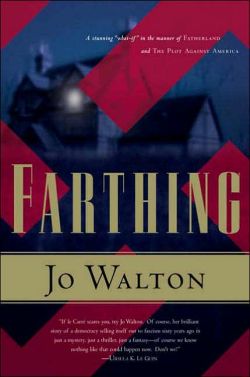
Book Review: Farthing

jwfarthing.jpg

This novel is for everyone who has ever studied any monstrosity of history, with the serene satisfaction of being horrified while knowing exactly what was going to happen, rather like studying a dragon anatomized upon a table, and then turning around to find the dragon's present-day relations standing close by, alive and ready to bite.

-the preface to Jo Walton's Farthing

Farthing, by Jo Walton, is an English murder mystery set in an alternate history universe. In the world of Farthing, several months into the Battle of Britain, prior to Germany's invasion of Russia, a faction within the British Conservative Party successfully negotiated a peace with Hitler behind Churchill's back. The novel takes place in 1949, in an England that has learned to peacefully co-exist with the evil that rules the Continent.

Farthing is the name of the country estate where most of the novel takes place. It is also the nickname given to the politicians who gather there, the "Farthing Set", who were responsible for making peace with Germany. As the novel opens, the Farthing Set is gathering at the estate for the weekend to prepare for an important party vote. Among the guests is Lucy Kahn, nee Eversly, the daughter of one of the more influential members of the group, and her husband David, a jewish banker whom the members of the set, including Lucy's parents, openly despise for his race. During the night Sir James Thirkie, the man who personally negotiated the peace with Hitler, is murdered. He is found in his bed, his shirt stained with blood, a knife protruding from his chest. He is pinned with a yellow Star of David badge, of the kind Jews are forced to wear in Europe. David Kahn is immediately taken as the prime suspect.

The story is told from two perspectives. Chapters alternate between a first-person narrative written by Lucy Kahn and a third-person narrative focused on Inspector Carmichael, who is sent by Scotland Yard to investigate the murder. It's an interesting technique that allows the reader to get a more full view of the main characters, by letting us see them as others see them and as they see themselves. At times it's a little jarring, though never obtrusively so, to skip back and forth between two very different characters with very different styles. Mrs. Kahn has a highly prolix and discursive style. Inspector Carmichael's chapters have the matter-of-fact brusqueness of a police procedural. Both, however, are lovingly written and intimate; it is a tribute to how well the characters are developed that every time you finish a Carmichael chapter you feel vaguely annoyed to be leaving him for Mrs. Kahn, and every time you finish a Kahn chapter you feel annoyed to be leaving her for Carmichael.

This novel is published by Tor, a science fiction label, and is to be found in the science fiction section at bookstores. Yet it is as much an English country house murder mystery as it is alternate history. The characters do not spend a lot of time chatting about the recent past; the events of the prior nine years are casually mentioned as they come up naturally in the course of the novel, but we are never plunked down to a history chapter on What Went Differently. The novel is written as a mystery novel first, and it is the murder that absorbs the characters's attentions throughout.

Yet it would be inaccurate to say that this is simply a mystery novel that happens to be set in an alternate timeline. The alternate history is more than a setting, it's an important element in the novel's development and larger themes. The book isn't just science fiction and it isn't just a mystery; the two genres are so seamlessly integrated that classifying the book as one or the other seems to do it a disservice.

The novel is rather brief, 320 pages in a hard-bound book with fairly large print, and makes for quick reading. The chapters are short, ten pages on average, and the story is absorbing. I read nealry the entire book in the course of a pair of several-hour sessions; I found it very difficult to tear myself away from it once I had gotten involved in it.

Right now the book is only available in hardback, for a fairly steep $25. Nonetheless, it is good enough that I'd recommend the hardback edition as well worth the price. It was released fairly recently, so I don't believe a paperback edition is forthcoming anytime soon.

A word of caution: The world of the book is frightening in its realism. Walton does an excellent job of showing us how we accomodate evil in our daily lives by showing us how the England of Farthing has just sort of learned to live with Nazi Germany in its backyard. She does everything very subtly, never jumping up and down or beating us over the head with it. The characters in Farthing, even the pure ones acting from righteous motives, never stop and say "I can't believe we've allowed this incredible evil to continue!" They just sort of accept it. Reading Farthing forces the reader to think hard about what sort of evils she might have just learned to accept, as though there were nothing wrong with them.

In any case, Farthing is an excellent, thoughtful novel, well-written, and worth picking up. I highly recommend it. I would argue, however, that Farthing is not, perhaps, the best novel to be reading on the eve of an election about which one is particularly nervous.

Posted by Zach at 02:34 AM | Comments (0)

October 09, 2006

Conversant

I came upon a great passage in The Red and the Black that seemed worth sharing. This comes from the Lloyd C. Parks's translation published by Signet:

"Following I don't know what notion, derived from some account of high society, such as the old surgeon major had seen it, wherever Julien happened to be with a woman, he felt humiliated as soon as there was silence, as though it were his own particular fault. This sensation was a hundred times more painful during a tete-a-tete. Filled with the most exaggerated and Spanish ideas about what a man ought to say when alone with a woman, his imagination had nothing to offer him in his perplexity but inadmissible ideas. His head was in the clouds, and yet he could not find a way out of the most humiliating silence. Thus, the stern look he wore during his long walks with Mme. de Renal and the children was accentuated by the cruelest suffering. He despised himself horribly. If unfortunately he make himself speak, it occurred to him to say the most ridiculous things. To crown his misery, he was aware and had an exaggerated idea of his own absurdity. But what he couldn't see was the expression in his eyes. They were so handsome and revealed such a fiery soul that, like good actors, they sometimes gave a charming import to words that had none at all. Mme. de Renal observed that, if alone with her, he never said anything well, excepting when, distracted by some unforeseen occurrence, he was not thinking about how to turn a compliment. Since the friends of the house did not exactly spoil her with new and brilliant ideas, she took great delight in Julien's flashes of wit."

I'm quite enjoying The Red and the Black, to the point where it's interfering with schoolwork. This weekend, every time that I meant to read for Corporations or start cite-checking sources for the Science and Technology Law Review I found myself picking up Stendahl instead. Now I'm wondering if I can get away with sneaking it into class and reading it under the desk while pretending to take notes. Or, to avoid arousing suspicion, I could read the book surreptitiously while pretending to play computer solitaire. If I looked like I was actually taking notes and paying attention to the professor somebody would think something was up.

Posted by Zach at 01:45 AM | Comments (0)

July 27, 2006

Making the Nose

Lately I've been reading The Shy Single, a book by Dr. Bonnie Jacobson, Ph.D. on dating for shy people.

For a while I've felt that I've been spending too much time home alone and not enough time going out and being sociable. But I've sort of always fallen back on the assumption that I just really don't like people and don't enjoy social interaction. So I've been vaguely dissatisfied with the way I've been handling life, but not sure that doing anything about it would make me any happier. Then I spent this last weekend with Dianna, of Snoqualmie fame, and it's somewhat altered my way of thinking about things. I quite enjoyed all the time I spent with her, even though nearly all of it was spent in conversation, which I normally find exhausting after an hour or two.

This makes me think I can enjoy socializing, and that I'd like to know more people and get out and do more things. And it also makes me think that, having been single for about a year and a half now, it's time to move on and start dating in earnest again.

Because I am a dork, my current situation reminds me of some dialogue from the British Science Fiction TV show Red Dwarf:

HOLLY: I was thinking it might help pass the time if I created a perfectly functioning replica of a woman, capable of independent decision-making and abstract thought and absolutely indistinguishable from the real thing.

LISTER: (Sitting up eagerly) Well why don't you, then?

HOLLY: Because I don't know how. I wouldn't even know how to make the nose.

Dating is something I'm eager and excited to try, but I don't even know how to make the nose. All of my experience, really, comes from the first few months of college, which was over five years ago now. I don't really know what to do or how to do it.

So, in line with my general modus operandi, I have turned to books in the hopes that they will provide the answer. And thus: The Shy Single. It's written by a Manhattan therapist who apparently specializes in group and individual therapy for shy people, with an emphasis on helping them with dating. Jacobson delineates three distinct elements of shyness, and focuses chapters no each: First, the fear of initiating contact with others, which leads the shy person to avoid socializing entirely. Second, fear in the midst of conversation that the shy person is making a fool of herself, leading her to either sit in silence listening to others talk or babble incessantly out of nervousness. Finally, there is the recrimination and self-criticism that follows social contact, which leads the shy person to over-analyze every element of her performance and reach the conclusion that everyone involved now hates her for what an ass she made of herself.

I'm not very far in the book, but so far it's been an eerily accurate description of my own feelings about informal social contact. Hopefully it will prove as astute in its advice as it is in its observations. It seems as though it mostly states the obvious (that the only way to get more comfortable with dating is to force yourself to do it) and provides advice on coping with anxiety, both in terms of internal mental techniques for getting through the ordeal and in terms of strategies for making the whole experience less stressful.

My plan is to put some of the book's initial advice into practice this weekend and actually go out in search of some sort of social contact. I'm not entirely sure that I know what I'm doing, but I suppose I have to go out and get some experience with this sort of thing if I'm to know how exactly to go about it.

Posted by Zach at 05:04 PM | Comments (4) | TrackBack

PLACEHOLDER OF DOOM!

This started out as a post about a book I'm reading, and is now turning into, not one, but TWO posts, one about the book, the other about an Amazon review of said book. Watch for them!

Posted by Zach at 09:56 AM | Comments (0) | TrackBack

June 02, 2006

Stories of Your Life

I can't believe I've been blogging nearly a year and haven't yet talked about Ted Chiang.

Ted Chiang is my absolute favorite science fiction short story author. He's won three Nebulas, a Hugo, and has been nominated (though he turned the nomination down) for a second Hugo. This is pretty amazing when you consider that he's written a grand total of nine stories. He may have the best works-to-awards ratio of any author in science fiction.

A lot of his work deals with the mind and neuroscience. Predestination, Free Will, Perception, and Faith are major recurring themes. I've shown his book to a Berkeley neuroscience professor who enjoys science fiction, and the science is both plausible and at the cutting edge of current understanding. At the same time, Chiang writes in a very understandable way, such that, even without a science background, you feel yourself informed about the subjects without being lectured. Chiang does an excellent job of explaining the science, where it's going (or has gone, by the time of the story) and then moving to the human implications of these changes.

Nearly all of Chiang's short stories are collected in a single volume, Stories of Your Life and Others. The one that isn't in that volume can be found here. Chiang is not, to say the least, prolific, having produced nine stories since he was first published in the early 90s. What he's produced is all good, though; while not everyone loves all of Chiang's stories, I know at least one person who loves each of them. And the advantage of such a sparse library of stories is that you can read one volume and say that you've read his entire body of work.

I would particularly recommend, incidentally, the stories "Understand," "Hell is the Absence of God," and "Liking What You See: a Documentary." The last one is my favorite Chiang story; it's organized as a documentary and explores the implications for college students at a Berkeley-esque school in the near future of a technology that allows you to turn off the part of your brain that tells you whether people are attractive or not. You still recognize how people look, and, on some intellectual level, you can piece things together to determine who's attractive and who isn't, but it won't be a gut instinct. For you, the concept of attractive and unattractive will no longer have meaning. The story is rich with ideas and explores all sides of the argument for and against the procedure. It raises interesting questions that it never answers and leaves to the reader to puzzle through on their own. When I finished reading it the first time, I set the book down and was temporarily dazed as I swam in ideas about perception and the mind and society. It took hours for me to return to the real world, and that, I think, is the sign of a good science fiction story.

Posted by Zach at 08:12 PM | Comments (2) | TrackBack

May 26, 2006

Book Review: Daughter of the Empire

Daughter of the Empire is the first book in a three-book collaboration between Raymond E. Feist and Janny Wurts.  The book's set in the Kelewan Empire, the parallel-universe antagonist from Feist's Rift War novels.  No knowledge of Feist's other works are necessary to understand Daughter; I went in knowing nothing of the Rift War series beyond the title.  The gist of the larger plot is that the Kelewan Empire exists in one universe, Midkemia in another, and there's a magical rift between the two.  Kelewan is a synthesis of various Asian cultures and empires, while Midkemia, I get the impression, is analagous to medieval Europe.  Kelewan is invading Midkemia through the rift, and the war has apparently gone on for some time.

But the war is just distant background.  Daughter is a novel of politics.  The book begins with a betrayal that kills the lord of the ancient Acoma clan, along with its sole male heir.  Rulership passes to Mara, the dead lord's daughter, who must establish control of the clan, rebuild its strength, forge alliances to ensure its continued survival, and exact revenge against the enemies of the Acoma.  The focus of the book is on relatively small-scale conflicts between clans and vassals.  There are a few armed skirmishes in the book, but for the most part Mara's victories are won in drawing rooms and reception halls. 

Feist and Wurts handle Mara's sex skillfully.  They don't take any easy outs by, for instance, making the Kelewan Empire tolerant of female rulership; Kelewan is as patriarchal as its real-world analogues in the Middle Ages.  Mara is placed in a position of simultaneous dominance and submission.  She rules her clan absolutely, and her fellow rulers make superficial gestures of respect.  Yet there is an undercurrent of bemusement.  People play along because tradition requires them to, but nobody considers her a serious threat. 

There's an interesting reversal mid-way through the book, when Mara marries and loses control her her household.  Even with an incompetent husband, her powerlessness is absolute, and it is nearly a year before she can wrest even a modicum of control over the Acoma back from him, and then only by his grudging concession.  It's interesting to contrast Mara before and after the marriage; she goes from being a shrewd and competent leader, managing the house with skill and intelligence, to essentially not a human being any longer.  She no longer has even the power to manage her own life, let alone her house. 

The book is a fun novel of politics in its own right, and provides interesting insights into female rulership, a topic oft neglected or glossed over in fantasy novels. 

At the same time, it has a few failings.  The writing is serviceable, but often repetitive.  In the space of a single chapter you will be told a dozen times that "the fate of the entire Acoma clan rested on (the events of the next few hours/what would happen beyond that gate/what would transpire in the dooryard)."  It's also a little irksome how often we hear about all the emotions the characters aren't showing.  The writing works for the most part, but there are those few ticks that irritate.

More substantively, the plot is a tad episodic.  Within a few chapters a formula is established: A problem arises that requires shrewd negotiation, Mara goes to some hostile lord/bandit/queen, Mara successfully tricks the rival into doing what she wishes, Mara returns triumphant, ready for her nxt advanture.  This changes with the marriage, which forms the most interesting part of the book, but the rest gets a bit monotonous as the format keeps getting repeated.

Mara also tends a bit to the Mary Sue-ish for my taste.  She seems just a little too clever and too perfect.  This isn't to say there aren't unexpected twists that redound to her disadvantage, but generally Mara always makes the best choice in any given situation, and Mara always wins.  After a while, this gets boring.

Nonetheless, it's a lot of fun overall.  The political machinations are interesting and the way that the various parties exploit the ancient forms is subtle and devious.  The book's entertaining throughout, and I would recommend it.

Posted by Zach at 09:41 PM | Comments (0) | TrackBack

Reading Notes

Just an update on my reading.  I finished Daughter of the Empire moments ago and will have thoughts on it after I get some sleep.  Now I need to decide what to read next.  I'd initially planned on Storm of Swords, with the idea of reading that so that I was all prepared to begin Hugo readings.  But now I'm wondering if I wouldn't prefer a slight break from medieval politics.  So what now, then?  Keep going with Storm of Swords?  Start in on the Hugo books (perhaps a light one, like Old Man's War)?  Or keep putting off Hugo reading and instead go with something else, like the Tiptree Awards Anthology or The Left Hand of Darkness?

Posted by Zach at 06:35 AM | Comments (0) | TrackBack

May 22, 2006

Sci-Fantasy Summer

I visited a few bookstores today (including a small independent Science Fiction/Fantasy bookstore) and ended up making some purchases.  I've decided to read a lot of science fiction and fantasy this summer, since I quite enjoy it and it's a nice break from all the law reading I do. 

I've decided to adopt the tentative goal of reading all the novels that have been nominated for a Hugo before Worldcon this summer, when the Hugos will be presented.  This way I'll actually have a legitimate opinion on who deserves to win the award.  To that end, today I bought Spin by Robert Charles Wilson, Old Man's War but John Scalzi, and Accelerando by Charles Stross.  I'll eventually pick up Learning the World: A Scientific Romance by Ken MacLeod, and I already own A Feast for Crows by George R.R. Martin, the fifth nominee. Of course, to read Feast I'll first need to finish A Storm of Swords which is 1200 pages.  Considering I'm only on page 300, I've got work to do.  Plus right now I'm reading Daughter of the Empire by Raymond E. Feist and Janny Wurts, which I've been putting off due to school and now have a change to get into.  I also picked up The James Tiptree Award Anthology, Volume 1, which I'm quite excited about. 

Hopefully, then, I'll have some reviews up as I finish.  Fortunately I've got a nice long subway commute to work, so I should have time to get regular reading done.  The Hugo Awards will be announced at Worldcon in LA on Saturday, August 26th, so I've a bit more than three months to get these books read.  The full list of Hugo nominees is here.

Posted by Zach at 02:44 AM | Comments (6) | TrackBack

January 13, 2006

A Song of Ice and Fire: A Critical Reading

While I patiently wait for certain parties who shall remain unnamed to finish their review of A Game of Thrones, I thought I'd throw out some thoughts about the book that have been bouncing around my head for a while.

First, let me say that the series is not done, so some of this is speculation. Further, I have only read the first two books out of four published, so it may be the case that some of my speculation is already invalid (or has come to fruition). Also, this discussion has some very light spoilers, insofar as I talk about non-plot twist events in the second book.

For much of the second book I disliked Catherine Stark. She spends a good part of the novel ensconced at Riverrun, and her principle activity there is worrying. She awakes in the morning, worries about nine impossible things before breakfast, takes her meal, worries about the war, eats lunch, worries about her children, watches for ravens that might bear fresh news to worry about, has dinner, worries about her father's health, then it's off to bed for a good night's sleep in anticipation of another long day's worry.

Most of her worrying revolves around the war. Why, she asks, can't we just stop fighting? Wouldn't that be better for everyone? You read it and want to throttle her. "Good lord! Can't you see that your hippie peacenik ways will only lead to death and destruction? Can't you see that sometimes things are worth fighting and dieing for, and your children have chosen this path for themselves? Get ahold of yourself!"

But here's the trouble: Fundamentally, she's right. The game of thrones is, in the end, just a game. A violent and destructive game, but a game nonetheless. It doesn't matter one whit who sits on the Iron Throne to most of the populace, and it probably won't matter too much for the nobility, either.

I feel this gets thrown into sharp relief by the lack of standard magic/quest fantasy tropes. There's no hideous warlock bent on world destruction, no sinister Other that the band of heroes is questing against. (That's not to say there aren't Others, but almost nobody's paying attention to them; they're too busy playing with swords). When a story features heroic protagonists pitted against an evil force that seeks to destroy the world, you can easily suspend your disbelief about the brutally oppressive nature of the Medieval polity.

But Martin's world is much closer to the real world than it is to Middle Earth, and as such it's harder to ignore the fact that you have a political system based on a small caste of gangsters exploiting the 95% of the population that's weaker than them. We can sort of accept that Eddard is relatively benevolent as gangsters go (Maybe. He's loved by the castle folk, and he's loved by his vassals, who are all members of the Gangster Caste). But do the Smallfolk, as they are called, really experience a better life if they toil on Stark lands than if they work under Lannister's banner? I have my doubts.

A point that comes up several times: The Smallfolk don't particularly care who the king is, and on the occasions they do care, they wish the Targaryens were back on the throne. This is important: The inbred and evil Targaryens were vicious to their gangster underlings, but treated the bottom 95% of the country about the same as anyone else did. The only difference between life under the Targaryens and life under the Baratheons is that there was a hell of a lot less war while the Targaryens ruled. But just because the Smallfolk don't care who rules doesn't mean they won't have to die over the question.

The argument that some of the nobles are good rulers who truly care about their people is undermined by the fact that nobody demonstrates effective rulership. Leave aside the gathering army on the Eastern Continent; the Westeros can't be expected to know about that. Leave aside also the wildling hordes and the Others; the North hasn't been a problem in years, and while a good ruler might take note of the disturbing reports by now, it's hardly a count against them to lack that sort of prescience. But the one thing that everyone knows damn well is that Winter is coming. Further, it having been a long Summer, it can be expected to be the longest Winter in history, 15, 20, 30 years. And how do the lords of Westeros collectively respond to this calamitous and inevitable natural disaster? By sowing more crops while they can and storing extra food to wait out the cold? Of course not. They take all the able-bodied men they can muster, march them to the middle of the continent, and set them about hacking one another to pieces. And while they're at it, they burn the most fertile fields on the continent to prevent their enemies from getting easy supplies. This, I would argue, is not a wise course of action.

The best course for the Starks would be to give in, accept the current King, and start sacking away for the coming famine. If they really feel it necessary, they can nurse a grudge and enact their vendetta when the time is right and their imminent destruction isn't at hand. Cruel as most of the Lannisters are, it seems unlikely they would seek to wipe out the Stark family out of spite. Of course, everyone calling it quits and enacting sound and rational agricultural policy wouldn't make for a very interesting novel.

I wonder if Martin agrees with me. The elements are certainly there, and we know that something's going to happen eventually with the Wildlings, the Others, and Daenerys Targaryen. Eventually he's going to give the Lords of Westeros a collective whack on the head and tell them to stop playing around and deal with the real problems they face. I hope he also throws some cold water on the medieval nostalgia that his book plays into so well(and that, to be fair, I absolutely love when I'm not wearing my Critical Studies cap). Remember: if you lived in the Middle Ages, the overwhelming probability is that you would live out your life poor, weak, and uneducated. You would live in fear of the local nobility until you perished as a toy soldier in someone's game of war, or were slaughtered by troops (probably from the very noble sworn to protect you) as they passed through your land on the way to battle.

Still, we care about who the author tells us to care about, and Martin wants us to care about the game of thrones (or perhaps he's waiting to drop the sword on our heads and scold us for misplaced priorities; I can only hope). In the end, though, caring deeply about whether the Starks or Lannisters prevail is like caring about whether the noble Bechtels or the sinister Halliburtons get the over-inflated government construction contract: At the end of the day, they're all a bunch of crooks.

Posted by Zach at 09:34 PM | Comments (0) | TrackBack

January 06, 2006

Susan Faludi Goes to the Movies

I've been reading Susan Faludi's Backlash.  I had been planning to wait until I finished it to write a review, but I just read her chapter on movies and had so many thoughts on it that I felt I should do a mini-review now before I forgot everything.

Let me start by saying that I've enjoyed the book thus far.  There are a few points I disagree with, and some assertions about which I'm skeptical, but overall I've found her argument compelling.  Faludia wrote Backlash in 1991, and her argument is that attitudes towards Feminism in the US undergo a cycle of progress and backlash.  There was the suffrage movement in the late Nineteenth/early Twentieth Centuries, leading to universal suffrage in 1919, followed by a backlash in the 1930s.  There was the advance for women in the workplace during World War II, followed by the return to the home and Nuclear Family in the 50s.  There was the advance of equal rights and career-oriented women in the 70s, followed by a backlash against working women in the 80s.  Most of the book is focused on analyzing the 80s backlash and contrasting it with societal trends in the 70s.

I'm largely in agreement with Faludi's views, but I feel she makes some spurious arguments when she gets to her chapter on the films of the 80s.  Faludi spends most of the chapter discussing Fatal Attraction, then turns her attention to broader trends in 80s films.  The Fatal Attraction analysis is convincing; the trend analysis is not.

Faludi marshalls powerful evidence that Fatal Attraction is not only a de facto anti-feminist film, but that it was consciously intended to send an anti-feminist message.  The story was written with a somewhat feminist message in mind.  A man sees his wife and family off for the weekend.  He then opens his little black book, calls a woman up, and has an affair with her.  The woman is devastated to discover that he's married and has used her.  She ends up trying to kill herself, the man's wife finds out, and he the rest of the movie explores the fallout of his thoughtless behavior.  The message the author was trying to convey was that there are serious consequences when men treat women like objects rather than respecting them as human beings. 

The story was bought by a producer with the intention of turning it into a feminist film.  The movie was then bought by Paramount and the original producer was pushed out for a new one.  The movie was given to Adrian Lyne to direct, and the first thing he did was to rewrite the script.  The male character needed to be more sympathetic, or the audience wouldn't care what happened to him.  The story went from thoughtless-man-sleeps-with-woman-and-she-tries-to-kill-herself to thoughtless-man-sleeps-with-woman-and-then-she-does-crazy-things-to-him-and-tries-to-kill-herself.  Not sympathetic enough.  So they changed it so that the woman seduced him, forced him to sleep with her, then torments him.  Still not enough.  Alright, now the woman's been driven psychotic by her career-orientation; she snares him with sex, then stalks him in the hopes of getting the marriage that her career has prevented her from obtaining.  The wife originally had a career.  Her character was re-written into a doting homemaker.  This was the version that was shot.  In the original ending, though, Glenn Close kills herself in the end while music from Madame Butterfly plays in the background.  Now she's too sympathetic.  The studios made them re-shoot the ending, so we get the new one where Michael Douglas starts to kill her, then Anne Archer finishes her off. 

Faludi also provides some fairly damning quotes from the director.  Glenn Close was driven crazy by her career, and while not all career women go as far as her, it is clear, according to Adrian Line, that they're crazy to some degree.  A woman's place is in the home.

So Faludi makes a sturdy argument that Fatal Attraction is anti-feminist.  Further, it's a pretty relevant target for her book.  Fatal Attraction was one of the top-grossing films of the decade.  It remains well-known and watched to this day. 

Then Faludi moves to broader trends in films.  The first problem with her analysis is that it's all anecdotal.  She picks out movies that fit her model of the bad, anti-feminist 80s film and contrasts them with her hand-picked good, feminist 70s films.  But how trust-worthy is this?  It's very easy to cherry-pick a few examples and then declare a trend (in fact, Faludi decries this very scheme of argumentation when she rebutts trend-journalism articles.  These articles tend to interview a few women who have left careers and then, with no statistical backing, declare that women are abandoning their careers for families in droves).  I'm not saying there wasn't a trend toward more anti-feminism in films in the 80s, but I'd like to see some statistical evidence compiled.  Perhaps someone could classify films as Feminist, Anti-Feminist, or Neutral and compare the numbers in each category over the years.

The thing is, though, based on the rest of her film analysis, I don't trust Susan Faludi to make those classifications.  She starts by discussing films which present the fairly overt message that women aren't fulfilled unless they're married and have children, such as Surrender and Baby Boom.  That's not too bad.  She gets overzealous, though, in declaring other films to be anti-feminist.  Any movie that shows a woman getting married and being happy about it is anti-feminist.  Any movie depicting babies and implying that they may be a source of happiness for a woman is anti-feminist. 

I see where she's coming from, but I feel she goes to far.  Her point is that these movies reinforce traditional notions of female life goals; women need to be married to be happy, women need to have babies to be happy.  I see her point, but I don't agree with it.  My problem is that people in real life get married and decide to have babies.  If you mandate that a film is anti-feminist if it depicts marriage or parenthood in a positive light, you've erected a pretty formidable barrier for the feminist film-maker who wants to appeal to any kind of mass audience.  It seems as though the solution to films which depict traditional lifestyles in a positive light is not to shun all films that do so; it's to create films that depict non-traditional lifestyles in a positive light. 

Faludi at least has a point with those films, but one I disagree with.  There are a lot of movies she condemns, though, that really stretch her credibility.  Any movie that fails to present a strong female character exemplifying feminist virtues is anti-feminist.  According to Faludi, Indiana Jones and the Last Crusade is anti-feminist.  Big is anti-feminist.  Field of Dreams is anti-feminist.  Star Trek V is anti-feminist.  The was one part of the chapter where I laughed out loud.  Half-way through, Faludi declares that Aliens is anti-feminist.  Even though Ellen Ripley kicks ass, Faludi argues, she does it, in part, to save a child.  The child calls Ripley "Mommy."  Thus, Aliens sends the message that women can only kick ass as part of their protective-maternal instincts.  Now I see Aliens in a whole new light.  Clearly, had Newt not been involved, Ripley would have rolled over and been eaten in the first alien attack.  After all, Ripley was dainty as a doiley until she discovered there was a child to protect.  Only then did she go into ass-kicking mode.  There are dozens of reasons not to like Aliens.  Anti-feminism isn't one of them.

It would be unfair to read too much into the Aliens condemnation.  It's clear that Faludi isn't really serious about that.  She's dismissing a counter-example by finding a stretched reading that makes it fit into her broader trend.  Still, though, Faludi watches films in a very odd way. She interprets them as making very strong implications about what they depict.  If Ripley kicks ass to save a child, then Aliens is implying that women can only kick ass if it's to save a child.  If a movie shows a woman happily married, it implies that women can only be happy if married.  If Indiana Jones and the Last Crusade has no strong female characters, it implies that there's no such thing as a strong woman.  And so on. 

Its annoying, because there are some good arguments in the chapter, but by the time you finish it it's a lot harder to take Faludi seriously thanks to the sheer number of films she takes offense at.  I would still cautiously recommend the book, but the movie chapter has shaken my faith.  Faludi tries to over-prove her point and winds up tarnishing her good arguments.

Posted by Zach at 04:57 AM | Comments (2) | TrackBack

December 30, 2005

Infinite Recurrence

There was a story bandied about a few months ago about a Harvard professor named Harvey Mansfield who gave a lecture arguing for a New Feminism.  Mansfield's principal activity these days seems to be writing books on masculinity, and the gist of the New Feminism he calls for is a return to the modesty and prudence of the days before the Old Feminism.  The New Feminism seems to look an awful lot like Non-Feminism, but that's not the point I'm trying to drive at.  Others have dealt with this more effectively than I.

The broad argument is that women are harming themselves by being promiscuous.  Mansfield takes as a first premise that the one thing women are after in romantic relationships is marriage.  Men seek only sex.  Women don't care too much for sex except as a means to the end of marriage.  Men would never get married if they could avoid it, because the only reason they seek the company of women is for sex.  In the traditional scheme, women were modest and seldom had sex outside of marriage.  Men were generally thwarted in their search for sex without marriage, because most women were unwilling to give it.  A woman used sex as a bargaining tool; she would offer a man what he truly wanted and could not obtain, sex, if only the man would give her the One Object Without Which No Woman's Life Has Meaning, a wedding ring (I'm sorry, I'm allowing editorial commentary to slip in.  I shall avoid this in the future).  So in a society where women generally don't consent to sex outside of marriage, women can leverage their control of the Sex Market to force men to grudgingly consent to matrimony.

But sadly, Mansfield argues, the balance of power has tilted with the rise of Feminism.  Now women have sex outside of marriage all the time.  Men can get sex without marriage, so therefore there's no reason for a man ever to marry.  Why buy the cow, to use the parlance of our times, when you can get the milk for free? 

I'm not posting this to argue against Mansfield.  Anything I could say has already been said, better, by the people I linked to above.  To choose just my favorite of the many reasons why he is wrong, he has created an explanation for a phenomenon that does not exist.  From what I understand, the average age of first marriage has slowly increased in recent years, but the rate of marriage has stayed roughly the same.  That is, despite female promiscuity and the lack of any reason for men to get married anymore, men and women defy all logic and continue to get married at roughly the same rate they did back in the days of feminine modesty.  Mansfield has thus created an explanation for a theoretical problem that, bafflingly, has failed to materialize in real life.  But that doesn't mean women shouldn't adopt Mansfield's New Feminism, just to be on the safe side in case people start acting in the way that he theorizes they ought to be acting.

No, my purpose here is to point out that Mansfield's argument is not a new argument.  It can be found throughout history and throughout our literature.  In fact, it can be found in the very first official novel written in the English language, Samuel Richardson's Pamela

(I should point out that there is some debate as to whether Pamela is truly the first English-language novel.  Gulliver's Travels was published before it, and some have argued that it should be accounted first among novels.  The objection raised is that Gulliver's Travels is nearly a novel, but not quite.  Gulliver's Travels is structured as four independent stories.  Each has its own plot and does not rely on the others in any way; they can be read and understood in any order.  The only common thread is the main character, Gulliver.  Gulliver's Travels, therefore, does not meet the criterion that a novel present a unified, sustained narrative of some length.  It is more a collection of novellettes.  Pamela, on the other hand, has its own problems.  It is an epistelary novel.  That is, it is a novel in the form of a series of letters, with only one brief omniscient narrative segment of about a page-and-a-half midway through the book.  It doesn't necessarily meet the standard template of a novel, either.  But my understanding is that Gulliver's Travels's failure of sustained narrative is more fatal to its claim to novelhood than Pamela's unusual means of storytelling.  I, personally, am in the Gulliver's Travels camp, but only because it seems a shame that the English language should have to claim a work as milk-curdlingly awful as Pamela as its first novel.)

Pamela tells the story of a young middle-class girl who works as a maid.  Her principal occupation during her free time is writing excruciatingly boring letters to her parents, which Richardson has thoughtfully compiled and forced us to read.  One day she is kidnapped by a wealthy young landowner with romantic designs upon her.  She is forced to live as his captive at his isolated estate.  Through devices I no longer recall and don't care to look up, she rebuffs all of his sexual advances.  Eventually he gives up and marries her, and she lives happily ever after as the wife of her kidnapper and attempted-rapist.  But she's married, and that's all any woman wants, right?

The moral of the story is clear: if a woman remains chaste, eventually a wealthy but morally off-kilter lord will marry her and make all her dreams come true.  Women use chastity to get marriage, which is both the only thing that will make them happy and everything they need to be happy. 

This message is driven home further by Richardson's second novel, Clarissa.  Many authors, talented though they may be, only have one novel in them, and just keep re-writing that novel as long as it will sell.  English's first novellist was one such author.  Clarissa is exactly like Pamela but for 3 key distinctions: 1.  Clarissa is about five times longer than Pamela.  2. Clarissa came from a wealthy family, while Pamela was middle class. 3. Pamela succedes in warding off her kidnappers advances.  Clarissa, despite her best efforts, fails, and is raped about half-way through the book.  This makes all the difference.  Pamela, by keeping her virginity, is wondrously well wed and lives happily ever after.  Clarissa is tossed aside after her kidnapper gets The Only Thing Men Want from her.  The rest of the novel is a series of further debasements, and Clarissa dies a destitute, lonely whore. 

Mansfield and his ilk are making the same argument that Richardson made in the form of bad novels 250 years ago:  For women, chastity leads to marriage and happiness.  Sexual impropriety will mean that no man will want you.  You won't marry, so your life will be meaningless.  You'll never find happiness and you'll die alone and miserable. 

I wonder if Mansfield would consider using Pamela as his model of the modern New Feminist.  It wouldn't make much of a sales pitch, but it would honestly admit that that New Feminism is neither new nor feminist.

Posted by Zach at 03:00 AM | Comments (4) | TrackBack

December 15, 2005

On CS Lewis: Lions, Witches, and Criminal Punishment

I picked up a copy of The Lion, the Witch, and the Wardrobe the other day. I was surprised, to start, at how short it was; you could read it in a dedicated afternoon. I think I expected something much different going in. I had heard so much about the friendship between Lewis and Tolkien that I sort of assumed that the Narnia books would be quite similar to Tolkien's works. They are not.

Lewis's work is squarely aimed at children. This is not a bad thing, and the spareness of the prose is something of a relief compared to Tolkien's dense descriptions. At the same time, I felt as though I wasn't nearly as drawn into the fantasy as I have been with most other fantasy novels. Perhaps I would come to love the land of Narnia and the Pevensie children more if I read the later novels, but it feels as though the only character in this book that we get any sort of insight into is Edmund. It would be nice to get to know the characters a bit better. Instead, Lewis rushes from plot point to plot point as quickly as possible so he can cover all the allegorical bases.

As for the allegory... Well... It's very odd. Everyone I've talked to who read these books as a kid has said that they didn't feel ministered to, and quite enjoyed the books on their own merit. And certainly large parts of it seem to be enjoyable on their own. But then you get to the parts about Aslan. While reading it, I felt as though if I didn't know Aslan was Jesus, I would just think he was a big Mary Sue. Think about it; everyone's talking about how great he is, there's an aura about him that causes everyone to love him, he magically solves everyone's problems, and despite the danger he puts himself in he can't really be killed. Thanks to Lewis's economy with descriptions and characterization, we don't really know why everyone loves him or why he's so wise, we're just told he is and everyone acts as though it's true.

Further, large parts of the book don't seem to make sense if you don't know that it's an allegory and what it's supposed to really mean. The parlay between Aslan and the White Witch seems particularly incomprehensible. All the talk of Deep Magic and the White Witch owning all who commit treason and Aslan not even considering circumventing the laws of the Emperor-beyond-the-sea seems like it would be quite obtuse when read without outside context. But if you go in knowing that Aslan is Jesus, the White Witch is Satan, and the Emperor-beyond-the-sea is the Father part of the Trinity, it all makes sense. So I'm curious, to those who read it without knowing of the allegory, whether it all hung together well on its own. And, I should add, I leave open the possibility that this all makes sense and gets explained within the context of the books in later Narnia novels.

Despite all this grousing, though, I quite enjoyed the book. It's refreshing to have a plot that moves so quickly; I've grown accustomed to much longer books that contain less plot than this one, bogged down with ponderous prose and endless descriptions. At some point I'll probably buy the omnibus edition of all the Narnia books and read through that. For now, though, I quite enjoyed The Lion, the Witch, and the Wardrobe. It gives a pretty significant return for a relatively small investment of time.

I also owe Lewis an apology. In comments below I'm afraid I mischaracterized an argument he made in one of his political writings. This was not a conscious misconstrual; it had been some years since I'd read it and I recalled his argument being rather different than it was. You can find the piece I was talking about here.

It's interesting; I read that piece before I had done much serious study of the theory and practice of criminal punishment. After a lot of subsequent coursework on the subject, I find myself far less inclined to disagree with him than I was when I first read the piece.

Lewis's main argument, which I tend to agree with, is that the problem with purely humanitarian visions of punishment is that they are, paradoxically, inhumane to those upon whom they are inflicted. The humanitarian vision, as Lewis characterizes it, is that people commit crimes because of a mental illness. They are products of society, or their upbringing, or whatever. The goal of our system of justice, then, should not be punishing criminals for moral transgressions; rather we should attempt to reform them, to cure them of their criminal tendencies and turn them into good citizens, fit to become productive members of society.

The trouble as Lewis sees it is that this not only drops the bottom out of a sentence (a hardened criminal could theoretically be cured and released within a week for even the most heinous of crimes) but extends the ceiling of a sentence to infiniti (a petty criminal might never be considered cured, and therefore could spend his life in prison for shoplifting from a convenience store). When we have a justice system premised on a moral theory, there is a need for a rough correspondence between crime and punishment. A small transgression deserves an equally small punishment. A grave crime requires a serious punishment. But when you remove the moral dimension and treat crime as a disease to be cured, there's no longer a need for correspondence between crime and punishment. You can always justify keeping the criminal within the correctional system so long as he is still diseased and still needs to be cured.

These are the points on which I largely agree with Lewis. He, however, held very radically skeptical views on the value of expertise (only the natural sciences should be permitted, and even then treated with caution. Social Science in all forms is an abomination, because it is not man's place to know the intricacies of Man, God's greatest creation. All forms of meddling with the natural order of things will inevitably lead to evils). Because of this, he felt that the humanitarian view of punishment had no place whatsoever in criminal justice. I tend to disagree; I think there's a place for reformation and rehabilitation of criminals, but it should be a secondary factor and always subject to certain constraints based in morality and human rights. Non-coercively attempting to get a criminal to reform his way of thinking to be more amenable to society is fine. Forced therapy to get a criminal to, for instance, change unsavory political views is not fine.

It's this last point where Lewis goes off the rails. He worries that soon Christianity will be deemed a mental illness, and Christians will be rounded up and forcibly reformed of their disease. This isn't entirely unfeasible, but he's arguing in bad faith. That's the sort of thing you would see in places like Soviet Russia and Maoist China, but there are very fundamental differences between that sort of hard-core utopian Leftism and the more moderate liberal democratic leftism of the sort Lewis was arguing against. It's an unfair argument in the same way that it is unfair to dismiss an argument from a Christian perspective by invoking the fear of inquisitions. Within the political context that the argument is being made, the worst-case scenario being spun is neither feasible nor intended by the opponent that the argument is made against.

So I'd recommend Lewis's Narnia books, and caution that, while there is merit to the political writings, they should be approached with a healthy skepticism.

Posted by Zach at 07:55 PM | Comments (0) | TrackBack

December 09, 2005

Narnia

I never read the Narnia books as a kid. I did, however, read the Lord of the Rings books as a kid. I thoroughly enjoyed the Lord of the Rings movies that came out the last few years, to the point where seeing a Lord of the Rings movie after winter finals has left an indelible mark on my memories of college. On the one hand, this here Narnia movie that's coming out looks good. But at the same time... Does it REALLY look good, or am I just experiencing (surprisingly fast-acting) nostalgia for the Lord of the Rings movies?

A further question: Assuming I do go see the Narnia movie (as I undoubtedly will, in the end): How're the books? Worth reading? Worth reading before I see the movie?

Posted by Zach at 09:55 PM | Comments (3) | TrackBack

November 22, 2005

Thoughts on A Song of Ice and Fire

As I have mentioned before, I am not, generally, a fan of high fantasy novels. Tolkien, sure (although it took me longer than I'd care to admit to get through Lord of the Rings), but most of my excursions into fantasy have been of the light fantasy variety. When J. Bradford DeLong recommended A Game of Thrones, I approached the recommendation skeptically, but nonetheless decided to follow it. I'm glad that I did, because, thus far, A Song of Ice and Fire, of which A Game of Thrones is the first book, is one of the best series I've ever read.

To start, this is the sort of fantasy that you can enjoy even if you aren't a fan of fantasy. It discards much of the fantasy baggage of magic and faeries in favor of a strong focus on politics and interpersonal relationships. This is not to say that there is no magic, just that it's relegated to the background thus far. The story, as far as I can piece it together, is that once there were dragons all over the place in the world, and with them came magic. But dragons are now extinct and magic has been slowly dying out. Only a few magical things remain, on the far periphery of the land, and they're rare enough that most people treat claims of magic with a heavy skepticism. But strange things are afoot on the mysterious eastern continent, and magic is slowly ebbing back into the world, though the people of Westeros are too busy playing at war to notice it.

And it is this war making that is the major focus of the novels. The books take place in the land of Westeros (which looks strangely like England), known colloquially as the Seven Kingdoms. Here, again, you have to piece together the details of the story, but the short version is that for a long time the land was divided into seven kingdoms. Then the Targaryen family invaded, conquered all of the kingdoms, and set themselves up as the rulers of all the lands of Westeros. Things stayed as they were for hundreds of years, until Robert Baratheon led a revolt against House Targaryen. Most of the Targaryens were slaughtered; the only survivors were two of the Targaryen children, who escaped to the eastern continent. Robert then declared himself the new King of Westeros, and House Baratheon its new ruling house. Fifteen years pass, and we arrive at the start of the first novel. Robert has become a fat, slovenly drunk, though, we suspect, still good at heart. He's in over his head as king, however, and he calls on his old friend from the revolution, Lord Eddard of House Stark, to become the King's Hand (think Prime Minister) and help him deal with the day-to-day troubles of kingdom management, which are now too much for him, and his scheming wife Cersei, of the Lannister clan. But, as you might imagine, all is not well. Despite the current peace and seeming prosperity, there are signs of impending troubles. Winter, as they say, is coming.

The book is told in an interesting style. Chapters are given the name of the character whose perspective they are told from, and Martin freely skips between characters hundreds (or thousands) of miles away from one another. It's interesting because something major will happen in, say, King's Landing, and it will take two or three chapters for a character in Winterfell to hear about it. He has a roster of about 8 characters that he switches between, and he varies it up enough that you can generally keep the plot threads fresh (though I can attest that this can be a beastly series to put down for a month or two and then come back to). By telling the story in many locations and from many perspectives, Martin allows for a grander scope than would otherwise be possible. And by bringing us back to the same narrative characters, he helps us forge bonds with many characters and get to know them more personally.

These are long books, but they're fast reads. A Game of Thrones is about 800 pages. A Clash of Kings is 900 pages or so. A Storm of Swords is 1150, and he switched to a smaller font size, so each page is more dense than the previous books. A Feast for Crows was going to be over 1600 pages, but he cut off a big chunk of it to include in the next book. This, in turn, means that a saga that was once going to be told in four books, and then six, has now expanded to a projected seven books. Current estimates are that Martin will finally pull the story down at around 7,000 pages, so this is not a good series if you have book commitment issues. At the same time, these books are quick reads. Martin comes to novel writing from television. When writing dramatic television, you have to learn to design plots on the Scheherazade principle: give your audience a climax just before the required commercial break, and force them to come back for the resolution. Martin makes sure the plot is constantly moving. It's not that we don't get character development, but he makes sure that every chapter has a purpose that advances the plot. And he spins his story compellingly, so you stay interested throughout all of the thousands of pages.

It also helps that he has likeable, well-developed characters. As mentioned, he tells the story from many perspectives (with characters entering and leaving the narrative core) and this helps the reader to bond with more characters than if he just focused on one hero or one group. Above all, and here I mush gush like the squealing fanboy that I am, I love Tyrion Lannister. The Imp! The dwarf son of the evil Tywin Lannister! Brother to Cersei Lannister, the scheming queen, and Jaime Lannister, the callous and narcissistic Kingslayer. Uncle to the petulant Prince Joffrey. He's spawned of evil, he looks evil (the Evil Dwarf is one of the classic stock villains of Medieval literature) and throughout the novels thus far he works selflessly to advance evil. And yet... He's essentially a good guy. He's loyal to the Lannister family because they're family and family comes first, but he's basically decent, though cynical. Tyrion approaches problems with a subtler touch than his almost comically evil siblings, and because he realizes that beating the people into loving you often isn't the best tactic, he's far more effective than his brethren. Tyrion is great because you can't read a Tyrion chapter without rooting for him, then as soon as you're done you think "God damn it! If Tyrion had stayed out of it and left his scheming sister to stew in her own juices, the Starks would have won by now." Tyrion is a valuable asset to House Lannister because he's such a good person, and if Tyrion were in control of House Lannister they wouldn't even be the problem that they are. But, of course, he's not in charge. Everyone hates him, especially his family, because he's a malformed dwarf. But still he works to serve their ends, because family comes first.

Enough of that. Some caveats. First, an analogy: I'm a Democrat (So's George R.R. Martin, by the way). Many of my readers are, too. Surely many of you recall the feeling of dread on Election Day last November. The feeling that events beyond your control were conspiring to do really bad things, and you were utterly helpless to stop them. You could only sit back and watch the large-scale nation-wide slow-motion train wreck. If you read these books, starting about a third of the way through the first book, you will begin to feel that exact feeling, and it will never let up. It will only grow worse as you move through. Early on you learn that Martin isn't afraid to let terrible things happen to his characters. You will constantly feel that doom is about to descend on the people you know and love. Any good moments are overshadowed by the sense that a horrible payoff is just around the corner. Sorry to be so melodramatic here, but Martin does a great job of getting you emotionally involved with characters, only to sucker punch you in the gut. Fairly warned be ye, says I.

Another thing: John Snow and Daenerys Targaryen. They're narrative characters from the start. But John Snow is hundreds of miles from the main action of the novels, and Daenerys is thousands of miles away (and doesn't know anyone involved in the main plot). They'll be important. Eventually. But, 2000 pages into the saga, they aren't important yet, and this gets annoying. You're moving through the plot at a good pace and then WHAM! you have to stop everything for a John Snow chapter. I was moving rapidly through the books, then took a several month break when I came to a John Snow-Daenerys-John Snow sequence. Again, I know that eventually they'll be important, and their chapters can be interesting, but it's irksome to get involved in the main plot, then have to drop everything to see how Daenerys is doing off in the East or how John Snow fares in his forays beyond The Wall.

The one other thing that bears mentioning is the appendices. These are pretty much limited to lists of the members of the Great Houses and their relationship to the heads of the houses. They are incredibly useful. You will find yourself consulting these charts nearly constantly at the beginning, because there are hundreds of characters. Eventually you start remembering who everyone is, but even after reading thousands of pages of the books I still have to peek at the back to refresh my memory occasionally. One other note about the house lists in the back: do not, under any circumstances, glance at the house lists for later books before you have finished the books before it. The house list for each book reflects the state of the houses as of the start of the book. But things happen. Characters die, characters join houses, characters switch sides. The house lists of books you haven't gotten to yet are giant spoilers. Just a warning.

All told, gripping and fun. I highly recommend them. Now, if only Martin could speed up the writing process a bit. Or at least keep his target from moving further and further away from him. Reading these books as they come out feels like Xeno's Paradox given life.

Posted by Zach at 01:29 AM | Comments (0) | TrackBack

November 16, 2005

Curse you, Piers Anthony, and your damnable puns!

I ran into the Barnes and Noble in Union Square at 9:59. It closes at 10. I wanted to check on something in a Piers Anthony book. Piers Anthony, for those who don't know, is quite fond of puns, particularly in the titles of his books. The book I wanted to check was Isle of View. I ran upstairs. Science Fiction was on the fourth floor. By the time I got there they were clearing people out. I got the security guard to let me check just this one thing, quickly. There was a young woman standing in the Science Fiction/Fantasy section. The following dialogue ensued:

Clerk: I'm sorry, we're closing now.
Me: I just have to check one thing fast, I know exactly what I'm looking for.
Clerk: Tell me what it is and I'll get it for you.
Me: Okay. It's by Piers Anthony, Isle of View.
Clerk: WHAT.
Me: No, I mean, Isle... Of... View
(Here it should be pointed out that, it being late, me being under a lot of stress, and the clerk being an attractive female, I was stuttering like crazy here. My first sentence in this dialogue was more like "I ... j-j-j.. ust ... have t-to ... ch-ch-check one thing ... fffffffast, I knnnnnnow ex...actly what I'm ... lllllooking for." So, when I carefully said "Isle ... Of ... View," spacing out the words, it didn't sound materially different from how I'd been talking before)
Clerk: I think you'd better leave, sir.
Me: No! I mean, it's like a pun. It's Isle, like, I-S-L-E Of, O-F, View, V-I-E-W.
Clerk: *glances at books* We don't have it. Please leave.
Me: Alright (At this point I saw it behind her, but wasn't about to contradict her)

Posted by Zach at 12:24 AM | Comments (2) | TrackBack

Sigh!

While waiting in line at a book signing tonight, I noticed a New Arrivals shelf. Prominently displayed on the top shelf were four "For Dummies" books.

Dating for Dummies
Depression for Dummies
Anxiety for Dummies
Stress Management for Dummies

I'm not sure what's worse, that I could use all four of them, or that I couldn't decide which one I needed most.

Posted by Zach at 12:09 AM | Comments (8) | TrackBack

November 15, 2005

Light Fantasy

I've been thinking that I need to give fantasy more of a try. I realized, in thinking about it, that I've read a lot of fantasy, but don't really consider myself a fantasy fan. I think part of the reason for that is that what I've read is almost entirely light or humorous fantasy, like Piers Anthony's Xanth series, Robert Asprin's Myth books, Craig Shaw Gardner's Saga of Ebenezum and Ballad of Wuntvor, and Terry Pratchett's Discworld. On the other hand, the science fiction reading I've done has been pretty much heavy throughout. I thus tend, unfairly, to consider fantasy to be much more light and frivolous. Also, I tend to have a somewhat skewed perspective on fantasy, if only because most of my encounters with it have been in the form of books that subtly or not-so-subtly poke fun at the genre and its conventions.

In thinking about this, a thought occurred to me: it seems like there are quite a few light or parodical fantasy series, many of them very long-running. Is there anything similar in the science fiction world? Have I missed the humorous SF literature, or is there just none to be found? The only one I can think of is the Phule series by Robert Asprin, who really did most of his work in fantasy and just dabbled a bit in SF. If this isn't observational error on my part, if there is indeed a paucity of light SF, the question then becomes: which genre is the aberration here? Is there something about fantasy that makes both its authors and its fans inclined to take it somewhat less seriously? Or is Science Fiction so caught up in its own importance that it feels it is something that should never be made fun of, ever?

Posted by Zach at 09:47 AM | Comments (8) | TrackBack

November 14, 2005

World-Building

Apropos Dianna's review of the various manifestations of Dune, I thought I'd throw in a thought on my own tastes.

(Completely stupid tangent that you can safely skip: I can't use the word "Apropos" without thinking of the Three Musketeers. Aramis! Porthos! And Apropos, the musketeer who builds on the accomplishments of other musketeers!)

Dianna makes mention of Dune's extensive appendices. Its glorious appendices. I've read Dune a couple of times, but I've read its appendices dozens of times. This leads me to probably my favorite aspect of science fiction and, to a lesser extent, fantasy novels: world building. Plot, sure, vitally important, a force of nature and all that. Characters, great, fleshed out, the rounder the better. But what really wins me over is the world. I don't just mean a high concept (Howsabout a planet where apes evolved from man?). I mean books where we don't just get a place, we get the place's geography, its races, its ethnicities, its religions, its cultures, its political forces, and, most importantly, its history. I probably care more about how the world got to be the way it is than I do about how it is now.

In some ways, I feel like good world building expands the value of a novel beyond the confines of its particular circumstances. A well-made world is a playground for the imagination. You can read and appreciate the events of the novel, sure, and see them as a sort of starter adventure, but once it's done you're free to explore your own ideas for grand political intrigues and smaller personal dramas.

That's one of the reasons, moving on to lower-brow science fiction, that I love Star Wars. Not the movies, even the original trilogy, none of which are amazing. But there is an extensive secondary literature surrounding the Star Wars universe that fleshes out the important figures, the groups, the races, the planets, the history, etc. It's one of the most well-developed science fiction universes out there. My big disappointment with the prequel trilogy was that the history I'd constructed in my mind of the fall of the Republic and the rise of the Empire based on the robust secondary literature was so much grander than the tale of adolescent rebellion that George Lucas gave us. But who cares? I still have my Star Wars Encyclopedia and Ship Schematics Manual. I can make my own fun with that.

That's also why I tend to buy a lot of manuals for pen-and-paper role playing games, even though I hardly ever play them. I haven't really found a group to play with, but I can have hours of fun leafing through the supplemental books on regions and groups and deities.

I realize I'm pretty far out of the mainstream on this. Seldom do readers say, as I have, "I'm bored with this character! Tell me about the hats these people wear, along with the 500 year history behind their appearance and symbolic meaning. And, if you have time, include a Foucaldian analysis of the way in which the wearing of hats subtly reinforces the society's dominance structures." On the other hand, I feel like a well-built world can be useful even within the context of a single novel, without outside imaginative play coming into it.

For starters, a thoroughly imagined world has more immediacy and interest than one simply slapped together from stock cliches. You can certainly carry an adventure in a generic fantasy world on characterization, but they'd better be some damned lovable characters. It also makes the reader care a lot more about the plot. They come to know and care about a deeply sketched world a lot more, and will be more likely to throw their emotional weight into their reading. It also, I would imagine, helps the author in plotting to have a thoroughly planned world in which to work.

Obviously, though, this world building needs to be integrated smoothly into the plot. It doesn't matter if there's a fascinating story that you've developed about why all your elves have exactly nine toes and eleven fingers if it never gets mentioned in the book. At the same time, it can't be done ham handedly. "Lord Flostrand shook the elf's six-fingered hand. By the way, have I mentioned why elves have eleven fingers? It's a fascinating story... (Here follows six pages on the elves and their hands, before we finally get back to the beleagered Lord Flostrand, who by this point has gotten bored and gone home, taking the reader with him)." Appendices seem like a nice compromise for getting all of your favorite world-building points in that you couldn't fit into the actual novel, and they avoid burdening uncooperative readers with tedious exposition about matters not directly relevant to the plot. On the other hand, they are a bit of an awkward kludge, and it's obviously better to seamlessly integrate everything you want into the actual novel.

So, there you have it. Effective world-building is a strong positive, provided it is handled in a deft manner. I would argue it's important in both science fiction and fantasy, but even moreso in science fiction, given that much of the point of science fiction is to explore how our world would be/will be different if certain things develop in a certain manner. And even Science Fiction not of a speculative bent benefits (What if, in the future, we traveled through space by folding it in the minds of special humans mutated by a spice which only grows on one planet in the universe, and the universe were ordered along feudal lines, and also there's a cult of witches who have a great master plan to breed a messiah who can bend space and time without the spice? And also...). In fact, Dune is arguably a novel in which the speculative elements have been entirely thrown out in favor of world-building.

So that's it. Writing advice from someone who's never written a novel. Hope it helps!

Posted by Zach at 05:26 PM | Comments (6) | TrackBack

October 02, 2005

Speaking of . . .

I'm in the market for science fiction books right now. Does anyone have any particular favorites to recommend?

Posted by Zach at 08:46 PM | Comments (6) | TrackBack

September 27, 2005

New old books

I allotted my lunchbreak poorly today and found myself back at the law school with about half an hour left until my next class. So I decided to wander northward. Two blocks north of the school I found a small used bookstore which, sadly, is closing forever on Thursday. The upshot of this is that they're having a clearance sale, 50 cents per book. I felt really bad because I had never shopped there and was now sweeping in to pick over the last remnants of their shop, like a vulture. Still, cheap books are nice. I ended up 5 minutes late to class after spending more time than I should have selecting 20 books.

I had to run back to my locker to grab my laptop, and figured it would be a lot of trouble to take the books with me. Unfortunately, the crate I had was too big for the locker, but I figured, if I put it off in the far corner (because my locker is in the far corner of the locker corridor) it would be safe. I went to Civil Procedure, and when I returned discovered that some person or persons unknown had absconded with four of my books. I mean, it's not too great a loss, I can't exactly figure out which books were taken, since I gathered the books in such haste, and in any case it's just $2. Still, it's annoying. I suppose it's vaguely plausible to believe that these were derelict books, free for the taking, and if I hadn't been 5 minutes late for class already I'd have made a sign for them, but still. If you saw a crate of old books on the street, you would be justified in thinking them abandoned. But who goes to the far back corridor of the locker room of a law school to abandon books?

Still, now I have 16 new books to read. They are: The Living City, by Roberta Gratz, The Innocents Abroad, Pudd'nhead Wilson, and A Connecticut Yankee in King Arthur's Court by Mark Twain, Vannity Fair by William Makepace Thackeray, The Fixer and The Assistant by Bernard Malamud, Anthropology Today by Alfred Kroeber (of Kroeber Hall fame), The Romance of an Empress by Catherine II of Russia, Explanatory Models in Linguistics by Pere Julia, Eternal Lawyer (a biography of Cicero) by Robert Wilkin, The Barbary Coast by Herbert Asbury, The Story of the Irish Race by Seumas MacManus, Imperial Sunset, Volume 1: Britain's Liberal Empire 1897-1921 by Max Beloff, Medieval Panorama by G. G. Coulton, and The Rise and Fall of Civilization by Shepard B. Clough. I'm fairly certain the four missing were on Rome and the classical world, the last few that I picked out.

I started on The Barbary Coast during Contracts. It seems entertaining, though slightly dubious in historical method. I believe, however, that I was fated to own this book; according to the inscription on the inside cover, the previous owner was one Muriel Sharpe.

Posted by Zach at 04:37 PM | Comments (5) | TrackBack

August 24, 2005

A Sheepish Return

Originally posted 8/22/05:
Well, once again I've lapsed in my blogging. Now, however, I've started Law School and probably won't have time for either video games or blogging, so this seems a stupid time to start things up again. Nonetheless, today something happened that I felt compelled to blog, causing a voice from the depths of my soul to scream "You must tell the world of this, and also how you feel about it, because it's kind of vaguely interesting, to the right sort of person!"

The precipitating event was my visit to Columbia's main library, the Butler Library. As you (perhaps?) know, I dedicated three years to working at the Main Stacks of Doe Library in Berkeley, one and a half of those years as a clerk responsible for database maintenance, problem solving, and general low-level scut work. So I tend to find libraries very welcoming and homey and, to an extent, Butler was no exception.

I am forced here to make comparisons between Butler and Doe, not all of them flattering to my old place of work. Butler has a nice coffee shop and lounge for the drinking of said coffee right by the main entrance, which I know many of my co-workers would consider a godsend. Further, Butler's food and drink policies are somewhat more sensible than Doe's (No food, but beverages are permitted in spill-proof cups, which are readily available for sale and can also be found all over the place free of charge during orientation). The architecture is quite nice in Butler, very similar to Doe's, and the interior decoration hinges more on stately murals, rather than display-of-the-month tchotchkes and rare books. There are a number of reading rooms that, while not quite as sumptuous as Morrison, make up for it by their larger size (the outer rim of three floors) and their more extensive hours.

So. Butler has very nice amenities, all the trappings of a great library, interesting architecture, aesthetically pleasing. But what, you are now asking, about the books themselves?

Here, I am afraid, Doe wins hands-down, which ultimately makes it the better library. To begin, and this is a rather esoteric point, Butler houses a mere 4 million volumes, while UC Berkeley's collection now approaches 10 million. This is not to say that Columbia's collection is paltry and insignificant in comparison, but... well, it sort of is.

More to the point, all of the elaborate reading rooms and coffee houses seem an elaborate facade designed to distract from a run-down stacks. The design of the library is such that there is a ring of peripheral stuff, reading rooms, computer labs, etc. with the books in the middle, behind somewhat obscure doors. The books are divided among, I believe, 15 small floors, each floor containing perhaps 30 ranges of 4 sections each. The stacks are poorly lit, claustrophobic, and somewhat dank. The ground is exposed concrete, the shelves metal, and there are metal link walls separating the patron from what (I believe) are the Butler-equivalent of 4RS, though I saw no SLEs scuttering about organizing books (On a related note, their trucks were all numbered. No cute names, no artwork. That's just sad). Large segments of the stacks have no lighting at all, necessitating either a flashlight or eyestrain.

And then something happened that set me off as a former clerk who has managed, by close and prolonged contact, to acquire some of the librarian's characteristic obsessive-compulsion: As I perused the books, suddenly and abruptly the call numbers changed. Initially I was in the CD section (I believe those are history-related science books, for example archeology). Then, suddenly, I encountered books that had call numbers that began with actual numbers. "This is curious," thought I to myself. "Are they Rowells?" but no, of course not, that's a Berkeley thing. I stared at the oddly numbered books and was suddenly struck by a revelation: These books are classified by the Dewey Decimal System! I ran to a directory and, sure enough, Columbia's books are divided between books with Library of Congress call numbers and books with Dewey Decimal call numbers (in about a 1:2 ratio), with Dewey Decimal books in the eastern half of the stacks and LoC books in the western half. Once home I looked up some books in the on-line catalog to see how this works in operation. Some books with multiple copies have both Dewey Decimal and LoC copies, others have just a Dewey Decimal copy, while still others have just an LoC copy.

I suppose I can understand how it works from the patron's point of view; you find your book, you get it's call number, you grab it. You don't care whether it uses one arbitrary organization system or another. But damnit! It's just not right! Having two separate call number systems in the same library goes against every principle of organization! I don't order half of my books by title, and the other half by author's last name! The whole process really cuts down on the ability to browse for books on the same subject, one of the most welcome and important features of an open stacks. Unless your book is one of the few with two copies, you need to research to find what the Dewey/LoC call number would be, and then browse that area after you finish looking in the other area.

I had been toying with the notion of applying for a job at the library, but now I'm not so sure; I don't think I could stand to be around so flagrant a disjunction in organization. Frankly, I'm not sure how Columbia's librarians allowed it to pass. Granted, it would be a lot of work switching to one or the other, but for Pete's sake, how can you justify living with such an abomination? I know I'll have a tough time sleeping tonight after what I've seen.

Posted by Zach at 10:17 PM | Comments (0) | TrackBack